
Reverse ETL vs Traditional CDP: Choosing the Right Data Activation Layer for Revenue Teams
Reverse ETL or traditional CDP? Compare architectures, costs, and use cases to pick the right data activation layer for your revenue team in 2026.


TL;DR
Quick Summary
Listen to summary
0:00 audio overview
Reverse ETL vs Traditional CDP: Choosing the Right Data Activation Layer for Revenue Teams
Quick Answer
Picture this. Your data team spent months building a clean, accurate customer model in your data warehouse. Churn scores, lifetime value, product usage signals. All of it. Perfectly modeled.
Your sales reps still can't see it in Salesforce. Your marketing team is pulling lists manually. And your CDP is showing customer data that does not match what the warehouse says.
This is the gap between having data and activating data. And right now, two very different tools promise to close it: the traditional Customer Data Platform, and Reverse ETL.
Choosing between them is one of the most important decisions a revenue team can make in 2026. This guide breaks it down plainly.
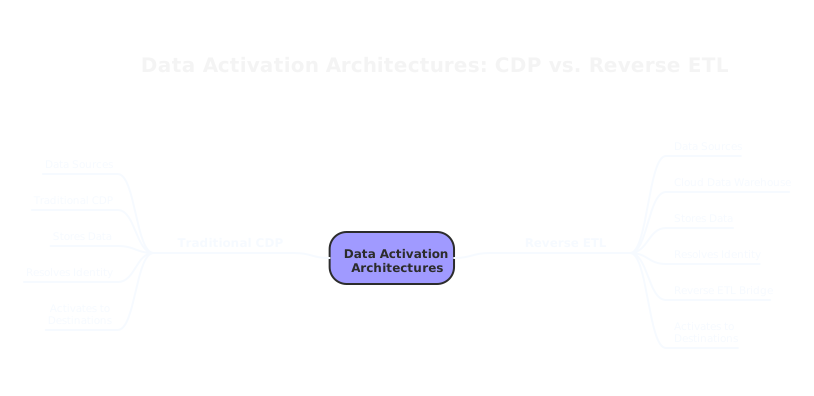
What Is a Traditional CDP?
A Customer Data Platform collects customer data from your various tools, unifies it into a single customer profile, and activates that data into downstream channels like email, ads, and CRM.
The CDP sits in the middle of your stack. It pulls data in, builds profiles, and pushes segments out.
Vendors like Segment, mParticle, and Tealium built their businesses on this model. The pitch is simple: one platform to unify everything and power personalization at scale.
For many teams, that pitch still holds up. If you need turnkey identity resolution and basic segmentation without a mature data engineering team, a traditional CDP can deliver.
But the model has real limitations. And for revenue teams with more complex needs, those limitations matter.
What Is Reverse ETL?
Reverse ETL flips the traditional data flow.
Instead of pulling data into a proprietary platform, Reverse ETL reads data that already lives in your cloud data warehouse and pushes it directly into your operational tools. Your CRM. Your marketing automation platform. Your ad networks.
Tools like Hightouch and Census are built for this. They act as a lightweight bridge between your warehouse and the rest of your stack.
The key difference: Reverse ETL does not store your data or manage your customer profiles. It simply takes what your data team has already built and makes it actionable in the tools your revenue team uses every day.
The Core Problem Each Tool Is Solving
Here is where the reverse ETL vs CDP comparison gets interesting. These tools are not actually trying to solve the same problem.
Traditional CDPs solve data consolidation. They assume the bottleneck is that customer data lives in too many places. The CDP collects it all into one system.
Reverse ETL solves data activation. It assumes the bottleneck is that good data already exists in your warehouse but cannot reach the tools where your team works.
If your problem is consolidation, a CDP may be the right answer. If your problem is activation, Reverse ETL is worth a serious look.
Most mature revenue teams discover they have both problems. But not in equal measure.
Where Traditional CDPs Fall Short
CDPs are built on a particular assumption: that the vendor's data model is good enough for your business. Often, it is not.
Rigid Data Models
Traditional CDPs are designed around individual user profiles. That works well for B2C companies tracking one customer, one email, one purchase history.
It breaks down fast for B2B teams. If you need to track accounts, buying groups, workspaces, and contact hierarchies, the CDP's model fights you at every turn. Workarounds exist, but they add complexity and cost.
Slow Activation Cycles
Most CDPs market themselves as real-time platforms. The technical reality is messier.
Data arrives in batches. Identity resolution runs on a schedule. Segments sync to destinations on another schedule. By the time a behavior in your product triggers a message to a customer, hours may have passed.
For use cases where timing matters, that lag is a real problem.
Compliance Complexity
A traditional CDP stores a copy of your customer data inside its own system. That means your customer data now lives in at least two places: your warehouse and the CDP.
When a GDPR deletion request arrives, your compliance team has to coordinate that deletion across multiple systems. Every extra copy of the data is another place the process can go wrong.
Cost at Scale
Most CDPs charge based on the number of profiles or events they process. As your customer base grows, so does your bill. Steeply.
Warehouse-first approaches scale differently. Your warehouse compute and storage costs grow more gradually. For companies with large customer bases, this cost difference becomes significant over time.
Where Reverse ETL Falls Short
Reverse ETL is not a replacement for everything a CDP does. It is important to be honest about that.
Reverse ETL does not collect data. You still need a way to get data into your warehouse in the first place. Tools like Fivetran or your own event pipelines handle that job.
Reverse ETL does not resolve identities out of the box. If the same customer appears as five different records in your warehouse, Reverse ETL will push all five records downstream. Identity resolution is your data team's responsibility.
Reverse ETL requires data engineering investment. Your team needs to be comfortable with SQL and tools like dbt. If you do not have that capability today, the warehouse-first approach has a steeper ramp.
For companies without a mature data engineering function, a traditional CDP may actually get you to value faster.
Reverse ETL vs CDP: A Direct Comparison
| Factor | Traditional CDP | Reverse ETL |
|---|---|---|
| Data storage | Proprietary profile store | Your existing warehouse |
| Identity resolution | Built-in, but limited | You control it in SQL/dbt |
| Data model flexibility | Rigid, vendor-defined | Fully flexible |
| Activation latency | 15 minutes to several hours | Near real-time achievable |
| Cost structure | Per-profile or per-event | Warehouse compute plus tool cost |
| Compliance | Multiple systems to manage | Single source of truth |
| Setup complexity | Lower for basic use cases | Higher, requires data engineering |
| Custom business logic | Limited, requires vendor | Full control in SQL and dbt |
A Real Scenario: Why This Choice Matters
Consider a subscription software company with 50,000 business customers. Their account executives need to see real-time product usage data inside Salesforce before every customer call. Accounts that have not logged in for two weeks need to trigger an automatic check-in sequence.
With a traditional CDP, this is technically possible. But the configuration is complex. The latency is often too long. And the data model does not cleanly map product workspaces to Salesforce accounts.
With Reverse ETL, the data team writes a SQL query that pulls the latest usage metrics from the warehouse and syncs them to Salesforce every 15 minutes. Account executives see current health data directly in their existing workflow. The check-in sequence triggers automatically when usage drops.
The build time for the Reverse ETL approach: a few days. The same use case in the CDP required weeks of professional services and still delivered inconsistent results.
This is the kind of velocity difference that compounds over time.
How to Choose the Right Approach for Your Team
The right answer depends on where you are today, not on what sounds most technically sophisticated.
Choose a traditional CDP if:
- You do not have a mature data engineering team
- You need turnkey identity resolution without building it yourself
- Your data model is straightforward, mostly individual consumer profiles
- You are a mid-market company that needs to move fast without deep technical investment
- Your activation use cases are standard: email segments, ad audiences, basic personalization
Choose Reverse ETL if:
- Your data warehouse is already your source of truth
- You have data engineers comfortable with SQL and dbt
- Your business model involves complex entities: accounts, workspaces, buying groups
- You need precise control over business logic and identity resolution
- Compliance and data governance are high priorities
- You want to lower your total cost of data activation at scale
Consider using both if:
- You need the CDP for marketing identity resolution and basic audience building
- You need Reverse ETL to operationalize more sophisticated warehouse models in sales and CS tools
- Your data team and marketing team have different maturity levels and different speed requirements
This is not a binary choice. The most sophisticated revenue teams often run both, with each tool doing what it is actually good at.
The Warehouse-First Shift Happening Right Now
The reverse ETL vs CDP conversation is not just a vendor debate. It reflects a real shift in how revenue teams think about data.
Three years ago, most companies treating Reverse ETL seriously were using it to supplement an existing CDP. Today, more new implementations are warehouse-first from the start, without a traditional CDP in the stack at all.
This shift is driven by a few things.
Data warehouses have gotten better at activation-specific features. Snowflake, BigQuery, and Databricks are all adding streaming ingestion, near-real-time transformation, and direct advertising integrations.
dbt has made it practical for data engineers to build and maintain sophisticated customer models in SQL. Those models can now power activation directly, without being translated into a CDP's proprietary format.
And revenue teams have gotten clearer about what they actually need: not more data in one platform, but faster paths from insight to action.
How House of MarTech Can Help
The reverse ETL vs CDP decision is not just a technical one. It touches your team structure, your budget, your compliance posture, and your ability to execute.
At House of MarTech, we help revenue teams audit their current stack, clarify what they actually need from a data activation layer, and build a practical path forward. Whether that means getting more from a CDP you already have, introducing Reverse ETL, or designing a composable stack from scratch.
We do not have a vendor preference. We have a results preference.
The Bottom Line
The reverse ETL vs CDP decision comes down to one question: where does your bottleneck actually live?
If your team struggles to consolidate customer data from disparate sources and you lack the engineering resources to build your own unification layer, a traditional CDP is still a solid choice.
If your warehouse already holds good data and your team's problem is getting that data into the hands of salespeople, marketers, and customer success managers quickly and accurately, Reverse ETL is the faster, more flexible path.
The teams winning at data activation in 2026 are not necessarily the ones with the most expensive platforms. They are the ones with the clearest path from a customer signal to a business action.
Pick the tool that shortens that path for your team. Start there.
Frequently Asked Questions
Get answers to common questions about this topic
Have more questions? We're here to help you succeed with your MarTech strategy. Get in touch
Related Articles
Need Help Implementing?
Get expert guidance on your MarTech strategy and implementation.
Get Free Audit