
The Automation Advantage: Integrated Martech for Seamless Experiences
More tools do not equal better results. Learn how intentional martech stack integration actually delivers seamless customer experiences and real business growth.


TL;DR
Quick Summary
Listen to summary
0:00 audio overview
The Automation Advantage: Integrated Martech for Seamless Experiences
Quick Answer
Picture this. A customer clicks your ad, lands on your site, fills out a form, and gets zero follow-up for three days. Then they receive five emails in one week. Your sales team calls them the same morning two of those emails land.
That is not a seamless experience. That is a disconnected stack pretending to work together.
The real automation advantage is not about having more tools. It is about having the right tools, connected with intention, doing specific jobs well. That is what seamless martech stack integration actually looks like in practice.
More Tools, More Problems
Here is a hard truth. Most marketing teams are not underinvested in technology. They are over-invested in the wrong way.
By 2025, there were over 15,000 distinct marketing platforms available. Yet most organizations still struggle to prove that their tech stack drives real revenue. Research shows that marketing leaders report spending more than half their time fixing problems inside their martech architecture. Cleaning data. Reconciling disconnected systems. Troubleshooting campaigns that look healthy but produce nothing.
That is not a technology problem. That is a strategy problem.
When you add a new tool without a clear purpose, you add hidden costs. A platform that starts at a few hundred dollars a month often costs two to three times more once you factor in implementation, training, integrations, and ongoing maintenance. And that is before counting the hours your team spends managing the tool instead of using it.
The fix is not more consolidation. The fix is more clarity.
What Seamless Martech Stack Integration Actually Means
Seamless does not mean everything runs through one platform. It means every tool knows its job, data flows cleanly between systems, and your team spends time on strategy instead of troubleshooting.
Think of it like a kitchen. A good chef does not use every tool available. They use the right tools, stored logically, ready when needed. The result is fast, consistent, and good. A kitchen stuffed with gadgets nobody knows how to use produces slow service and bad food.
Your martech stack works the same way.
Seamless martech stack integration has three parts.
First, every tool has a defined purpose. If two tools do the same thing, one of them goes. If a tool is doing something no one can clearly explain, it probably should not be there.
Second, data moves between tools without manual effort. Customer information collected in one place is available where it is needed. Your CRM knows what your email platform knows. Your analytics see what your ad platforms are doing.
Third, your team can act on information quickly. The point of integration is speed and relevance. If it takes a week to build a simple segment or update a workflow, the architecture is fighting you.
The Hidden Cost of Doing Everything
Most organizations believe that tight platform integration creates flexibility. The opposite is often true.
When systems are deeply coupled, changing one thing breaks another. A platform update improves one feature but quietly breaks a downstream data export. A custom integration written two years ago no longer works after an API change. Your team becomes afraid to touch anything because the whole system feels fragile.
This is what some practitioners call a Frankenstack. It looks integrated on a diagram. In practice, it requires constant maintenance and delivers inconsistent results.
The smarter approach is what is called composable architecture. Each tool connects to a shared data foundation, like a central customer data warehouse. Tools talk to that foundation. They do not need to talk directly to each other. When you need to swap out a tool, you do it cleanly. When you add a new capability, it connects to the same foundation without rebuilding everything else.
This approach can reduce integration and reporting time significantly. More importantly, it gives your team real flexibility to improve individual parts of the stack without risking the whole system.
At House of MarTech, helping businesses move from fragile, over-integrated stacks to clean, composable architectures is one of the most common engagements we take on. The results are consistently the same. Less time fixing. More time growing.
Automation Without Strategy Is Just Faster Chaos
Automation is only as good as the process underneath it.
If your lead handoff process is broken, automating it makes it break faster and at higher volume. If your email sequences are irrelevant, automating them means more people ignore or unsubscribe. If your data is dirty, automating decisions based on that data produces confident-looking mistakes.
This is why seamless martech stack integration strategy must start with process, not platforms.
Before you automate anything, ask these questions.
Is this process actually working when done manually? If the answer is no, clean it up first. If the answer is yes, then automation will help you do it faster.
Who owns this data? Data quality degrades without a clear owner. Assign responsibility. Build a simple governance process. Review it regularly.
What decision does this automation make? Every automated workflow makes a decision on your behalf. Know what that decision is. Know when it should escalate to a human instead.
These questions are not technical. They are organizational. That is the point. Most martech problems look like technology problems but are actually people and process problems wearing a technology costume.
The Authenticity Problem Automation Creates
Here is something most martech guides will not tell you. The more you automate, the more your customers want human connection.
Research shows that only 59 percent of customers are satisfied with AI-driven interactions, while 90 percent of companies believe their customers are happy with them. That is a significant gap. Nearly half of consumers say they would cancel a service that offers AI-only support. More than half say they trust brands more when content is clearly created by humans.
Automation fatigue is real. When every touchpoint feels like a machine talking at a customer, the experience feels cold. Customers notice. They churn.
The automation advantage is not about removing humans from the experience. It is about using automation to free your team to focus on the interactions that actually matter. Routine tasks, routing, scheduling, basic follow-up, those are the right jobs for automation. Complex conversations, high-value decisions, relationship-building moments, those need a human.
The brands winning right now are the ones that use technology to get their team to the right customer, at the right moment, faster. Not the ones replacing their team entirely.
A Practical Approach to Martech Stack Integration
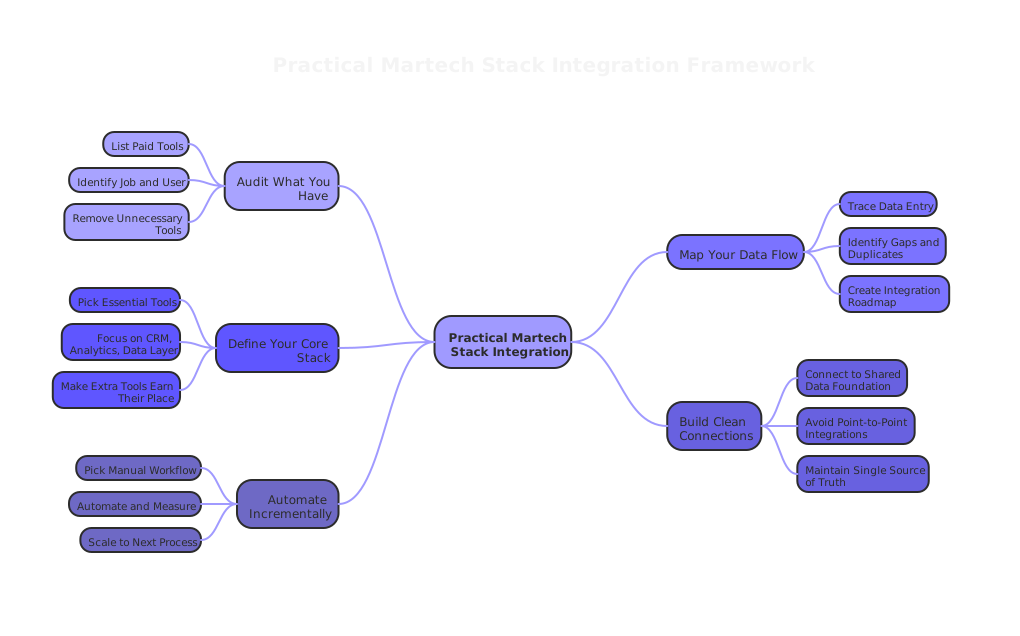
If you are ready to move toward a cleaner, more intentional stack, here is a simple framework that works.
Step One: Audit What You Have
List every tool you currently pay for. For each one, answer three questions. What specific job does this do? Who on the team uses it? What would break if we removed it tomorrow?
If you cannot answer all three questions, that tool is a candidate for removal.
Step Two: Map Your Data Flow
Draw a simple diagram of how customer data moves through your stack. Where does it enter? Where does it live? Which tools read it? Which tools write to it?
You will likely find gaps, duplicates, and dead ends. This diagram becomes your integration roadmap.
Step Three: Define Your Core Stack
Pick the smallest number of tools that cover your core needs. CRM, email or marketing automation, analytics, and a data layer. Everything else should earn its place by solving a specific, documented problem.
This is the heart of seamless martech stack integration best practices. Less is more. Clarity beats comprehensiveness.
Step Four: Build Clean Connections
Connect your core tools at the data layer. Use a customer data platform or a central data warehouse as your source of truth. Tools should read from and write to this foundation. Avoid point-to-point integrations between individual platforms wherever possible. They are fragile and hard to maintain.
Step Five: Automate Incrementally
Do not automate everything at once. Pick one workflow that is currently manual, high-volume, and well-defined. Automate it. Measure the result. Fix what breaks. Then move to the next one.
This incremental approach surfaces problems early, before they multiply across your entire stack.
Measuring What Actually Matters
A marketing automation guide that skips measurement is leaving out the most important part.
Most teams measure platform activity. Opens, clicks, sessions, leads. These are useful signals. They are not business outcomes.
The teams getting the most from their martech investments measure at two levels simultaneously. Short-term activity metrics to catch problems fast. Long-term revenue impact to confirm the strategy is working.
If your dashboards are green but your pipeline is flat, trust the pipeline. Something in the middle is broken. More likely than not, it is signal quality. The leads look engaged. They are not buying. That is a data and targeting problem, not a volume problem.
Build measurement habits that connect marketing activity to revenue. Incrementality testing, revenue attribution, and customer lifetime value tracking are all worth the investment. They tell you what is actually working, not just what looks like it is working.
The Discipline That Creates the Advantage
The organizations that genuinely benefit from integrated martech are not the ones with the biggest stacks. They are the ones with the clearest strategies, the cleanest data, and the discipline to subtract before they add.
They ask whether a tool earns its place. They build governance habits that keep data clean over time, not just at launch. They use automation to elevate their team, not replace them. They measure revenue, not just activity.
This is the real marketing automation guide. Not a list of platforms. Not a checklist of features. A set of disciplines that make the technology work for you instead of the other way around.
If you are not sure where your stack stands, a martech audit is often the clearest starting point. At House of MarTech, we help business owners understand what they have, what it is costing them, and what a leaner, more effective architecture would look like. No pressure to buy more tools. Often, the recommendation is to remove some.
What to Do Next
Start with one honest question. Is your current stack helping your team move faster, or slowing them down?
If the answer is slowing them down, the problem is almost never that you need more tools. It is that the ones you have are not working together with intention.
Seamless martech stack integration is achievable. It just requires starting with strategy, not shopping.
If you want a second set of eyes on your current setup, reach out to the team at House of MarTech. We will tell you what we actually see, not what you want to hear.
Frequently Asked Questions
Get answers to common questions about this topic
Have more questions? We're here to help you succeed with your MarTech strategy. Get in touch
Related Articles
Need Help Implementing?
Get expert guidance on your MarTech strategy and implementation.
Get Free Audit