
Unlocking the Power of Progressive Profiling
Discover how progressive profiling helps you build richer customer profiles over time, improve your martech stack, and drive smarter, data-driven lead capture without overwhelming your audience.


TL;DR
Quick Summary
Listen to summary
0:00 audio overview
Unlocking the Power of Progressive Profiling
Quick Answer
Imagine you walk into a coffee shop for the first time. The barista asks for your name, your favorite milk, your preferred roast, your ideal cup size, and whether you want sugar — all before you have even sat down.
You would probably walk right back out.
Now imagine the opposite. You order a simple coffee. The barista remembers your name next time. By your fifth visit, they already know how you like it. No interrogation. Just a relationship that grew naturally.
That is exactly what progressive profiling does for your marketing.
Instead of asking your customers or leads for everything upfront, you collect small pieces of information over time. Each interaction adds another layer to what you know about them. The result is a richer, more accurate picture — built on trust, not pressure.
If you are managing a martech stack and looking for smarter, data-driven lead capture strategies, this guide is for you.
What Is Progressive Profiling?
Progressive profiling is the practice of gathering customer or lead information gradually, across multiple touchpoints, rather than all at once.
Think of it as a slow-building conversation instead of a one-time survey.
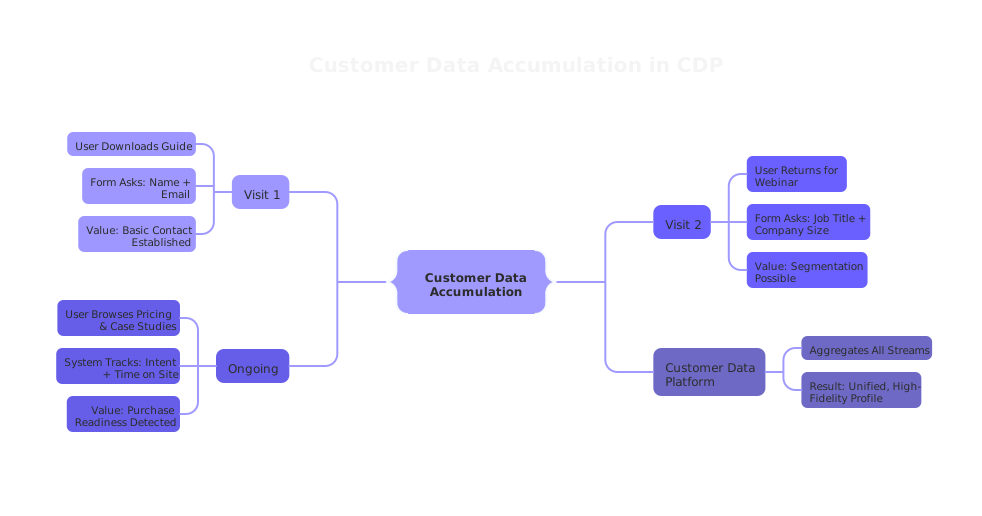
Here is a simple example. The first time someone downloads a guide from your website, you ask for their name and email. The next time they return, you ask for their company size. The time after that, you ask what their biggest challenge is. Each visit, you learn a little more — without ever making them feel like they are filling out a job application.
This approach fits naturally into a well-structured martech stack and works especially well when connected to a CDP (Customer Data Platform), which can store and organize all of those small data points into a single, unified customer view.
Why the "Fill Out This Form First" Approach Often Fails
Many marketing teams still rely on long forms. The thinking makes sense on the surface: get as much information as possible, as early as possible.
The problem is that most people do not complete long forms. Studies consistently show that the more fields a form has, the lower the completion rate. You end up with either incomplete data or no data at all.
There is also a trust problem. Asking for too much too soon signals that you care more about your database than about the person in front of you. That feeling — even if it is never spoken — shapes how someone sees your brand.
Progressive profiling solves both problems. You get better data over time, and the experience feels more respectful to the person giving it to you.
Two Ways to Build Profiles: Asking vs. Watching
There are two main methods for collecting data progressively. Understanding both is key to a strong data-driven lead capture strategy.
1. Explicit Profiling — You Ask, They Answer
This is the traditional approach, but done in smaller steps. Instead of a 10-field form, you show two or three questions at a time. Each visit or interaction adds new fields, so you are always learning without overwhelming anyone.
Tools like HubSpot, Marketo, and Pardot have built-in progressive form features that automatically show new questions once earlier ones have been answered. When these tools are connected to your CDP, every answer gets stored and linked back to that contact's full profile.
This method is great for capturing structured information like job title, company size, or budget range — the kind of data that helps your sales team have smarter conversations.
2. Implicit Profiling — You Watch, They Act
This is where things get genuinely powerful — and where companies like Netflix and Amazon have set the bar.
Netflix does not ask you what kind of shows you like. It watches what you play, what you skip, how long you watch, and what you rewatch. From those signals, it builds a picture of your preferences that is often more accurate than what you would describe yourself.
Amazon does something similar. It tracks what you browse, what you buy, and what you look at more than once. Over time, it builds a profile that feels almost like it knows you — without ever asking a single question.
You can apply the same thinking to your own marketing. Track which pages someone visits, which emails they open, which content they download, and how long they spend on specific topics. Feed all of that into your CDP and you start to see patterns that tell you what someone cares about — even before they tell you directly.
This is what makes a modern martech stack so valuable. When your analytics tools, email platform, CRM, and CDP are all connected, every interaction becomes a piece of useful information.
A Real-World Example Worth Studying: Duolingo
Duolingo, the language-learning app, does not start by giving you a placement test. It starts by getting you into the experience as fast as possible.
As you go through lessons, the app watches where you struggle, what you get right quickly, and where you slow down. It uses all of that to adjust what comes next — without ever asking you to describe your skill level.
The result is a learning experience that feels personal, even though you never filled out a profile.
For marketers, the lesson is simple: let the experience do the asking. Design your content, emails, and website interactions to reveal preferences through behavior. Then use your martech stack to capture and act on what you learn.
How Progressive Profiling Connects to Your CDP
A Customer Data Platform is the engine that makes progressive profiling work at scale.
Here is why: progressive profiling generates data from many different places — forms, website behavior, email clicks, app usage, purchase history. Without a central system to bring all of that together, you end up with a scattered, incomplete picture.
A CDP solves this by creating a single profile for each person and updating it continuously as new data comes in. Every form answer, every page visit, every email open gets added to that profile in real time.
This unified view is what enables truly personalized marketing. Instead of sending the same message to everyone, you can tailor content, offers, and timing based on what each person has actually shown you they care about.
For teams working on CDP implementation, progressive profiling is one of the most practical use cases to start with. It demonstrates clear value quickly — richer profiles, better segmentation, smarter campaigns.
The "Less Is More" Principle in Action
One insight that stands out from teams using progressive profiling well: more data does not always mean better results.
An Emarsys case study found that focusing on just three high-value data points — the ones most closely tied to purchase decisions — led to a significant lift in customer lifetime value. The teams that chased every possible data point often ended up with databases full of stale, low-quality information that was hard to act on.
The takeaway for your data-driven lead capture strategy: decide which three to five pieces of information matter most for your business goals. Build your progressive profiling around those. Resist the urge to collect just because you can.
This is also a privacy-smart approach. Collecting only what you need, with clear value in return, builds trust and aligns with data regulations that are getting stricter every year.
Building a Progressive Profiling Strategy That Works
Here is a practical framework you can follow:
Step 1: Map Your Key Data Points
Start by identifying what information actually changes how you market to someone. Job title? Industry? The problem they are trying to solve? Budget range? Pick five or fewer. These become your target fields.
Step 2: Sequence Your Questions
Decide which questions belong at which stage of the relationship. Early on, stick to basics — name, email, maybe company. As someone engages more, introduce deeper questions. Save the most sensitive questions (like budget or timeline) for when trust is already established.
Step 3: Set Up Behavioral Tracking
Configure your analytics and marketing tools to track key behaviors — pages visited, content downloaded, emails opened, links clicked. Make sure this data flows into your CDP so it enriches profiles automatically.
Step 4: Connect Your Tools
Your progressive profiling strategy is only as strong as the connections between your tools. Your forms, CRM, email platform, and CDP need to talk to each other. This is the foundation of a well-integrated martech stack. If data is not flowing smoothly between systems, profiles stay incomplete and campaigns stay generic.
Step 5: Use What You Learn
This sounds obvious, but it is where many teams fall short. Collecting progressive data is only half the work. The other half is using it to change what you send, when you send it, and how you segment your audience. Set up automated workflows that respond to profile changes — so when someone crosses a key threshold, they automatically get content or outreach that matches where they are.
A Word on Trust and Transparency
Progressive profiling works best when people understand the exchange. You are asking for their information, and in return, they get a better, more relevant experience.
Be clear about this. When you ask a question, briefly explain why it helps them. "Tell us your biggest challenge so we can send you only what's relevant." That one sentence shifts the dynamic from data extraction to genuine value exchange.
This matters even more as privacy regulations evolve. Building your data-driven lead capture strategy on transparency now puts you in a much stronger position for the future — both legally and in terms of audience trust.
Where This Is All Heading
The direction is clear: profiles built from behavior, not just form fills.
Cookie-based tracking is fading. Third-party data is becoming less reliable. What is growing in value is first-party data — information people give you directly or generate through their actions on your owned channels.
Progressive profiling, connected to a strong CDP and a well-integrated martech stack, is exactly how you build that first-party data asset over time. The brands that invest in this now will have a real advantage as the marketing landscape continues to shift.
The most forward-thinking teams are already moving toward systems where every interaction — a chat, a click, a purchase, a support request — adds to a living profile that makes the next experience better. Not in a surveillance way, but in the way a great salesperson remembers what matters to you and uses that to help, not just sell.
Final Thoughts
Progressive profiling is not a new concept, but most teams are still not using it to its full potential.
The opportunity is significant. By shifting from one-time data grabs to ongoing, layered learning — through both explicit questions and behavioral signals — you build customer profiles that are richer, more accurate, and more useful than anything a long form could give you.
When you connect that approach to a well-built CDP and a thoughtfully integrated martech stack, you create a foundation for marketing that actually feels personal.
Start small. Pick your five most important data points. Set up one progressive form. Connect your tools. Watch what behaviors tell you before you even ask.
The conversation with your customer is already happening. Progressive profiling just helps you listen better.
At House of MarTech, we help growing teams build smarter data strategies — from CDP implementation to full martech stack integration. If you want to explore how progressive profiling can work for your business, we would love to talk.
Frequently Asked Questions
Get answers to common questions about this topic
Have more questions? We're here to help you succeed with your MarTech strategy. Get in touch
Related Articles
Need Help Implementing?
Get expert guidance on your MarTech strategy and implementation.
Get Free Audit