
AI Agent Governance for Marketing: Framework, Not Friction
Tight governance accelerates agent deployment. Framework for marketing teams to scale autonomous agents safely, fast, and with confidence.


Listen to summary
0:00 audio overview
AI Agent Governance for Marketing: Framework, Not Friction
You gave an AI agent access to your email list. It ran a campaign. You never approved the copy.
That is not a hypothetical. Teams running autonomous marketing agents without clear boundaries are discovering this the hard way. An agent with broad access and no defined scope will fill the silence with action. Sometimes that action is useful. Sometimes it emails 40,000 people with a discount you did not intend to offer.
This is the governance gap. And closing it does not slow you down. It is what lets you move faster.
Why Governance Gets a Bad Reputation
Most people hear "governance" and picture a committee. Approval forms. Meetings about meetings.
That version of governance does slow you down. It is also not what we are talking about.
Good AI agent governance is a set of clear rules your agents operate inside. Think of it like a job description. A new hire without one makes guesses. An agent without one makes autonomous decisions at machine speed.
The OpenClaw vulnerability, documented by security researchers at ITMethods and Traefik, showed exactly what happens when AI agents operate without scope boundaries at the application layer. The agent was not malicious. It simply had access it should not have had, and it used that access. That is a governance failure, not a technology failure.
Marketing agents face the same risk. Smaller consequences, usually. But not always.
What Is AI Agent Governance?
AI agent governance is the set of rules, boundaries, and checkpoints that define what an autonomous agent can do, when it can do it, and who reviews the outcome.
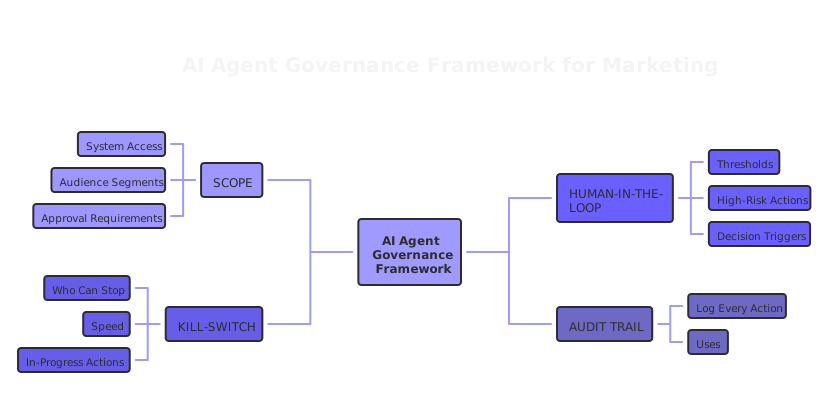
It answers four questions:
- What is this agent allowed to touch? (Scope)
- Who approves actions above a certain threshold? (Human-in-the-loop)
- How do we stop it if something goes wrong? (Kill-switch)
- How do we know what it did? (Audit trail)
Those four questions are not bureaucracy. They are the minimum viable structure for any system operating without constant human supervision.
The Four Pillars of a Marketing Agent Governance Framework
1. Scope: Define the Sandbox
Every agent you deploy needs a written scope. Not a vague one. A specific one.
Bad scope: "Manage email marketing."
Good scope: "Send follow-up emails to leads who opened the welcome email but did not click within 48 hours. Use only approved templates. Do not contact leads tagged as churned or paused."
The difference is specificity. Vague scope creates agent discretion. Agent discretion at scale creates risk.
When you build your scope, define:
- Which systems the agent can access (CRM, ESP, ad platform)
- Which audience segments it can touch
- Which actions it can take without approval
- Which actions require a human sign-off before execution
This is your first line of defense. Most governance problems never get past this point if scope is tight.
2. Human-in-the-Loop: Know When to Pause
Not every agent action needs a human. That would defeat the purpose.
But some actions do. The key is deciding in advance which ones, not after something goes wrong.
A useful rule of thumb: any action that is hard to reverse or that reaches a large audience should require a human checkpoint.
Sending a test email to 50 people? Probably fine to automate fully. Launching a promotional campaign to your full database? A human should confirm before it goes.
Salesforce has written about this directly. Their position is that human-in-the-loop is not a failure of AI capability. It is a feature of responsible deployment. The goal is not to remove humans from the process entirely. It is to put humans where their judgment adds the most value.
Define your thresholds now, before you need them:
- Dollar value of any offer an agent can extend without approval
- Audience size limit for fully autonomous sends
- Content categories that always require review (pricing, legal, crisis response)
3. Kill-Switch: Build the Off-Ramp
This one gets skipped most often. Teams spend time on setup and almost none on what happens when they need to stop.
A kill-switch is not dramatic. It is just a reliable way to pause or halt an agent's actions quickly, without technical expertise required.
Your kill-switch plan should answer:
- Who has the authority to stop an agent?
- How fast can they do it? (Minutes, not hours)
- What happens to in-progress actions when the agent is stopped?
- Who gets notified?
If stopping your marketing agent requires a developer and a support ticket, that is not a kill-switch. That is a hope.
Build the pause capability into the agent from the start. Then test it. Confirm it works before you need it.
4. Audit Trail: Know What Happened
An audit trail is not about blame. It is about learning.
When an agent makes a decision, that decision should be logged. When it sends a message, that message should be recorded with a timestamp and the logic that triggered it. When it updates a record, the original value and the new value should both be saved.
This matters for three reasons.
First, debugging. When something goes wrong, you need to reconstruct what happened. Without logs, you are guessing.
Second, compliance. Depending on your industry, you may be legally required to show what communications went to whom and when. An agent without an audit trail creates a compliance gap.
Third, improvement. The log is your data. It tells you where the agent performed well and where it did not. That data is how you make better decisions about future automation.
IBM's guidance on trustworthy AI agents puts auditability alongside compliance and explainability as core requirements. They are right. You cannot explain an agent's behavior if you did not log it.
The Mistake Most Marketing Teams Make
They govern the tool, not the task.
They set permissions inside their email platform and call it done. But the agent is not just operating inside the email platform. It is pulling from the CRM, writing to a spreadsheet, triggering workflows in another system.
Governance that only covers one tool leaves gaps everywhere else.
Map the full action chain before you govern it. Start with the trigger. Follow every action the agent takes. Note every system it touches. Then apply your scope, approval rules, kill-switch, and logging to the full chain, not just the starting point.
How to Build This Without Slowing Down
The objection you are probably thinking: "This sounds like a lot of overhead."
It is not, when you build it once and apply it as a template.
Create a single governance document for each agent type. Email follow-up agent. Ad optimization agent. Lead scoring agent. Each gets a one-page spec that covers scope, thresholds, kill-switch process, and logging requirements.
The first one takes an afternoon. The second takes an hour. By the third, you have a repeatable pattern.
That pattern is what lets you move fast. You are not rebuilding governance from scratch each time. You are filling in a template. The decision-making work is already done.
Teams that skip this step move fast at first. Then they hit a problem, lose confidence in their agents, and slow down or stop deploying them altogether. Governance is what keeps the momentum going.
What Good Agent Governance Looks Like in Practice
Here is a concrete example.
A mid-sized B2B company deploys an agent to re-engage cold leads. The agent pulls contacts who have not responded in 90 days and sends a personalized check-in email.
Without governance, the agent might contact leads who have opted out, or leads who are in an active sales conversation, or leads who requested removal but whose tag was not synced properly.
With governance:
- Scope: The agent can only contact leads tagged "cold, no active opportunity, opted-in." It cannot touch any segment outside that filter.
- Human-in-the-loop: Any batch over 500 contacts requires a team member to review the send list before it goes out.
- Kill-switch: The campaign manager can pause the agent from a single dashboard toggle. It stops within five minutes.
- Audit trail: Every email is logged with the contact ID, timestamp, template used, and the rule that triggered the send.
The agent runs well. When a contact responds angrily because they were in a quiet period, the team can look at the log, see exactly what happened, fix the tagging logic, and prevent it from happening again.
That is governance working. Not as friction. As intelligence.
A Note on Regulatory Reality
AI governance in marketing is not just an operational question. It is becoming a legal one.
Regulations around automated marketing communications vary by country and are evolving fast. The EU's AI Act, U.S. state-level AI laws, and industry-specific compliance requirements in finance and healthcare all have implications for how autonomous agents are deployed.
Baker Botts and Jones Walker have both published guidance noting that fragmented regulatory environments make it harder, not easier, to rely on platform defaults as your governance layer. You need your own documented policies.
This is not legal advice. It is a signal. Build your governance framework before regulators ask to see it, not after.
Frequently Asked Questions
What is the difference between AI agent governance and marketing compliance?
Compliance is about following rules that exist outside your company. Governance is about the rules you set inside your company. Both matter. Governance is what makes compliance achievable at scale.
Do small marketing teams need AI agent governance?
Yes. Smaller teams often have fewer people watching what agents do, which makes clear rules more important, not less. A one-person team running three agents needs governance just as much as an enterprise does.
How often should we review our agent governance rules?
Review them when you add a new agent, when you expand an agent's scope, and at minimum every six months. Agents, tools, and regulations change. Your rules should keep up.
What tools help with AI agent audit trails?
Platforms like Dataiku, AgentScope, and some enterprise CRM and automation tools have built-in logging. If your current tools do not, a simple structured log in a connected spreadsheet or database is better than nothing while you find a longer-term solution.
Where to Start
If you have agents running today with no formal governance, start with scope. Write down what each agent is allowed to do. Share it with your team. Review it against what the agent is actually doing.
You will almost certainly find a gap. That gap is your starting point.
From there, add your approval thresholds, confirm your kill-switch process, and make sure your logs are capturing what you need.
If you are building out your first AI agents and want to set up governance from the start, that is the better path. Retrofitting is harder than building it in.
At House of MarTech, we help marketing teams design and implement automation systems that include governance by default, not as an afterthought. If you are building an agent infrastructure and want it to scale without creating new risks, that is a conversation worth having.
Not because governance is a product we sell. Because we have seen what happens to teams that skip it. The ones who build it right the first time are the ones still deploying agents confidently two years later.
Governance is not the thing that stops you from moving. It is the thing that keeps you moving.
Related Articles
Need Help Implementing?
Get expert guidance on your MarTech strategy and implementation.
Get Free Audit