
AI-Powered Lead Qualification Frameworks: Scoring Beyond Demographics and Firmographics
Implement AI-powered lead qualification that goes beyond basic demographics. Use behavioral data, intent signals, and ML for smarter lead scoring.


Listen to summary
0:00 audio overview
AI-Powered Lead Qualification Frameworks: Scoring Beyond Demographics and Firmographics
Picture your sales team on a Monday morning. They open the CRM and see 80 new leads waiting. Half are tagged "high priority." But by Friday, only three of those leads took a meaningful next step.
This isn't a hustle problem. It's a qualification problem.
Traditional lead scoring gave sales teams a compass that often pointed the wrong direction. Company size. Job title. Industry. These signals tell you who someone is. They don't tell you whether that person is ready to buy.
AI lead qualification changes the question entirely. Instead of asking "does this company match our profile," you ask "is this specific person, inside this specific account, showing signals of active buying intent right now."
That shift is where the real lift comes from.
Why Firmographics Alone Fail You
Firmographic data is a filter, not a predictor.
A 500-person SaaS company in your target industry is not a qualified lead. It's a category. Plenty of perfectly profiled companies will never buy from you because they have no urgency, no budget cycle alignment, and no internal champion pushing the initiative forward.
Yet most scoring models still weight firmographics heavily. Industry match earns points. Company size earns points. Revenue range earns points. And sales teams end up chasing profiles instead of buyers.
The data backs this up. Roughly 70% of MQLs never convert to SQLs. About 94% of leads that get passed to sales are later rejected. These aren't small rounding errors. They represent a systematic mismatch between what marketing calls qualified and what sales actually needs.
The fix isn't adding more firmographic filters. It's adding different signal types entirely.
What AI Lead Qualification Actually Measures
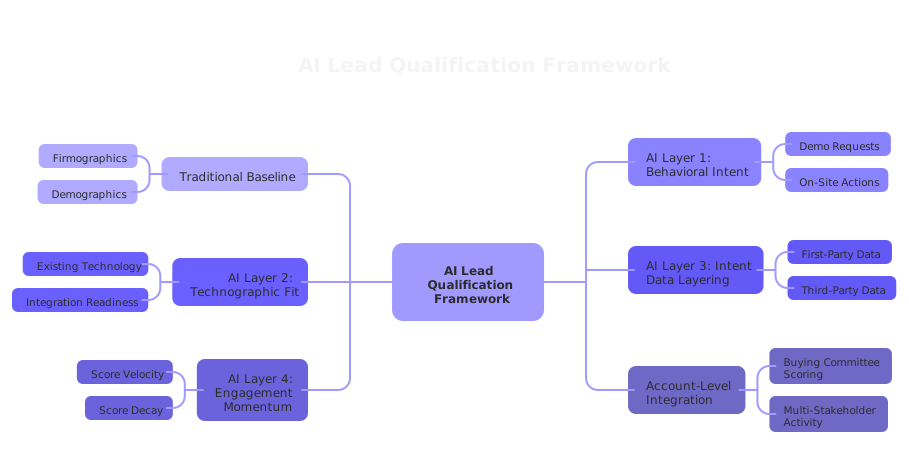
A mature AI lead qualification strategy layers four distinct signal types on top of basic fit criteria.
Behavioral Intent
This is what a prospect does on your properties. Pages visited. Content downloaded. Emails clicked. Demo requests submitted. Pricing pages explored.
These signals are weighted based on what they imply. A pricing page visit earns more points than an email open because it signals a different stage of thinking. A demo request earns more than a whitepaper download because it requires active commitment.
The key insight: behavioral signals reflect intent in the moment. They're perishable. A lead who visited your pricing page twice last week and hasn't returned since is different from one who visited yesterday.
Technographic Fit
This dimension asks whether your solution actually fits inside a prospect's existing technology environment.
Do they run a platform you integrate with? Are they using a legacy system that creates upgrade urgency? Do they have a competitor install that signals they're already investing in your category?
Technographic signals improve qualification accuracy because they capture a dimension that firmographics miss entirely. Two companies of identical size and industry can have completely different technology ecosystems. Only one of them may actually be ready to onboard your solution without a painful implementation project.
Intent Data Layering
First-party intent comes from your own properties. Third-party intent comes from behavior across the broader web, industry publications, competitor research, category-related searches, analyst content consumption.
Use first-party intent as your primary qualification trigger. It's reliable. Then use third-party intent to identify accounts that are researching your category but haven't found you yet. These are prospects worth reaching before competitors do.
Don't weight both equally. First-party signals indicate a prospect who knows you exist and chose to engage. Third-party signals indicate someone who may be in research mode without specific vendor preference. They require different responses.
Engagement Momentum
This is where most scoring models leave significant value on the table.
A lead with 65 points today who had 40 points two weeks ago is more valuable than a lead with 70 points whose score hasn't moved in a month. The first lead is accelerating. The second is stagnant.
Momentum tells you where a prospect is going. Static scores only tell you where they've been. Leads with positive momentum are significantly more likely to convert than leads with high but flat scores.
Practically, this means calculating score velocity over 7, 14, and 30-day windows. Reprioritize your pipeline based on movement, not just position.
The Buying Committee Problem
Here's something most scoring frameworks ignore: companies don't buy things. People do. And in B2B, multiple people are involved in almost every decision.
The average enterprise buying decision now involves more than a dozen internal stakeholders. Single-lead qualification misses most of them. You may be scoring your champion enthusiastically while the economic buyer has never seen your content and the technical buyer is actively evaluating a competitor.
Effective AI lead qualification strategy accounts for this by scoring at the account level, not just the contact level.
When multiple stakeholders from the same account start engaging, that collective signal is far more predictive of deal probability than any individual lead score. One person visiting your pricing page is interesting. Three people from the same company visiting your pricing page, including someone from finance, is a buying signal.
Build your qualification logic to recognize account-level engagement patterns. Flag accounts where multiple departments are engaging. Treat multi-stakeholder activity as a high-value trigger for sales outreach.
The PQL Model for Product-Led Companies
If your product has a free tier or trial, you're sitting on the richest qualification data available.
Product-Qualified Lead scoring uses trial behavior as the primary intent signal. The logic is simple. Someone using your product is further along the buying journey than someone who downloaded a PDF about it.
The signals that matter inside a trial:
- Did they complete onboarding and reach the core value moment?
- Are they using the features that correlate with retention and expansion?
- Did they visit the pricing page during the trial?
- Did they invite other users, indicating organizational buy-in?
Companies using PQL-based qualification report MQL-to-SQL conversion rates above 50%, compared to a 39% industry average. The gap exists because trial behavior is empirical evidence of engagement, not an inference from demographics.
If you run a product-led growth model and you're still primarily scoring on form fills and email opens, you're ignoring your best data.
AI Lead Qualification Best Practices: What Actually Works
Start Simple Before Adding Complexity
The most common mistake in AI lead qualification implementation is building a model with too many variables before you understand which ones actually drive conversions.
Teams that launch with 40+ scoring signals spend more time debugging the model than using it. Effective qualification often relies on five to seven core signals that predict the majority of conversions. Adding more signals beyond that produces marginal accuracy gains while increasing maintenance burden significantly.
Start with a small number of high-confidence signals. Measure conversion rates. Then add signals only when you have clear evidence they improve prediction accuracy.
Audit Your Data Before You Score It
Every AI lead qualification model is only as good as the data feeding it. Stale job titles, invalid email addresses, and outdated company information corrupt scores from the inside out.
If 20% of your contact data is inaccurate, your model is making confident predictions on a broken foundation. Before implementing any scoring model, run a data quality audit. Clean bad emails. Update company information. Validate job titles. This takes time upfront. It saves significant time downstream.
Implement Score Decay From Day One
A lead who engaged heavily six months ago and hasn't returned is not the same as a lead who engaged last week. Without decay logic, scores accumulate indefinitely and your high-priority list fills with ghosts.
A simple starting point: reduce scores by 25% monthly for any lead with no new engagement activity. This keeps your qualified pipeline reflecting current intent, not historical curiosity.
Connect Qualification Thresholds to Sales Capacity
This is rarely discussed, but it matters.
If your sales team grows, your qualification threshold should adjust slightly downward to fill the increased capacity. If conversion rates drop, raise the threshold to protect deal quality. Qualification thresholds aren't permanent decisions. They're calibration points that should respond to actual sales performance data.
Build a feedback loop. Track which MQLs converted to SQLs. Track which SQLs closed. Use that data to continuously recalibrate signal weights and thresholds. Quarterly reviews are a floor, not a ceiling.
The Alignment Issue Underneath the Technology
Here's the honest truth about most AI lead qualification implementations that underperform.
The model isn't the problem. Alignment is.
Marketing and sales often have fundamentally different definitions of qualified. Marketing may define a qualified lead as one that matches ICP criteria and showed behavioral engagement. Sales defines a qualified lead as one that expressed specific buying intent and has realistic authority to make a decision.
When these definitions don't match, every MQL handoff creates friction. Sales rejects leads. Marketing generates more leads to compensate. The cycle continues.
Before investing in more sophisticated AI lead qualification tools, align your marketing and sales teams on a single shared definition of what qualified means. Write it down. Agree on the specific signals that trigger each qualification stage. Then build the scoring model around that shared definition.
Technology enforces agreements. It can't create them.
Where to Focus Your Next 90 Days
If you're early in your AI lead qualification implementation, prioritize three things.
First, identify your five highest-confidence conversion signals from historical closed-won data. Build your initial model around those signals only.
Second, implement account-level engagement tracking. Know when multiple stakeholders from the same account are engaging simultaneously. That signal alone will surface opportunities your current model misses.
Third, add decay logic. A qualified lead list that never shrinks isn't a priority queue. It's a backlog.
If you already have a scoring model in place, the highest-value next step is usually a retrospective analysis. Pull your last 100 closed-won and 100 closed-lost deals. Calculate what their scores were at the point of first qualification. If high-scoring leads didn't convert significantly more often than lower-scoring leads, your model is misaligned and needs recalibration before additional sophistication adds any value.
At House of MarTech, we help teams work through exactly this kind of audit. Sometimes the biggest gains come from simplifying and realigning an existing model, not replacing it with something more complex.
Qualification Is a Strategy, Not a Setting
AI lead qualification isn't a feature you turn on. It's a strategic commitment to measuring the right things, aligning on shared definitions, and continuously refining based on what actually closes.
The scoring model is the expression of that commitment. But the commitment has to come first.
Start with clarity on what qualified means for your business. Then build the simplest model that reflects that definition. Add sophistication only where you have evidence it improves outcomes.
That approach produces better results than any algorithm running on misaligned assumptions.
Related Articles
Need Help Implementing?
Get expert guidance on your MarTech strategy and implementation.
Get Free Audit