
Behavioral Segmentation in Marketing: A Systematic Framework That Actually Works
Most marketing teams segment their audience by who people are. The ones winning right now segment by what people do. Here is a clear, practical framework for behavioral segmentation in marketing that helps you reach the right people at the right moment.


TL;DR
Quick Summary
Listen to summary
0:00 audio overview
Quick Answer
The Real Reason Your Campaigns Are Not Landing
Picture this: A customer visits your pricing page three times in one week. They read your case studies. They open every email you send. And then your marketing system sends them a welcome discount meant for first-time visitors.
That is not a small mistake. That is a signal that your marketing does not see what that person is actually doing.
This happens more often than most teams realize. And it happens because most segmentation strategies are built around who a customer is, their age, their location, their job title, rather than what they are actively doing right now.
Behavioural segmentation in marketing changes that. It shifts your strategy from guessing at identity to responding to action. And when you do it well, the results are not marginal. The difference between sending a generic message and responding to a real behavior can be the difference between a conversion and a lost opportunity.
This guide gives you a clear, practical framework for building behavioral segmentation into your marketing, step by step, without the jargon.
What Is Behavioural Segmentation in Marketing?
Behavioural segmentation in marketing is the practice of grouping customers based on the actions they take, not just who they are.
Instead of asking "What kind of person is this?" you ask "What has this person done, and what does that tell us about where they are in their journey?"
Those actions might include:
- Pages they visited on your website
- Products they browsed or purchased
- Emails they opened or ignored
- Features they used (or never touched) inside your product
- How often they come back
- When they tend to go quiet
Each of these signals tells you something real about that customer's intent, interest, and readiness to act.
Behavioural Segmentation vs. Demographic Segmentation
Demographic segmentation tells you a customer is a 35-year-old marketing manager in London. That is useful context.
Behavioral segmentation tells you that same person has visited your integration documentation page four times this week, downloaded your ROI calculator, and has not opened your last two promotional emails.
The second picture is far more useful for deciding what to say next.
Both approaches have value. But behavioral data gives you something demographic data rarely can: real-time intent.
The Four Core Types of Behavioural Segmentation
Before building a framework, it helps to understand the main categories of behavior you can track and act on.
1. Purchase Behavior
This looks at how, when, and what customers buy. Are they first-time buyers or repeat customers? Do they buy during sales or at full price? Do they buy in bundles or individual items?
Understanding purchase patterns helps you build smarter upsell paths, loyalty programs, and win-back campaigns.
2. Engagement Behavior
This covers how people interact with your content, emails, ads, and product. High engagement often signals high intent. Low or dropping engagement can be an early warning sign worth acting on before someone churns.
3. Occasion-Based Behavior
Some customers only buy at specific times, end of quarter, holiday season, or when a contract is about to renew. Mapping these patterns lets you reach people exactly when they are most ready to act.
4. Benefit-Seeking Behavior
Different customers use the same product for different reasons. One customer values speed. Another values simplicity. A third cares about integration. Knowing what benefit each group is chasing helps you personalize your messaging at a level that feels genuinely relevant.
A Systematic Framework for Behavioural Segmentation in Marketing
Most guides stop at definitions. This one goes further. Here is a clear, repeatable process for putting behavioral segmentation into practice inside your business.
Step 1, Decide What Behaviors Actually Matter
Not all data is equally useful. The first step is picking the behaviors that are most connected to real business outcomes.
Ask yourself: What actions, when taken, reliably lead to a purchase, a renewal, or a referral?
Common high-value signals include:
- Visiting a pricing page more than once
- Completing a product demo or free trial
- Returning to the site within 48 hours of a first visit
- Clicking a specific category of content consistently
- Going 30 days without logging in (for SaaS products)
Start with five to ten clear behavioral signals. You do not need hundreds. You need the right ones.
Step 2, Map Behaviors to Moments in the Customer Journey
Every behavior tells you something about where a person is right now. Your job is to match your response to that moment.
A simple way to think about this:
| Behavior | What It Signals | Right Response |
|---|---|---|
| First website visit | Awareness stage | Educational content |
| Return visit to product pages | Consideration | Case studies or comparison content |
| Pricing page visit x3 | Decision stage | Direct conversation or offer |
| No activity for 30+ days | Risk of leaving | Re-engagement campaign |
| Third purchase in 90 days | Loyalty signal | Referral or community invite |
This kind of mapping turns behavior data into a clear playbook.
Step 3, Build Your Segments
With your signals mapped, you can now create your audience groups. Each segment should share a meaningful set of behaviors that calls for a similar response.
Good behavioral segments are:
- Specific enough to personalize to
- Large enough to be worth acting on
- Stable enough to test and improve over time
A segment like "Users who visited pricing 3+ times but have not signed up" is specific, actionable, and measurable. A segment like "Interested people" is too vague to do anything useful with.
Step 4, Choose Your Tools
Behavioural segmentation in marketing only works if you have the right infrastructure to collect, organize, and act on data in a connected way.
The tools you need generally fall into a few categories:
- A way to collect behavioral data, this might be your website analytics platform, your product analytics tool, or a customer data platform (CDP)
- A way to store and organize that data, so different teams can access the same customer picture
- A way to act on it, your email platform, your CRM, your ad platform, or your automation workflows
Many businesses already have pieces of this in place. The challenge is often connecting them so data flows between systems without friction.
At House of MarTech, we work with businesses at exactly this stage, helping teams figure out which tools they already have, what gaps exist, and how to connect the right pieces without overbuilding or overspending.
Step 5, Create Relevant Responses for Each Segment
A segment without a response plan is just a list. The value comes from what you do next.
For each behavioral segment, define:
- What message fits this moment?
- What channel does this person prefer?
- What timing makes sense?
- What outcome are you trying to create?
This is where personalization becomes real, not "Hello [First Name]" personalization, but genuine relevance based on what someone has actually done.
Step 6, Test, Measure, and Improve
Behavioral segmentation is not a one-time setup. It is an ongoing practice.
Test your segments against each other. Watch your conversion rates, your engagement rates, and your churn signals. Look for patterns in what is working and what is not.
The businesses that get the most from behavioral segmentation treat it as a system they continuously learn from, not a campaign they launch and forget.
What Good Behavioural Segmentation Looks Like in Practice
Consider a B2B SaaS company selling project management software. They notice that customers who use three or more integrations in their first 30 days almost never churn in year one. Customers who use fewer than two integrations churn at a much higher rate.
That single behavioral insight becomes the foundation of their onboarding strategy. New users who have not connected integrations by day seven get a specific, helpful sequence showing them exactly how to do it. Users who have connected integrations get a different path focused on advanced features.
Same product. Same customers. Completely different experience, based on what each person has actually done.
This is what behavioural segmentation in marketing looks like when it is working well. It is not about sending more messages. It is about sending the right one.
Common Mistakes to Avoid
Even teams with good intentions run into problems. Here are the most common ones:
Segmenting by too many variables at once. Start simple. One or two clear behaviors per segment is easier to manage and easier to test.
Collecting data but not connecting it. Behavioral data sitting in five different tools, your analytics platform, your email tool, your CRM, your ad platform, your product, cannot give you a single clear picture of a customer. The connection between systems matters as much as the data itself.
Treating segments as permanent. People's behaviors change. A customer who was highly engaged six months ago might be going quiet now. Segments need to be dynamic, updating as new behaviors occur.
Skipping the "so what." The point of segmentation is action. If you cannot articulate exactly what you will do differently for each segment, the segmentation is not done yet.
Where to Go From Here
Behavioural segmentation in marketing is one of the clearest paths from generic, forgettable marketing to communication that feels genuinely useful to the people receiving it.
The framework is not complicated:
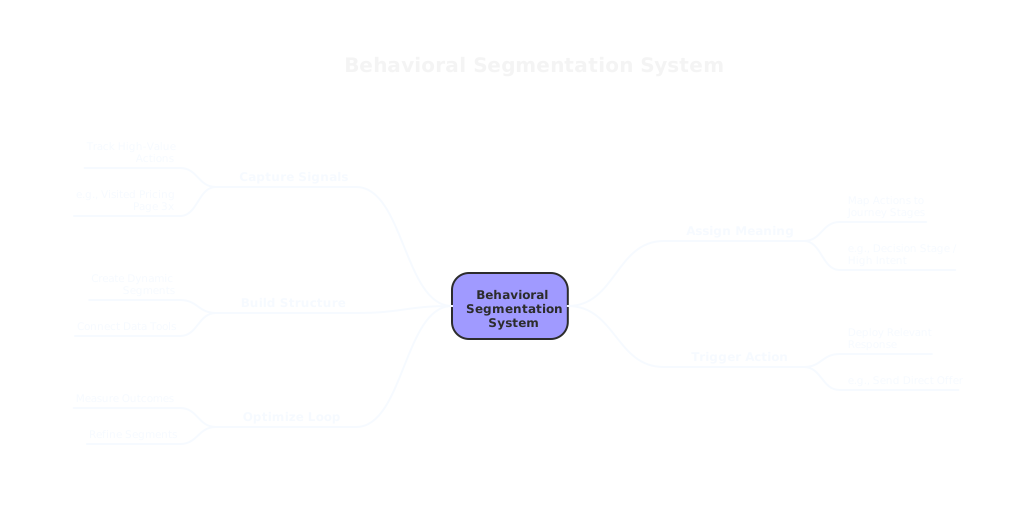
- Identify the behaviors that matter most in your business
- Map those behaviors to moments in the customer journey
- Build specific, actionable segments
- Make sure your tools are connected enough to support this
- Create relevant responses for each segment
- Measure and improve continuously
If you are unsure where your current setup has gaps, whether in data collection, tool connectivity, or segmentation strategy, that is a practical question worth exploring.
At House of MarTech, we help businesses at different stages of this journey figure out what they actually need, what they already have, and how to build toward a more connected, intelligent marketing approach, without unnecessary complexity.
The best place to start is usually an honest look at what data you are already collecting and whether it is being used to its full potential. Most teams are surprised by how much is already there, waiting to be acted on.
Looking to explore how behavioral segmentation fits into your current MarTech setup? House of MarTech works with marketing and technology teams to make sense of what they have, identify what they need, and build practical paths forward.
Frequently Asked Questions
Get answers to common questions about this topic
Have more questions? We're here to help you succeed with your MarTech strategy. Get in touch
Related Articles
Need Help Implementing?
Get expert guidance on your MarTech strategy and implementation.
Get Free Audit