
Customer Data Translator Framework
The Customer Data Translator bridges business needs and MarTech data. Master the 5-stage framework to unlock CDP value and beat 70% failure rates in 2026.


Listen to summary
0:00 audio overview
The Customer Data Translator: The New Critical Role in MarTech
Your CDP is live. Your data is flowing. Your AI tools are connected.
And yet, nothing useful is coming out.
Sound familiar? You are not alone. Most CDP projects stall not because the technology fails, but because no one in the room can do one specific job. No one can take a real business question and turn it into something the data can actually answer.
That gap has a name. And it needs a person.
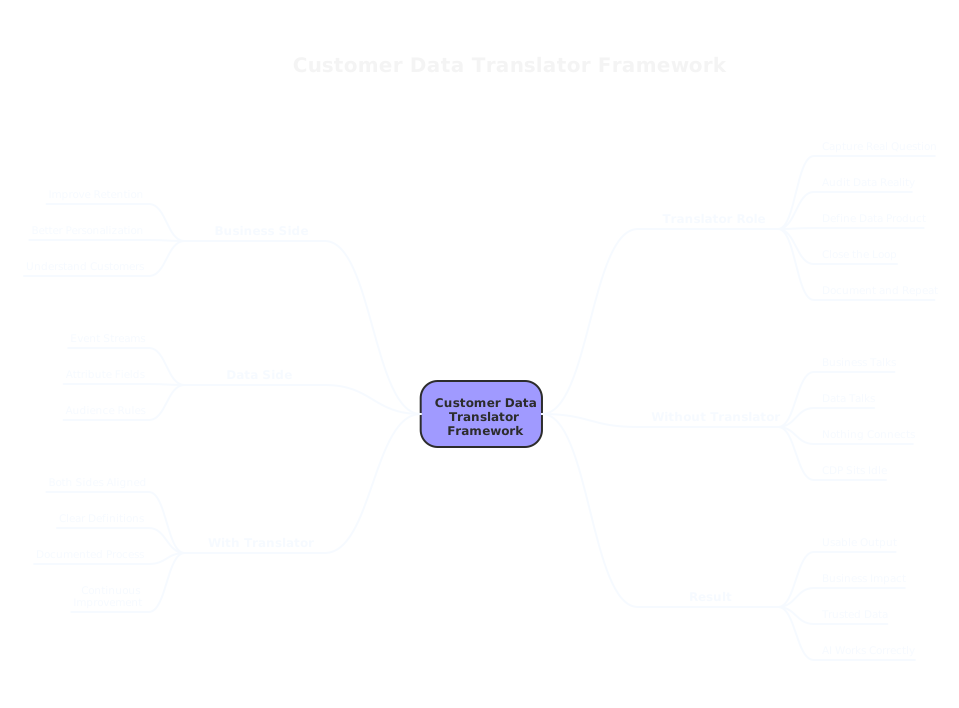
The Problem No One Talks About
Here is how most CDP implementations go:
The data team builds pipelines. The marketing team requests reports. The two groups talk past each other for months. Eventually, someone pulls a spreadsheet and calls it a win.
This is not a technology problem. It is a translation problem.
Your data platform does not know what "improve customer retention" means. It only knows event names, attribute fields, and audience rules. Someone has to close that gap. Someone has to speak both languages fluently.
That person is the customer data translator.
What Is a Customer Data Translator?
A customer data translator is the person who maps business questions to data products.
They sit between your executive team and your data infrastructure. They hear "we want to reduce churn in our top segment" and they know how to turn that into a specific query, audience definition, or AI training input your CDP can act on.
McKinsey identified this role years ago under the label "analytics translator." Tealium has started calling it out directly, pointing to translators as a key hire for teams that want AI and CDPs to produce usable outcomes. The job title may vary. The need does not.
Think of it this way. You could have the best interpreter in the world working for you. But if you never tell them what conversation needs to happen, they cannot help you. The customer data translator makes sure the conversation happens, and that both sides understand it.
Why This Role Is Now More Critical Than Ever
AI has raised the stakes.
When your marketing stack was just email and a CRM, a misaligned data request wasted a day. Maybe a campaign underperformed. Now, with AI-driven personalization and agentic marketing tools, a poorly framed question can spin up entire automated workflows pointed in the wrong direction.
Bad input does not just produce bad output anymore. It produces confident, fast, scaled bad output.
The translator role existed before AI. But AI made it essential.
The 5-Stage Customer Data Translator Framework
This is not a hiring checklist. This is a working process. Whether you bring in one dedicated person or split the responsibilities across your team, these five stages are what a customer data translator actually does.
Stage 1: Capture the Real Business Question
Most business questions arrive fuzzy. "We want better personalization" is not a question. It is a wish.
The translator's first job is to get specific. They ask: What decision are we trying to make? What would a good answer look like? What would change if we knew this?
A retail brand might come in saying they want to "understand their best customers better." After one focused conversation, the real question becomes: "Which customers who bought in Q4 have not returned, and what did they buy?" That is a question your data can answer.
Actionable takeaway: Before touching your CDP, write the business question in one sentence. If you cannot, you are not ready to query your data.
Stage 2: Audit What Data Actually Exists
Business people assume the data exists. Data people know it often does not, or does not exist in a usable form.
The translator bridges this reality check. They walk into the data environment and ask: Is this event tracked? Is this attribute populated? Is the data clean enough to be trusted?
This step saves weeks of work. It also prevents the most common CDP failure mode: building an audience on incomplete data and then wondering why the campaign did not perform.
Actionable takeaway: Map your business question to specific data fields before you build anything. Confirm those fields are actually populated.
Stage 3: Define the Data Product
A data product is the output your CDP or AI tool will create. It might be an audience segment, a predictive score, a triggered journey, or a reporting dashboard.
The translator defines exactly what that product looks like. Not in vague terms. In specific ones. Which attributes define membership in this segment? What is the refresh rate? How will this audience be activated?
This is where a lot of teams skip ahead and regret it. They build a segment without defining success criteria. Then they argue about whether it worked for three months.
Actionable takeaway: Write a one-paragraph brief for every data product before you build it. Include what it is, who it serves, and how you will know if it is working.
Stage 4: Close the Loop With Stakeholders
Once the data product is built, the translator brings it back to the business owner.
Not just to say "here it is." But to confirm: Is this what you actually needed? Does this answer the original question?
This step sounds obvious. It is almost never done well. Data teams ship outputs and move to the next ticket. Business teams receive reports they did not ask for and do not trust. The loop stays open.
The translator closes it. They sit in the room where the output is reviewed. They listen for the "yes, but" moments. Those moments are intelligence. They feed directly back into Stage 1.
Actionable takeaway: Schedule a 30-minute review of every data product with the business owner who requested it. Make it a standard step, not an optional one.
Stage 5: Document and Repeat
The translator's fifth job is to build institutional memory.
What questions have been answered? What data products exist? What did not work and why? Which audience definitions produced results?
This documentation is the difference between a company that keeps getting smarter with its data and one that starts over every time someone leaves.
At House of MarTech, we see this pattern constantly in CDP audits. A team spent six months building something valuable. Then a key person left. Six months later, the next team is rebuilding it from scratch because no one wrote anything down.
Actionable takeaway: Keep a living document of every data product you build. Include the business question it answers, the data fields it uses, and the outcome it produced.
What This Person Actually Looks Like
The customer data translator is not always a data scientist. They are not always a marketer either.
They tend to be curious people with just enough technical knowledge to be dangerous and just enough business sense to stay grounded. They ask good questions. They are comfortable sitting in messy conversations. They do not need perfect information to move forward.
Some teams find this person already exists inside their organization. They might be a senior marketing operations manager who has learned to speak data over the years. They might be an analyst who has developed a habit of asking "what will you do with this?" before writing a query.
Other teams need to hire for it explicitly. Job boards are starting to reflect this. Searches for roles combining business analysis, data interpretation, and marketing operations skills are rising. The title is still inconsistent, but the responsibilities are converging.
What to look for:
- Comfort with ambiguity. They should not need a perfect brief to get started.
- Business fluency. They understand revenue, retention, and customer lifetime value without needing a glossary.
- Data literacy. They do not need to write SQL, but they need to understand what a data model is.
- Communication skills. They can explain a complex data decision to a non-technical executive in two minutes.
Where AI Fits In
AI tools, including the AI layers being built into CDPs like Tealium's platform, are designed to surface patterns and accelerate decisions. But they are only as useful as the questions they are given.
If your AI system is trained on poorly defined audiences or activated against unclear business goals, it will optimize for the wrong things. Fast.
The translator is the quality gate. They make sure your AI inputs are sound. That means your AI outputs are trustworthy.
Think of the translator not as a job that AI replaces, but as the job that makes AI worth using.
How to Know If You Need This Now
You probably need a customer data translator if any of these are true:
- Your CDP has been live for more than six months and you cannot point to a clear business outcome it produced.
- Your data team and marketing team have regular misunderstandings about what a report or segment actually means.
- Your AI-powered personalization is running, but nobody is confident it is targeting the right people.
- You have rebuilt the same audience segment more than twice because it "did not work" without anyone defining what working looked like.
If two or more of those are true, the technology is not your bottleneck. The translation is.
Getting Started Without a Full Hire
You do not need to post a job listing today. You can start building this capability inside your existing team.
Pick one business question that matters right now. Work through the five stages above. Document everything. See where the process breaks down.
Where it breaks down is exactly where your gap is.
That exercise will tell you more about your data maturity than any platform audit. It will also help you write a clear brief if you do decide to bring in outside support.
At House of MarTech, we work with marketing teams to map business questions to data products, audit CDP configurations, and build the internal processes that make these investments pay off. If your team is stuck in the gap between data and decisions, that is exactly the kind of work we do.
The Real Competitive Advantage
Everyone has access to the same CDP vendors. The same AI tools. The same data clouds.
The teams that pull ahead are the ones who ask better questions of their data. They do that because they have someone, or a process, that translates business intent into data action.
That is the customer data translator. It is not a trendy title. It is a function your stack has always needed and mostly never had.
Build it deliberately. The return is not just better reports. It is a marketing team that finally trusts its own data.
Frequently Asked Questions
What does a customer data translator do?
A customer data translator maps business questions to data products. They sit between leadership and data infrastructure, turning strategic goals into specific, actionable queries, segments, or AI inputs.
Is a customer data translator the same as an analytics translator?
The roles are closely related. McKinsey's "analytics translator" focuses broadly on connecting data science outputs to business decisions. The customer data translator is specifically focused on customer data platforms, CDP activation, and marketing use cases.
Do I need to hire a full-time customer data translator?
Not always. Some organizations distribute this function across existing roles. But you do need someone who owns the process of turning business questions into data products. Whether that is one person or a coordinated handoff between two, the function must exist.
Why do CDPs fail without a translator function?
CDPs fail when the data being collected and the business questions being asked never connect. The technology works. The alignment does not. A translator function closes that gap before it becomes a six-figure mistake.
If you are building out your CDP strategy and want a clear-eyed look at where your current setup stands, House of MarTech offers MarTech strategy and implementation support. No jargon. No templates that were not built for your situation. Just an honest assessment and a practical path forward.
Related Articles
Need Help Implementing?
Get expert guidance on your MarTech strategy and implementation.
Get Free Audit