
First-Party Data Activation Playbook: From Collection to Campaign Without Third-Party Cookies
A step-by-step playbook for collecting, unifying, and activating first-party data across your MarTech stack in a post-cookie world. Real workflows included.


Listen to summary
0:00 audio overview
First-Party Data Activation Playbook: From Collection to Campaign Without Third-Party Cookies
Imagine you ran a physical store for twenty years. You knew your regulars by name. You remembered what they bought last time. You knew who was browsing and who was ready to buy. Then one day, someone took that knowledge away. You had to start guessing again.
That is exactly what cookie deprecation feels like for most marketing teams.
Third-party cookies were a shortcut. They let you borrow knowledge about customers from other websites. That shortcut is gone. But the good news? The replacement is better. First-party data, collected directly from your own customers, is more accurate, more durable, and more trusted than anything third-party data ever gave you.
This playbook walks you through a practical first-party data activation strategy. From collection to campaign. No shortcuts. No guesswork.
What First-Party Data Activation Actually Means
First-party data is information your customers give you directly. It comes from your website, your app, your emails, your forms, your checkout flow, and your loyalty program. You own it. Your customers knowingly provided it.
Activation means putting that data to work. It means using what you know to send the right message, to the right person, at the right time, through the right channel.
A solid first-party data activation strategy connects those two things: collection and action. Most businesses do one or the other. Few do both well.
Why This Matters More Than You Think
This is not just a technical problem. It is a relationship problem.
Third-party cookies tracked people without asking. First-party data requires you to earn it. That shift changes everything about how you market.
When a customer fills out a preference center, downloads a guide, or completes a quiz, they are telling you something. They are raising their hand. That signal is infinitely more valuable than a behavioral trace scraped from a website they visited three weeks ago.
The businesses winning right now are not the ones with the most data. They are the ones using data that customers willingly shared, to deliver experiences customers actually want.
That is the foundation of a sustainable first-party data activation strategy.
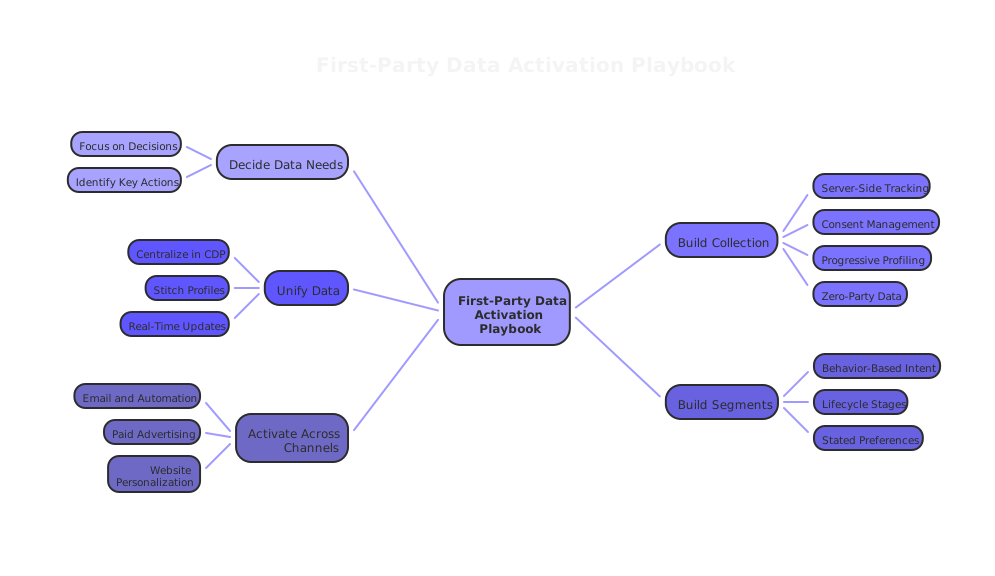
Step 1: Decide What Data You Actually Need
Before you collect anything, get clear on what decisions the data will inform.
Most organizations make the mistake of collecting everything they can. Then they end up with massive databases they never use. Worse, they slow down their teams and complicate their compliance obligations.
Start with these three questions:
- What customer actions, if we knew about them, would change how we communicate?
- What information would help us personalize our emails, ads, or website?
- What do we need to know to identify customers who are ready to buy?
Write down specific answers. Then build your data collection plan around those answers only.
This focused approach is a core best practice in first-party data activation strategy implementation. Collect less. Use it more.
Step 2: Build Your Collection Infrastructure
You need four things working together to collect first-party data at scale.
A. Server-Side Tracking
Client-side tracking, the kind that uses browser pixels, is breaking down. Ad blockers, iOS privacy settings, and browser restrictions mean you are losing data on a significant portion of your audience.
Server-side tracking fixes this. Instead of firing a pixel in a browser, your server sends conversion data directly to ad platforms. This means fewer gaps. Better attribution. Cleaner signals for your advertising algorithms.
If you are running paid campaigns and still relying only on browser pixels, you are flying with instruments that are reading wrong.
B. Consent Management as Infrastructure
Consent is not a legal checkbox. It is the first data point you collect.
When a customer tells you what they are willing to share and how they want to be reached, that preference should flow directly into your marketing tools. It should govern what segments they land in, what emails they receive, and what ads they see.
A consent management platform connected to your CRM and marketing automation does exactly that. It prevents non-compliant sends. It also ensures every message reaches someone who actually wants it.
That is not just good compliance. That is better marketing.
C. Progressive Profiling
Do not ask for everything at once. Nobody fills out a ten-field form on a first visit.
Progressive profiling means collecting information gradually. Ask for an email address first. Then, on a follow-up interaction, ask for their industry or role. Later, invite them to complete a preference center.
Each interaction builds the profile deeper. Each piece of information is provided in exchange for something of value. A guide. A recommendation. A personalized result.
This approach consistently produces more accurate data because customers are not rushing through forms to get to the other side. They are choosing to share.
D. Zero-Party Data Tools
Zero-party data is information a customer gives you proactively and intentionally. Think quizzes, assessments, calculators, and surveys.
A skincare brand that asks customers about their skin type before recommending products is collecting zero-party data. The customer benefits immediately. The brand gets explicit preference data it can activate across channels.
This is one of the most underused collection methods in first-party data activation strategy. It generates high-quality data and delivers value at the same moment.
Step 3: Unify Your Data in One Place
Collected data sitting in five different tools is not useful. You need a single place where all customer data lives together.
That place is typically a Customer Data Platform, or CDP.
A CDP pulls in data from your website, email platform, CRM, ad accounts, and any other source. It stitches that data together around individual customer profiles. Then it makes those profiles available for segmentation and activation.
The key word in that last sentence is "available." A CDP is only as valuable as what you do with the data inside it.
When evaluating CDPs, prioritize these capabilities:
- Deterministic identity resolution, meaning it matches customers based on verified identifiers like email addresses, not probabilistic guesses
- Direct integrations with the tools you already use
- Real-time profile updates so your campaigns reflect current behavior
At House of MarTech, we help businesses evaluate and implement CDPs based on their actual use cases, not vendor feature lists. The right platform depends on what you are trying to activate and how your team operates.
Step 4: Build Segments That Reflect Real Intent
Segmentation is where first-party data activation strategy moves from theory to practice.
Most businesses segment by demographics. Age, location, industry. These are blunt instruments. First-party data lets you segment by behavior and stated preference, which is far more precise.
Here are three segment types worth building immediately:
Behavior-based segments. Group customers by what they have done. Pages visited. Content downloaded. Products viewed. These actions signal interest better than any demographic can.
Lifecycle stage segments. Know who is a new lead, an active customer, a lapsed customer, and a loyal repeat buyer. Each stage requires different messaging. Sending the same email to all four groups wastes money and drives unsubscribes.
Preference-based segments. Use what customers told you explicitly. If someone said they want to hear about product updates but not promotions, honor that. Your engagement rates will improve because your list is smaller but more receptive.
Step 5: Activate Across Channels
Now you put it all together.
A first-party data activation strategy implementation only works if the data actually reaches your campaigns. Here is how that looks in practice.
Email and Automation
Trigger emails based on behavior. A customer downloads a guide on email automation. Your system adds them to a sequence covering related topics. The content matches what they already showed interest in.
This is not complex. It is just using the signal the customer gave you.
Paid Advertising
Upload your first-party customer lists to Google Ads and Meta. Use them to suppress existing customers from acquisition campaigns. Or create lookalike audiences modeled on your best customers.
When you feed verified, consented customer data into ad platforms, the algorithms have better signals to optimize against. Campaign performance improves because you are starting with truth, not inference.
Website Personalization
Use behavioral data to adapt what customers see when they return to your site. Someone who spent time on your pricing page should see something different from someone reading a beginner's guide.
This does not require advanced technology. A basic CDP connected to your CMS can handle it.
The Metric That Actually Tells You If It Is Working
Most businesses measure first-party data activation by conversion rate or cost per acquisition. Those are fine short-term signals.
The metric that actually tells you if your strategy is working is customer lifetime value.
Customers who receive personalized, relevant experiences based on data they willingly shared stay longer and spend more. That improvement shows up over months and years, not days.
Set up a simple comparison. Track CLV for customers who went through your first-party data collection and activation flow versus those who did not. That gap will tell you more than any vendor benchmark ever could.
Common Mistakes to Avoid
Collecting data you never use. Every field you collect is a field a customer had to fill in. If you are not activating it, you are wasting their time and cluttering your database.
Treating consent as a one-time event. Customer preferences change. Run consent refresh campaigns regularly. Give customers easy ways to update what they want from you.
Skipping the unification step. Data in silos does not activate. If your email tool, CRM, and ad accounts are not connected, your first-party data strategy is not a strategy. It is a collection of disconnected tools.
Optimizing for opens instead of relationships. Sending more emails to get more opens drives short-term numbers and long-term unsubscribes. Use first-party data to send fewer, better emails.
What Good Looks Like
The New York Times noticed through its own subscriber data that readers were heavily engaging with its crossword content. It turned that insight into a paid subscription product. No third-party data. No inference. Just paying attention to what existing customers were already doing.
That is first-party data activation strategy at its simplest and most effective. You collected the signal. You unified the view. You acted on it.
You do not need a massive budget or a team of data scientists to do this. You need clarity about what you are collecting, a unified place to store it, and campaigns built around what your customers actually told you.
Where to Start
If you are building a first-party data activation strategy from scratch, start here:
- Audit what data you are already collecting and what you are actually using.
- Implement server-side tracking to fix your attribution gaps.
- Connect your consent management platform to your marketing tools.
- Choose a CDP that fits your current stack and use cases.
- Build three behavior-based segments and activate them in one channel first.
Do not try to do everything at once. One channel, working well, built on clean first-party data, will outperform five channels built on guesswork.
If you want help mapping this out for your specific stack, House of MarTech works with businesses at every stage of this journey, from initial audits to full CDP implementation and campaign activation. Start with what you have. Build toward what works.
The cookies are gone. The opportunity is not.
Related Articles
Need Help Implementing?
Get expert guidance on your MarTech strategy and implementation.
Get Free Audit