
Digital Data Collection Strategy: Collect Less, Know More
Stop collecting more data. Collect the right data. Build first-party strategies that drive real competitive advantage in privacy-first MarTech. House of MarTech shows business leaders how.


TL;DR
Quick Summary
Listen to summary
0:00 audio overview
Quick Answer
Most marketing teams have a data problem. Not a shortage of data. Too much of the wrong kind.
They have spreadsheets, CRM exports, ad platform reports, social metrics, and Google Analytics dashboards. They have data coming from six directions. But when someone asks, "Why did revenue drop last quarter?" nobody has a clear answer.
More data did not make things clearer. It made things murkier.
A solid digital data collection strategy does not start with tools or platforms. It starts with a question: What decisions are you actually trying to make?
Why Most Data Collection Gets It Backwards
Here is the typical pattern. A business launches. It sets up Google Analytics, connects a CRM, adds a pixel or two, and starts running ads. Data flows in automatically. Over time, the stack grows. More tools, more data sources, more dashboards.
Nobody sat down and said, "Here is what we need to know, and here is exactly how we will collect it."
The result is what data professionals call fragmentation. You have customer data in three places that do not talk to each other. You have metrics that look meaningful but do not connect to revenue. You have reports that take hours to build and still do not answer the real questions.
This is not a technology failure. It is a strategy failure.
The fix is not a better tool. The fix is intentional collection.
What Is a Digital Data Collection Strategy?
A digital data collection strategy is a plan that defines what data you collect, why you collect it, where it lives, and how it connects to your marketing and business decisions.
It answers four questions:
- What do we need to know to grow?
- What data will tell us that?
- Where and how do we collect it?
- How do we keep it clean, connected, and compliant?
Without those answers, you are collecting data by accident. With them, every data point has a job to do.
The Four Types of Data Worth Knowing
Before building your strategy, you need to know what you are working with. Not all data is equal, and the marketing world is shifting fast on which types actually hold value.
Zero-Party Data
This is data a customer shares with you directly and intentionally. A quiz result. A preference survey. A "what are you shopping for?" prompt at checkout. Because the person chose to share it, it is highly accurate and completely yours.
Zero-party data is the most trustworthy data you can collect. And most businesses are not collecting nearly enough of it.
First-Party Data
This is data you collect through your own channels. Website behavior, email engagement, purchase history, support interactions. You own it. It does not depend on a third party to stay accurate.
First-party data is the foundation of any privacy-first strategy. Google, Apple, and regulators have been eroding third-party data for years. What you collect directly is what you keep.
Second-Party Data
This is another company's first-party data that they share with you directly, usually through a partnership. Less common, but valuable in the right context.
Third-Party Data
This is data purchased from external providers who aggregated it from sources you do not control. It was the backbone of digital targeting for years. It is now unreliable, often inaccurate, and increasingly off-limits due to privacy regulations like GDPR and CCPA.
The shift is clear: the future of digital data collection is first-party and zero-party. Build your strategy around what you own.
How to Build a Digital Data Collection Strategy That Actually Works
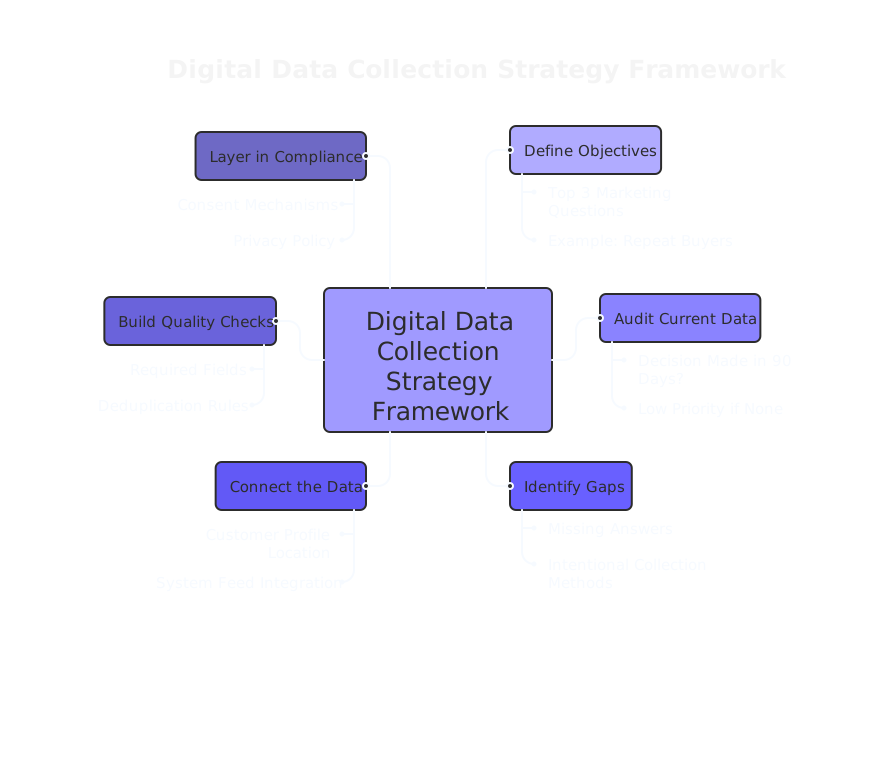
Step 1: Start With Your Objectives, Not Your Tools
Before you touch a platform or add a tracking pixel, write down the three most important questions your marketing team needs answered right now.
Examples:
- Which traffic source brings customers who actually stay and buy again?
- Where do potential customers drop off before their first purchase?
- What does our best customer look like before they become our best customer?
Your data collection exists to answer those questions. If a data source does not connect to one of them, it is a low priority.
This step sounds obvious. Most teams skip it entirely.
Step 2: Audit What You Already Have
You probably have more useful data than you realize. You also probably have a lot of noise cluttering the signal.
Do a simple audit:
- List every data source you currently collect from.
- For each one, ask: "What decision has this data helped us make in the last 90 days?"
- If the answer is "none," that source is not a priority to maintain or expand.
This is not about deleting data carelessly. It is about understanding what is actually earning its place in your stack.
Step 3: Close the Gaps With Intentional Collection
Once you know what questions you need answered and what data you already have, the gaps become obvious.
Maybe you have strong website traffic data but no visibility into what happens after someone calls your sales team. That is a CRM integration gap. Maybe you know what people buy but not why they almost did not. That is a zero-party data gap you could close with a post-purchase survey.
Common collection methods worth building into your strategy:
- On-site behavior tracking: What pages do people visit? Where do they spend time? Where do they leave?
- CRM records: Every customer interaction, deal stage, and service touchpoint.
- Email engagement data: Opens, clicks, and most importantly, what content drives action.
- Transactional data: Purchase history, order value, frequency.
- Direct customer input: Surveys, preference centers, onboarding forms.
- Social campaign data: Not vanity metrics. Actual click-through and conversion behavior.
The goal is not to collect all of these. The goal is to collect the ones that close your specific gaps.
Step 4: Define Where Data Lives and How It Connects
Collected data that sits in silos is almost as bad as not collecting it. If your email platform does not know what your CRM knows, you are making decisions with partial information.
This is where platforms like Customer Data Platforms (CDPs) become genuinely useful. A CDP pulls data from multiple sources into a single customer profile. That means the email campaign you send can reflect what someone bought last week, not just what they clicked on six months ago.
You do not need a CDP to start. But you do need to decide, explicitly, where your data of record lives. One place owns the customer profile. Everything else connects to it.
At House of MarTech, this is one of the first things we help clients work through. The tool choice matters less than the architecture decision: who is the source of truth, and how does everything else feed it?
Step 5: Build Quality Checks In From the Start
Poor data quality is one of the most common reasons MarTech implementations fail. It is also one of the most avoidable.
Duplicate records, missing fields, inconsistent formatting, and data that simply stops flowing when a platform updates its API. These problems compound over time. A database that starts with 80% clean data will not stay that way without maintenance.
Build in basic hygiene practices:
- Define required fields before you start collecting.
- Set up deduplication rules in your CRM or CDP.
- Assign someone ownership of data quality, even if it is not their only job.
- Review your data health quarterly, not annually.
Clean data is not glamorous. But it is what separates teams that can trust their insights from teams that are always second-guessing their numbers.
Step 6: Stay Ahead of Privacy Requirements
GDPR, CCPA, and an expanding list of state and national privacy regulations are not going away. They are getting stricter.
Your data collection strategy needs a compliance layer. That means:
- Clear consent mechanisms before collecting personal data.
- A privacy policy that actually explains what you collect and why.
- A process for honoring data deletion or access requests.
- Documentation of where data flows through your stack.
This is not just legal protection. Consumers are paying attention. Brands that are transparent about data use are building trust. Brands that are not are eroding it.
A Scenario Worth Thinking Through
Consider a mid-sized e-commerce brand. They have solid traffic and decent conversion rates. But their repeat purchase rate is low, and they cannot figure out why.
They have Google Analytics. They have Klaviyo for email. They have Shopify for transactions. None of these talk to each other in a meaningful way.
They run campaigns based on what email segments clicked last month. But they have no visibility into whether those clickers actually bought, returned, or never came back.
The solution is not more data. It is connecting what they already have. When their email platform knows who bought, what they bought, and how often, their campaigns stop being guesses. They become responses to actual customer behavior.
That connection is the strategy. The tools just execute it.
What a Strong Digital Data Collection Strategy Delivers
When you collect data with intention, a few things change:
- Decisions get faster. You spend less time wondering what the data means and more time acting on it.
- Campaigns get sharper. You stop targeting broadly and start targeting accurately.
- Trust builds. With your customers, because you respect their data. With your team, because the numbers make sense.
- AI tools actually work. Every AI-powered marketing tool is only as good as the data you feed it. Garbage in, garbage out. Clean, connected first-party data is what makes AI useful rather than misleading.
Where to Go From Here
You do not need to overhaul your entire stack to improve your data strategy. You need clarity on what you are trying to know, and a plan to collect it cleanly.
Start with the audit. List your data sources. Ask which ones are actually driving decisions. Then identify one gap that, if closed, would change how you market.
If you are not sure where to start, or if your team has tried to connect the dots before and gotten stuck, that is exactly what House of MarTech helps with. We work with business owners to map their current data flows, identify what is missing, and build integration strategies that make their existing tools work harder.
No stack rebuild required. Just a clearer picture of what you have, what you need, and how to connect them.
Good data does not happen by accident. But it does not have to be complicated either. Start with one question. Build from there.
Frequently Asked Questions
Get answers to common questions about this topic
Have more questions? We're here to help you succeed with your MarTech strategy. Get in touch
Related Articles
Marketing Data Privacy Compliance Audit Checklist: GDPR, CCPA, and 2026 Global Regulations
Zero-Party Data Collection Strategies: Preference Centers, Quizzes, and Value Exchange Programs That Actually Work
Zero-Party Data Collection Strategies: Building Preference Centers That Customers Actually Use
Need Help Implementing?
Get expert guidance on your MarTech strategy and implementation.
Get Free Audit