
Marketing Data Privacy Compliance Audit Checklist: GDPR, CCPA, and 2026 Global Regulations
Complete compliance audit checklist for marketing teams. Ensure your MarTech stack meets GDPR, CCPA, and emerging 2026 global privacy regulations.


Listen to summary
0:00 audio overview
Marketing Data Privacy Compliance Audit Checklist: GDPR, CCPA, and 2026 Global Regulations
Picture this. Your marketing team runs a campaign. It performs well. Then a regulator contacts you asking how you collected that data, whether you honored opt-out requests, and whether your vendors meet current security standards. You start digging through your MarTech stack. The answers are not clean.
That is the situation many marketing teams are walking into right now. Not because they are careless. Because marketing data privacy compliance was never built into their systems. It was bolted on after the fact.
2026 is different. Regulators are not issuing guidance anymore. They are issuing fines. The California Privacy Protection Agency brought enforcement actions in 2025 and is ramping up. GDPR enforcement is coordinated and specific, with Article 17 erasure rights as a declared 2026 priority. The question is no longer whether you need a compliance strategy. It is whether yours will hold up when someone actually looks at it.
This checklist gives you a practical audit you can run across your marketing stack today.
What Marketing Data Privacy Compliance Actually Means in 2026
Marketing data privacy compliance means your team can prove, not just claim, that you collect data lawfully, use it as stated, protect it properly, and honor customer requests.
That last word matters. Prove. Regulators are now checking whether your processes actually work, not just whether they exist on paper. A non-functional opt-out form cost Tractor Supply a $1.35 million fine. The violation was not the tracking. It was telling users they had opted out when they had not.
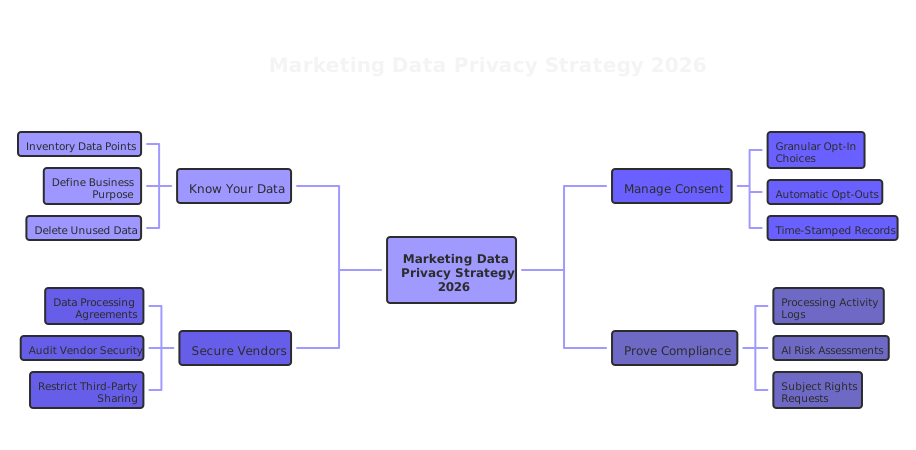
Good marketing data privacy compliance strategy has four parts:
- You know what data you collect and why.
- You get proper consent and honor it.
- Your vendors meet the same standards you do.
- You can show all of this in writing if asked.
Work through each section below and note where you have gaps.
Section 1: Data Inventory Audit
You cannot protect data you do not know you have. Start here.
Checklist
- Do you have a written inventory of every customer data point your marketing team collects?
- Does each data point have a documented business reason for collection?
- Do you know where each data point is stored, who can access it, and how long you keep it?
- Have you removed data you no longer use or cannot justify collecting?
- Do you have a written data retention schedule with defined deletion timelines?
Why this matters. GDPR's Article 17 erasure requirements are a 2026 enforcement priority. If a customer asks you to delete their data and you cannot find all of it, you have a problem. A complete data inventory is the foundation of every other compliance activity.
Practical note. If your inventory is a spreadsheet someone built two years ago and has not touched since, it is not a real inventory. Assign ownership and a review schedule.
Section 2: Consent Management Audit
Consent is where most marketing teams have the biggest gap between what they think is happening and what is actually happening.
Checklist
- Does your consent banner clearly explain what data you collect and why?
- Do you offer granular opt-in choices rather than one "Accept All" button?
- Is your "Reject" or "Opt Out" option as easy to find and use as your "Accept" option?
- Do you honor Global Privacy Control signals automatically?
- As of January 1, 2026, do you show visible confirmation that GPC opt-out signals have been processed?
- Do you store a record of each user's consent choice with a timestamp?
- If a user changes their consent preferences, does that change actually affect your tracking and data use in real time?
- Have you tested your opt-out flow to confirm it works end-to-end?
Why this matters. The CCPA amendments that took effect January 1, 2026 require organizations to display visible confirmation that GPC signals have been received and processed. That is a consumer-facing proof requirement. You cannot quietly honor it in the background and call it done.
The dark pattern risk. Designing your consent UI to make "Accept All" the obvious choice while hiding the "Reject" option is a regulatory target. It is also increasingly visible to consumers who have become more privacy-literate. Your consent experience is now part of your brand experience.
Section 3: Data Minimization Review
More data is not always better. This is one of the most counterintuitive but important shifts in marketing data privacy compliance best practices.
Checklist
- For each data point you collect, can you name the specific business decision it supports?
- Have you removed data fields that are collected "just in case" with no active use?
- Are your data collection forms requesting only what is necessary for the stated purpose?
- Are your email sign-up and lead capture forms free of optional fields that feel mandatory?
- Do you have a process for reviewing collected data regularly and removing what is no longer needed?
Why this matters. Data minimization is a legal requirement under GDPR. It is also a business advantage. Smaller, intentional datasets are easier to manage, cheaper to store, and less exposed in the event of a breach. Teams that have cut their data collection to what actually drives decisions report cleaner models and clearer insights.
Collect what you will use. Delete what you will not.
Section 4: Automated Decision-Making and AI Audit
If your marketing stack uses AI or algorithms to make decisions about customers, you have new documentation requirements in 2026.
Checklist
- Have you identified every AI or algorithm in your MarTech stack that makes or influences decisions about individual customers?
- Do any of those decisions touch employment, housing, financial services, education, or healthcare?
- If yes, have you conducted a formal risk assessment and documented it before deployment?
- Have you tested your AI systems for bias or disparate impact on protected groups?
- Do you have documentation of model training data, testing methods, and accuracy assessment?
- Can customers request human review of automated decisions that affect them?
Why this matters. California's updated regulations require risk assessments for automated decision-making technology used for significant decisions. The EU AI Act reaches full enforcement in August 2026. If you use AI for lead scoring, customer segmentation, or predictive targeting that feeds into high-stakes decisions, you need documentation showing you assessed the risks before deployment, not after.
At House of MarTech, we help clients audit their MarTech stacks to identify where AI is being used and whether the documentation requirements are being met. This is one of the areas where teams are most often caught off guard.
Section 5: Vendor and Third-Party Risk Audit
Your vendors' compliance gaps are your compliance gaps. Regulators hold you responsible for what your processors do with customer data.
Checklist
- Do you have a current list of every vendor that accesses customer personal data on your behalf?
- Does each vendor have a signed Data Processing Agreement (DPA)?
- Have you reviewed each DPA to confirm it meets current GDPR and CCPA requirements?
- Have you asked each vendor to complete a security questionnaire in the past 12 months?
- Have you verified vendor claims about encryption, access controls, and incident response?
- Do you know what each vendor does with the data you share with them?
- Do your vendor contracts prohibit vendors from selling or re-sharing your customer data?
- Do you have a process to remove vendor access when a contract ends?
Why this matters. You cannot outsource compliance responsibility. If a vendor mishandles your customers' data, the regulatory exposure falls on you as the data controller. Vendor management is not a procurement function. It is a governance function.
Ask your vendors hard questions. Verify their answers. Document everything.
Section 6: Subject Rights Request Process Audit
Customers have rights. They can ask to see their data, correct it, delete it, or move it. Your ability to respond quickly and completely is a legal requirement.
Checklist
- Do you have a clear, visible process for customers to submit data access, correction, or deletion requests?
- Does your process meet the required response timelines (30 days under GDPR, 45 days under CCPA)?
- Do you have a documented workflow for finding all customer data across your systems?
- Can you confirm deletion across all systems, including third-party vendors?
- Do you log every subject rights request and your response?
- Have you tested this process end-to-end in the past six months?
Why this matters. GDPR Article 17 erasure rights are a declared 2026 enforcement priority. Regulators will look at deletion workflows, what exceptions you claim, and whether your reasoning is documented. A request that takes 90 days and results in incomplete deletion is a compliance failure even if you meant well.
Section 7: Documentation and Audit Trail
The organizations that handle enforcement best are the ones that can show their work. Documentation is not paperwork for its own sake. It is your defense.
Checklist
- Do you maintain a Record of Processing Activities (RoPA) as required by GDPR Article 30?
- Does each processing activity in your RoPA include the legal basis for processing?
- Have you completed written risk assessments before starting any new high-risk processing activity?
- Do you have documented policies for data handling, breach response, and access control?
- Do you have a written breach notification process with defined timelines (72 hours under GDPR)?
- If your revenue exceeds $50 million, have you confirmed your cybersecurity audit certification timeline?
- Are your compliance records stored securely and accessible to the people who need them?
Why this matters. Organizations with auditable, documented processes have defensible positions when regulators investigate. Organizations that treated compliance as a checkbox exercise face exposure that can be far more expensive than the cost of getting it right upfront.
Section 8: First-Party Data Strategy Review
This section is forward-looking. The organizations building durable marketing programs right now are shifting from third-party tracking to consented, first-party data collection.
Checklist
- Are you actively building first-party data assets through owned channels?
- Do you have a clear value exchange for customers who share data with you?
- Do you activate data immediately after collection so customers see the benefit?
- Are you using progressive profiling rather than collecting all data upfront?
- Have you explored contextual advertising as an alternative to behavioral tracking?
- Are you testing zero-party data approaches, such as preference quizzes or explicit interest registration?
Why this matters. Third-party cookies are effectively gone for compliant marketing stacks. Organizations still dependent on cross-site tracking are building on a foundation that regulatory enforcement is actively dismantling. First-party data collected with clear consent is a proprietary asset. It does not deprecate. It does not get blocked by browser updates. It grows more valuable over time.
Cisco research found that 95% of businesses reported privacy investments outweighed the costs. Better data quality and reduced regulatory risk are the two most common reasons cited. That is not a coincidence.
How to Use This Checklist
Run through each section and mark every item you cannot confidently check off. Those gaps are your compliance roadmap.
Prioritize by risk. Consent management failures and missing vendor agreements carry the highest regulatory exposure. Incomplete documentation and weak subject rights processes are close behind.
Assign ownership. Every compliance function needs a named owner, not a committee. Someone needs to be responsible for keeping the data inventory current, running the vendor questionnaire cycle, and testing the opt-out flow.
Set a review cadence. This is not a one-time audit. Privacy regulations are being updated and enforced on an ongoing basis. A quarterly review of your highest-risk areas and an annual full audit is a reasonable starting point.
If your current MarTech stack makes it difficult to run a clean audit, that is a signal about your architecture, not just your processes. At House of MarTech, we work with marketing teams to assess their data infrastructure, identify compliance gaps, and build systems where privacy is built in rather than bolted on. Reach out if you want a second set of eyes on where you stand.
Marketing data privacy compliance is not a destination. It is an ongoing part of running a marketing operation that customers can trust and regulators can audit. The checklist above gets you started. What you do with it determines where you end up.
Related Topics
Related Articles
Zero-Party Data Collection Strategies: Preference Centers, Quizzes, and Value Exchange Programs That Actually Work
Zero-Party Data Collection Strategies: Building Preference Centers That Customers Actually Use
First-Party Data Activation Playbook: From Collection to Campaign Without Third-Party Cookies
Need Help Implementing?
Get expert guidance on your MarTech strategy and implementation.
Get Free Audit