
Zero-Party Data Collection Strategies: Preference Centers, Quizzes, and Value Exchange Programs That Actually Work
Build trust and collect valuable zero-party data with preference centers, quizzes, and value exchanges. Proven tactics for post-cookie marketing success.


TL;DR
Quick Summary
Listen to summary
0:00 audio overview
Zero-Party Data Collection Strategies: Preference Centers, Quizzes, and Value Exchange Programs That Actually Work
Quick Answer
Imagine you walk into a store. Before you browse a single shelf, a staff member hands you a clipboard with fifteen questions about your income, buying habits, and lifestyle. You fill it out because they asked. Then you get served the exact same generic promotions as everyone else.
That is what bad zero-party data collection looks like. And most businesses are doing exactly that.
Here is the truth: customers are not afraid to share information. They share their preferences, opinions, and values constantly. They just do not want to feel tricked into it. When you ask for data and do nothing meaningful with it, people notice. They stop trusting you.
Zero-party data collection done right is the opposite of that experience. It feels like a real conversation. You ask, they answer, and something genuinely useful happens for them because of it.
This guide will show you what actually works and why.
What Is Zero-Party Data Collection?
Zero-party data is information a customer shares with you directly and intentionally. They know they are sharing it. They chose to share it. It is not inferred from their clicks or purchased from a third party.
Examples include:
- A quiz answer about their skin type
- A preference center selection for email frequency
- A survey response about an upcoming purchase
- A chatbot conversation about product preferences
Zero-party data collection is the process of gathering that information through channels and experiences customers actually want to engage with.
The difference between zero-party data and first-party data is simple. First-party data is what you observe, like website visits, purchase history, and open rates. Zero-party data is what customers tell you directly.
The difference matters. Observed behavior is a guess. Declared preference is a statement.
Why Most Zero-Party Data Strategies Fall Short
Most businesses treat zero-party data collection as a compliance checkbox. They build a preference center because their legal team asked for one. They run a survey because their platform included a survey feature. They add a quiz to their site because a competitor did.
Then the data sits in a silo.
The preference center does not connect to the email platform. The quiz results do not update the CRM. The survey responses get exported to a spreadsheet and never looked at again.
Customers notice this disconnect. They told you they only want emails on Tuesdays about product releases. You sent them a Thursday promotion for a service they already own. The preference center was theater. The data collection was performative.
Research shows that 88% of EU-based companies with consent management platforms fail GDPR compliance, often because their systems do not actually enforce the preferences they collect. That is not a legal problem. That is a trust problem.
The fix is not a better form. The fix is a better system.
The Three Methods That Actually Work
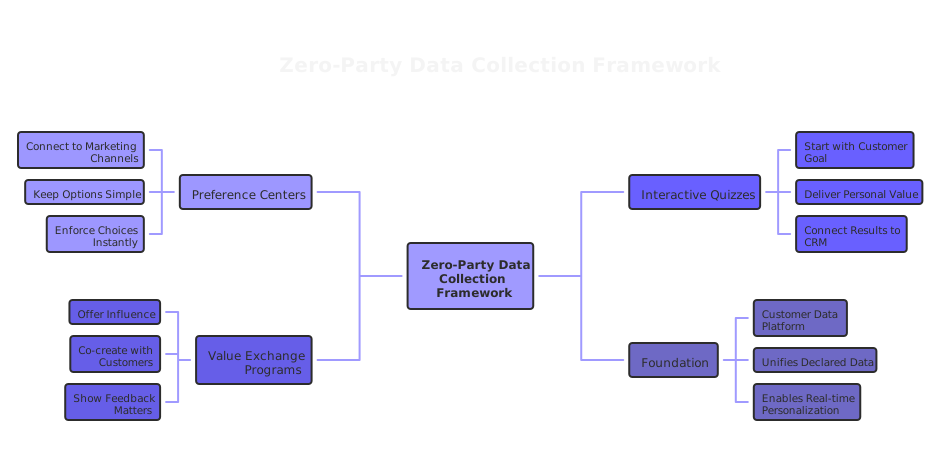
1. Preference Centers Built for Enforcement, Not Optics
A preference center should do one thing above all: make sure your marketing actually reflects what the customer told you.
That sounds obvious. It almost never happens.
Most preference centers are owned by compliance teams. They are separate from the email platform, the ad platform, and the personalization engine. A customer updates their preferences and that change takes days, sometimes weeks, to propagate through your systems. By then, you have already violated what they asked for.
Here is how to build a preference center that works:
Connect it to everything. Every preference change should trigger an immediate update across all your marketing channels. Email, SMS, paid retargeting, onsite personalization. All of it. This requires technical integration work. It is worth it.
Keep the options simple and meaningful. Do not offer fifteen toggles nobody understands. Offer real choices that produce noticeably different experiences. If customers cannot feel the difference between option A and option B, the preference center is useless.
Make it easy to find. Every email, every SMS, every notification should link directly to the preference center. Not just an unsubscribe link. A full preference page.
Measure preference accuracy, not just completion. The metric is not how many people filled out the form. The metric is how often your marketing matches what they asked for.
When you treat preference data as seriously as behavioral data, something counterintuitive happens. Customers who reduce their communication frequency actually engage more. They open more emails. They click more links. Less volume plus better alignment equals better results.
2. Quizzes That Deliver Value First
Standard forms convert at 2 to 5 percent. Well-designed interactive quizzes convert at over 40 percent.
That is not a small improvement. That is a different category of result.
The reason is not design tricks or dark patterns. The reason is that quizzes answer a question before they ask one. They create value for the customer before requesting anything in return.
A form that asks "What is your hair type?" creates friction. A customer has to stop, recall details about their hair, decide which option fits, and submit information with no immediate reward.
A quiz that asks a series of short, engaging questions about their hair routine, goals, and challenges, then delivers a personalized product recommendation, creates a different experience entirely. The customer is engaged. They receive something genuinely useful. The data sharing feels fair.
ASICS ran a survey-based campaign to collect customer shopping and athlete preferences as part of a cross-promotion. It achieved a 90 percent completion rate and collected an average of 21.5 data points per user. Those numbers far exceed standard benchmarks. The reason was simple: customers were participating in something that actually involved them. Their input would influence which athletes the brand featured. The data sharing felt meaningful because it was.
Your zero-party data collection implementation should follow this principle. The experience of sharing data should itself be worth the customer's time. The result should be something they could not get without participating.
Here is a simple framework for building a quiz that collects useful data:
- Start with the customer's goal, not your data need. What do they want to figure out?
- Ask questions that help them get there. Each question should feel relevant to the result.
- Deliver a specific, useful result. Not "you prefer quality over price." Something actionable.
- Connect the result to your systems. Tag the contact, update their profile, trigger a follow-up sequence.
Quizzes work in B2B too. Replacing "What is your job title?" with "What operational challenge is your team solving right now?" collects more useful data and positions your brand as a problem-solver, not a form-filler.
3. Value Exchange Programs With Real Stakes
Most loyalty programs offer points. Points feel transactional. Customers calculate whether the math is worth it, decide it probably is not, and disengage.
The highest-performing zero-party data collection strategies offer something points cannot: influence.
When customers can see that their input shaped a real decision, something changes. They do not feel like data sources. They feel like participants. That psychological shift drives deeper engagement and more honest data sharing.
Patagonia's Footprint Chronicles lets customers trace the environmental and social impact of each product. To engage with the platform fully, customers share values-based information about what matters to them in sourcing and materials. They share it willingly because the platform uses it to show them something they genuinely want to know. Their data contributes to their own experience.
The result is that 65 percent of Patagonia's customers cite transparency as a major factor in purchasing decisions. That is not a loyalty program metric. That is a relationship metric.
You do not need to be Patagonia to apply this principle. Here are practical ways to make your value exchange feel real:
Show customers how their feedback changed something. If a product feature was updated based on customer input, say so. "We heard you" is only powerful if it is followed by proof.
Give customers visibility into how they are profiled. Let them see the preferences and tags your system has assigned. Let them correct errors. Customers who can see and edit their own profile trust the personalization more.
Create co-creation moments. Invite customers to vote on upcoming products, color options, or content topics. Publish the results. Close the loop.
The underlying zero-party data collection best practice here is simple: customers share more when they believe sharing makes a difference. Financial rewards help at the margin. Genuine influence is more powerful.
The Architecture Problem You Cannot Ignore
You can run great quizzes, build a clean preference center, and design compelling value exchange programs. None of it will work if your data architecture is fragmented.
This is the most common failure point in zero-party data collection strategy. The collection tools work fine. The data sits in disconnected systems and never reaches the personalization engine.
The solution is a Customer Data Platform (CDP). A CDP unifies zero-party data from preference centers, quizzes, surveys, and progressive profiling into a single customer profile. It makes that profile available in real time to every system that needs it.
Without unified data infrastructure, preference center updates take days to enforce. Quiz results get stored in a separate platform that does not talk to email. Survey responses get analyzed quarterly and filed away.
With unified infrastructure, a preference update changes what content a customer sees within hours. A quiz result triggers a personalized welcome sequence immediately. A survey response updates their segment automatically.
If you are unsure whether your current stack can support this level of integration, that is exactly the kind of assessment the team at House of MarTech can help you with. Getting the architecture right before investing in collection tools saves significant time and budget.
Progressive Profiling: Collect Data Over Time, Not All at Once
Zero-party data collection does not have to happen in a single session. In fact, it probably should not.
Progressive profiling collects data gradually across multiple interactions. A customer shares basic information at signup. They share product preferences after their first purchase. They update communication preferences after three months. They answer a lifestyle question during a seasonal campaign.
This approach reduces friction at every individual touchpoint. It also means the data you collect is more accurate. Customers know more about their own preferences after they have experienced your product than they did when they first signed up.
The technical requirement is a system that stores partial profiles reliably, triggers follow-up collection at the right moments, and uses whatever data is available to personalize even before the profile is complete.
If your system cannot handle partial profiles well, progressive profiling will frustrate customers more than it helps them. They will feel like they are being asked the same questions repeatedly. That defeats the purpose entirely.
When it works, progressive profiling feels natural. Customers do not feel surveyed. They feel understood, a little more each time they interact.
One Practical Next Step
If you are looking at this and wondering where to start, start with your preference center.
Audit it honestly. Does a preference change actually update your email platform within 24 hours? Does it affect your ad targeting? Does it change what content appears when that customer logs in?
If the answer to any of those is no, that is your first problem to solve. Fix the enforcement before you add more collection points.
Once your preference center actually does what it promises, move to quizzes. Pick one customer segment, one clear question they want answered, and build a single quiz around it. Connect the results to your CRM. Measure completion rate and the quality of the follow-up experience.
Then look at your value exchange. Ask yourself honestly: when a customer shares something with you, do they receive something worth sharing for? If the honest answer is no, that is the next thing to redesign.
Zero-party data collection is not a campaign. It is a system. When the system works, customers share more because sharing is worth their time. You personalize better because your data is accurate. And the relationship grows because it is built on something real.
If you want help mapping out that system for your specific stack and customer journey, House of MarTech works with businesses at every stage of this process, from auditing existing data infrastructure to designing collection experiences that actually convert.
The starting point is always the same: stop asking for data before you have earned the right to receive it.
Frequently Asked Questions
Get answers to common questions about this topic
Have more questions? We're here to help you succeed with your MarTech strategy. Get in touch
Related Articles
Need Help Implementing?
Get expert guidance on your MarTech strategy and implementation.
Get Free Audit