
Zero-Party Data Collection Strategies: Building Preference Centers That Customers Actually Use
Master zero-party data collection with preference centers, quizzes, and value exchanges that respect privacy while delivering personalization.


TL;DR
Quick Summary
Listen to summary
0:00 audio overview
Zero-Party Data Collection Strategies: Building Preference Centers That Customers Actually Use
Quick Answer
Imagine you walk into a store. Before you can browse, a staff member hands you a clipboard. It has forty-seven questions. They want to know your content preferences, your communication cadence, your lifestyle interests, and your data-sharing comfort level.
You put the clipboard down and walk out.
That is what most preference centers do to your customers online. They are built with good intentions. They often fail in practice.
This guide covers what actually works when it comes to zero-party data strategies, why most implementations fall short, and what a few smart brands are doing differently.
What Is Zero-Party Data, and Why Does It Matter Now?
Zero-party data is information a customer shares with you directly and intentionally. They fill out a quiz. They set communication preferences. They tell you what they care about.
This is different from first-party data, which you collect by observing behavior. Zero-party data is what they tell you. First-party data is what they show you.
Why does this matter right now? Third-party cookies are disappearing. Privacy regulations are tightening. Customers are more cautious about how their data is used. Brands that rely on third-party tracking are losing visibility. Brands that build direct relationships with customers are gaining it.
Zero-party data strategies fill that gap. But only when they are done right.
The Core Problem: Preference Centers Most Customers Ignore
Here is an uncomfortable truth about most preference centers. They collect data customers do not actually care about providing, store it in systems that do not act on it, and call that a strategy.
There are three specific reasons this happens.
1. Customers Do Not Always Know What They Prefer
When you ask someone to rate their interest in a product category on a form, they often pick whatever sounds right in that moment. Researchers call this "insufficient effort responding." The customer is not being dishonest. They are being human.
They may select "interested in sustainability" because it feels like the right answer. But their actual purchase history shows they have never bought a sustainable product. Their stated preference and their real behavior do not match.
If you build your personalization on stated preferences alone, you are building on shaky ground.
2. Preference Data Goes Stale Fast
A customer fills out your preference center during onboarding. Six months later, their job changes. Their interests shift. Their budget looks different. Your system still shows their original answers.
You are personalizing for a person who no longer exists.
Most preference centers do nothing to encourage customers to update their profiles. So the data sits there, aging silently, while your marketing engine treats it as current truth.
3. Too Many Choices Create Friction, Not Trust
Offering customers fifty toggles and granular controls does not feel empowering. It feels like work. It also signals something customers notice: that you are collecting a lot of data, and you want them to manage it.
That is not a trust-building experience. That is burden-shifting.
What Zero-Party Data Strategies Best Practices Actually Look Like
The brands seeing real results from zero-party data strategies have one thing in common. They collect less, not more. And they make the data collection feel like a service, not a survey.
Lead With Value, Not Data Collection
Colgate-Palmolive ran a quiz about customers' oral care routines. It was framed as personalized advice, not a data collection exercise. The result was an 84% completion rate with more than eleven data attributes collected per customer.
That number is remarkable. But it makes sense when you understand why. Customers were not told "help us build your profile." They were told "let us help you improve your routine." The value was upfront. The data collection was a byproduct.
This is the core of effective zero-party data strategies: the customer has to benefit first. Data collection is secondary.
Use Progressive Profiling Instead of Long Forms
Progressive profiling means collecting data gradually across multiple interactions rather than all at once.
At first contact, ask for an email address. After the first purchase, ask for a product preference. After engagement with a specific content topic, ask about interest level in that area.
Each individual ask is small. Together, they build a rich profile over time. More importantly, each question is asked in the context where it is most relevant. A customer reading about running shoes is more likely to give you accurate footwear preferences than a customer staring at a blank registration form.
This is one of the highest-impact zero-party data strategies implementation choices you can make. It reduces upfront friction and improves data quality at the same time.
Try Conversational Collection
Forms feel transactional. Conversations feel relational.
AI-powered chatbots and assistants are changing how brands collect preference data. When a customer types "I need running shoes for long trail runs on a budget," they are giving you layered preference data without filling out a single field.
Conversational interfaces extract intent, context, and nuance that structured forms cannot. And customers engage more willingly because it feels like getting help, not providing data.
If you have a chatbot on your site and you are not using it as a preference collection tool, you are leaving useful signal on the table.
The Data Quality Problem Nobody Talks About
Most MarTech content on zero-party data strategies glosses over a critical issue. Stated preferences are often wrong. Not because customers lie. Because human memory and self-reporting are unreliable.
When a customer says they prefer premium products, they may be reflecting what is culturally top-of-mind, not their actual purchasing behavior. When they say they want personalized recommendations, they may not have considered what that really means until they start receiving emails that feel invasive.
This does not mean zero-party data is useless. It means you should treat it as a hypothesis, not a conclusion.
Combine Zero-Party and First-Party Data
The best zero-party data strategies implementation treats stated preferences and behavioral data as partners. One tells you what the customer says they want. The other tells you what they actually do.
When they align, you have high confidence. When they conflict, you have something even more valuable: a real insight into the gap between aspiration and behavior.
A customer who says they care about sustainability but never clicks sustainability content is telling you something. Maybe your sustainable products are not visible enough. Maybe the messaging is not landing. Maybe the stated preference is aspirational. That discrepancy is a signal worth acting on.
Use zero-party data to add context to behavioral data. Do not use it to replace behavioral data.
Why Most Preference Center Implementations Fail Organizationally
The technology is rarely the problem. The organization usually is.
Effective zero-party data strategies require marketing, legal, IT, and customer service to work together. They require leadership to treat customer data strategy as a business priority, not a compliance checkbox.
When leadership views preference centers as a legal requirement rather than a customer experience investment, the implementation reflects that. You get a minimum viable system that checks the regulatory box but does not serve the customer or the business.
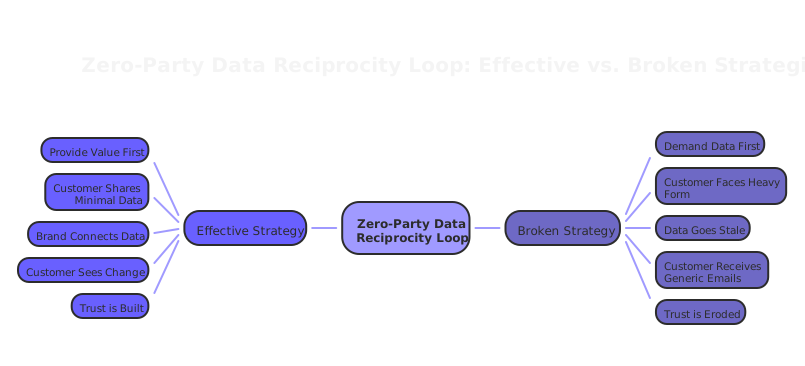
There is also a trust paradox worth naming. When a customer updates their preferences and then receives the exact same emails at the exact same frequency, they notice. The preference center said they had control. Nothing changed.
That is not a trust-building experience. That actively erodes trust.
Close the reciprocity loop. When a customer shares preferences, they should see an immediate, observable change. Fewer emails if they asked for fewer emails. Different content if they shifted their interests. The preference center only builds trust if the rest of your marketing stack actually listens to it.
This is one of the most common gaps we see in our data integration work at House of MarTech. Preference data gets collected and stored but never connected to execution. Fixing that connection is often more valuable than any improvement to the preference center itself.
A Simpler Frame for Zero-Party Data Strategy
Most organizations approach this backwards. They build a large data collection infrastructure and then create a preference center to manage customer concerns about it.
The better approach is to start from the opposite direction.
Ask: What is the minimum data we need to serve this customer well?
Then collect only that. Be transparent about what it is and why you need it. Show customers exactly how it shapes their experience.
That is it. That is the strategy.
The New York Times tested something close to this. Rather than building extensive preference profiles, they created a simple registration wall requiring only an email address. One data point. Clear purpose. Obvious benefit. The result was a dramatic increase in digital subscription conversions compared to non-registered users.
Simplicity converted better than complexity.
Practical Steps for Zero-Party Data Strategies Implementation
Here is how to move from where you are to where you need to be.
Step 1: Audit what you are collecting. List every data point your preference center captures. For each one, answer honestly: are we actually using this to serve the customer better? If the answer is no, stop collecting it.
Step 2: Simplify the experience. Reduce your preference center to the three to five choices that actually matter. Communication frequency. Core content interests. Maybe channel preference. That is usually enough.
Step 3: Add progressive profiling. Stop asking for everything upfront. Map two or three moments in the customer journey where a single, contextually relevant question makes sense. Build those into your email flows or post-purchase experience.
Step 4: Connect preferences to execution. This is non-negotiable. If a customer sets a preference and nothing changes, your preference center is theater. Audit the connection between preference data and your marketing automation. Fix the gaps.
Step 5: Make data use visible. Add a simple line to emails that shows why the customer received that message. "Based on your interest in [topic]." This observable transparency does more for trust than any privacy policy ever will.
Step 6: Treat preferences as hypotheses. Watch whether stated preferences align with behavior. When they conflict, investigate. Use that insight to improve both your preferences and your products.
What Good Zero-Party Data Strategies Look Like in Practice
A useful benchmark: if a customer cannot update their preferences in under sixty seconds, the system is too complex.
If a customer updates their preferences and cannot see the effect within their next interaction, the system is not connected.
If your preference center is primarily designed to maximize data capture rather than serve customer needs, it will not generate the trust required to collect accurate data.
The brands building the most effective preference systems are not necessarily the ones with the most sophisticated technology. They are the ones asking the most honest questions about what customers actually need from the relationship.
Final Thought
Zero-party data strategies work when they are built around a genuine exchange. The customer shares something useful. You use it to serve them better. They can see that you used it. Trust builds over time.
That loop is simple. Most organizations break it somewhere in the middle.
If you want help auditing your current preference center, connecting your data collection to your marketing execution, or designing a progressive profiling strategy that fits your customer journey, that is work we do every day at House of MarTech.
The goal is not a more sophisticated preference center. The goal is a customer who trusts you enough to tell you what they actually want.
That is worth building toward.
Frequently Asked Questions
Get answers to common questions about this topic
Have more questions? We're here to help you succeed with your MarTech strategy. Get in touch
Related Articles
Need Help Implementing?
Get expert guidance on your MarTech strategy and implementation.
Get Free Audit