
Lead Generation Systems That Actually Convert in 2026
Most lead gen fails in execution, not tactics. Learn the system changes winning companies use to bridge strategy-reality gaps.


TL;DR
Quick Summary
Listen to summary
0:00 audio overview
Quick Answer
You spent $40,000 on ads last quarter. Your team captured 2,300 leads. And your sales team closed... eleven of them.
That is not a lead generation problem. That is a system problem.
Here is the pattern most companies miss: they keep swapping out tactics — a new landing page here, a chatbot there, a fresh email sequence — while the underlying system stays broken. It is like rearranging furniture in a house with a cracked foundation and wondering why the floors still slope.
The companies quietly winning at lead generation and lead conversion in 2026 are not doing anything flashy. They are doing something far more powerful. They are building systems where every piece talks to every other piece — and where no lead falls through the gaps between marketing and sales.
This post walks you through exactly how those systems work, step by step.
Why Most Lead Gen Fails (And It Is Not What You Think)
Let us be honest about something. There is no shortage of lead generation tactics. Content marketing, paid ads, webinars, LinkedIn outreach, AI-powered chatbots — the list grows every month. Most businesses have tried at least five of these in the last year.
So why do conversion rates stay stubbornly low?
Because tactics without a system are just noise.
Here is what typically happens:
- Marketing runs a campaign and captures leads into one tool
- Those leads get passed to sales in a spreadsheet or a disconnected CRM
- Sales follows up three days later (if they follow up at all)
- The lead has already gone cold, moved on, or talked to a competitor
- Everyone blames each other
The problem is not the tactic. The problem is the space between the tactic and the outcome. That space — the handoff, the timing, the context — is where most revenue quietly dies.
The Real Cost of Disconnected Tools
A company we worked with had seven different tools touching their lead journey. A form builder, an email platform, a CRM, a chat tool, an analytics dashboard, a scoring model, and a scheduling app. None of them shared data in real time.
When a lead filled out a high-intent form at 2 PM, the sales team did not see it until the next morning's sync. By then, the lead had already booked a demo with a competitor who responded in four minutes.
Seven tools. Zero system. That is the gap.
The Lead Conversion System Framework
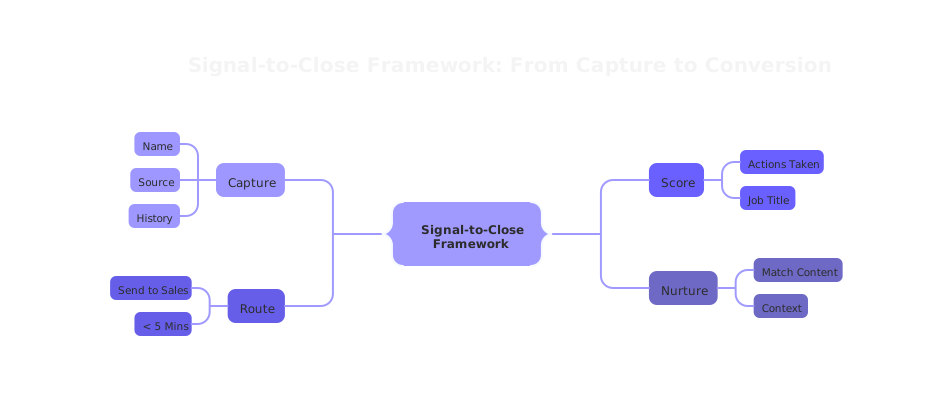
Instead of listing more tactics, let us look at what a lead generation system that actually converts looks like in 2026. We call this the Signal-to-Close Framework, and it has four connected layers.
Layer 1: Capture With Context
Most lead capture is binary. Someone fills out a form, and you get a name and email. Maybe a company name if you are lucky.
But a system-first approach captures context, not just contact info:
- Where did they come from? A Google search for "best CDP for mid-market" tells you something very different than a click on a LinkedIn ad.
- What did they do before converting? Did they read three blog posts about data integration? That is a signal.
- What is their company profile? Firmographic data (company size, industry, tech stack) can be enriched automatically.
The best lead capture in 2026 does not ask for more fields. It connects more data sources behind the scenes so your team understands why someone raised their hand, not just that they did.
Practical step: Audit your current lead forms. For each one, ask: "When a lead comes in from this form, does my team know the full story — or just a name?" If it is just a name, you have a context gap.
Layer 2: Score With Behavior, Not Just Demographics
Lead scoring has been around for years. But most scoring models are stuck in 2018.
They give points for job title (VP = 10 points), company size (500+ employees = 15 points), and maybe email opens. The result? A "Marketing Qualified Lead" who has the right title but zero buying intent.
A lead generation and lead conversion system that works in 2026 scores based on behavior patterns, not just profile data:
- Visited the pricing page twice in one week → high intent signal
- Downloaded a comparison guide → actively evaluating options
- Opened three emails but never clicked → curious but not ready
- Returned to the site after 30 days of silence → re-engaged, worth a personal touch
The shift is simple but powerful: score what people do, not just who they are.
Practical step: List your top five "best customers" from the last year. Now trace backward — what actions did they take before they became customers? Those actions are your real scoring signals. Build your model around them.
Layer 3: Route and Respond in Minutes, Not Days
Here is a stat that matters: leads contacted within five minutes of expressing interest are 21 times more likely to enter the sales pipeline than leads contacted after 30 minutes. (This comes from research by Lead Response Management and has been validated across industries.)
Twenty-one times. Not 21 percent more. Twenty-one times.
Yet the average B2B response time is still measured in hours or days.
A working lead conversion system automates the routing:
- Lead comes in with context and a behavior-based score
- System evaluates — does this meet the threshold for sales outreach?
- If yes: Automatically routes to the right salesperson based on territory, expertise, or availability — and triggers an alert within seconds
- If not yet: Enters an automated nurture sequence matched to their specific interests and stage
No manual review. No waiting for the Monday pipeline meeting. No leads sitting in a queue while someone decides who should call.
Practical step: Measure your current average response time from form fill to first human contact. If it is over 15 minutes, you are losing deals to speed alone. Automation can close this gap fast.
Layer 4: Nurture With Relevance, Not Just Frequency
The final layer is where most automation goes wrong. Companies set up email sequences that send the same seven emails to every lead, regardless of what that lead actually cares about.
The result? Unsubscribes. Spam complaints. And a growing list of "leads" who will never buy.
A system-first approach to lead nurturing matches content to context:
- Lead interested in data integration? Send them your data integration guide, not your generic company overview.
- Lead who attended a webinar on automation? Follow up with automation-specific case studies, not a broad newsletter.
- Lead who went quiet after initial engagement? A gentle re-engagement message works better than pretending they are still active.
This is where your tech stack either helps or hurts. If your email platform, CRM, and website analytics do not share data, you cannot nurture with relevance. You are stuck sending the same thing to everyone and hoping for the best.
Practical step: Open your current nurture sequences. Count how many different paths a lead can take based on their behavior. If the answer is one (everyone gets the same emails), you have a relevance problem worth solving.
What Changes When the System Works
When these four layers connect — context-rich capture, behavior-based scoring, fast routing, and relevant nurturing — something shifts.
You stop chasing more leads and start converting more of the leads you already have.
Here is what that looks like in practice:
| Before (Tactic-First) | After (System-First) |
|---|---|
| 2,300 leads, 11 closed | 900 leads, 47 closed |
| Marketing and sales blame each other | Shared data, shared goals |
| 48-hour average response time | 4-minute average response time |
| One-size-fits-all nurture emails | Behavior-triggered content paths |
| Lead scoring based on job titles | Lead scoring based on buying signals |
Notice: the system-first approach often generates fewer total leads. And that is the point. You stop paying to fill a leaky bucket and start building a bucket that holds water.
How to Know If Your Current System Is Broken
Not sure where you stand? Here are five honest questions to ask yourself:
Can your sales team see what a lead did on your website before they pick up the phone? If not, they are calling blind.
Does a high-intent lead get routed to a human within five minutes? If not, speed is costing you deals.
Do your marketing emails change based on what each lead has done? If everyone gets the same sequence, you are trading relevance for convenience.
Can you trace a closed deal back to its first touch and see every interaction in between? If not, you do not actually know what is working.
Do marketing and sales share the same definition of a "qualified lead"? If not, you have an alignment problem that no tool can fix on its own.
If you answered "no" to three or more of these, you do not need a new tactic. You need a new system.
Where AI Fits (Without the Hype)
You cannot talk about lead generation in 2026 without talking about AI. But let us skip the hype and focus on where it actually helps.
AI is genuinely useful for three things in lead conversion:
- Pattern recognition: AI can spot which combination of behaviors predict a purchase better than any human-built scoring model. It learns from your actual data, not industry averages.
- Content matching: AI can recommend the right nurture content for each lead based on what similar leads engaged with before converting.
- Timing optimization: AI can learn when each lead is most likely to engage and trigger outreach at that moment, not on a fixed schedule.
Where AI does not help: replacing the human relationship that closes complex B2B deals. The handshake still matters. AI just makes sure the handshake happens at the right time, with the right context.
Practical step: Before adding any AI tool, ask: "What data will this tool use, and is that data clean and connected?" AI built on messy, siloed data will give you confident-sounding answers that are completely wrong.
How to Start Building Your System (This Week)
You do not need to overhaul everything at once. Here is a realistic starting point:
Week 1: Map your current lead journey. From first touch to closed deal, draw every step. Include every tool, every handoff, every delay. Be brutally honest about where things break.
Week 2: Fix the biggest gap first. For most companies, this is either response time or marketing-to-sales handoff. Pick the one that costs you the most revenue and focus there.
Week 3: Connect two tools that should already be talking. Your form builder and your CRM. Your CRM and your email platform. Your website analytics and your scoring model. Start with one integration that closes one gap.
Week 4: Measure what matters. Stop tracking total leads. Start tracking lead-to-opportunity conversion rate, average response time, and nurture engagement by segment.
This is not glamorous work. But it is the work that moves revenue.
Your Next Step
If you read this and kept nodding, you already sense where your system is breaking. The question is whether you will fix the gaps yourself or keep layering new tactics on top of a cracked foundation.
At House of MarTech, this is what we do. We help growth-minded companies audit their lead generation and lead conversion systems, find the gaps between tools and teams, and build connected systems that actually close deals. Not by adding more complexity — by making what you already have work together.
If you want a clear-eyed look at where your leads are leaking, reach out for a system audit. No pitch deck. No pressure. Just an honest map of what is working, what is not, and what to fix first.
Because in 2026, the companies that win are not the ones generating the most leads. They are the ones losing the fewest.
Frequently Asked Questions
Get answers to common questions about this topic
Have more questions? We're here to help you succeed with your MarTech strategy. Get in touch
Related Articles
Need Help Implementing?
Get expert guidance on your MarTech strategy and implementation.
Get Free Audit