
Martech Debt Framework for AI Success
AI tools won't save a broken stack. Before you spend another dollar on AI, use this framework to audit your martech debt, cut hidden costs, and build the data foundation AI actually needs.


Listen to summary
0:00 audio overview
Martech Debt Framework for AI Success
You bought the AI tool. You set it up. You waited.
Nothing changed.
Your team is frustrated. Your reports still don't make sense. Your CRM still has three versions of the same contact. And the AI is doing exactly what you hoped it wouldn't: amplifying the mess you already had.
This is what martech debt looks like in practice. And it is the real reason most AI investments underperform.
Before you approve another AI budget line, you need to understand what is underneath your stack. This post gives you a practical framework to find your debt, prioritize what to fix, and know when you are actually ready to experiment with AI.
What Is Martech Debt?
Martech debt is the hidden cost of every shortcut your team took to keep marketing moving.
It is the campaign that got launched before the UTM parameters were right. The CRM field that nobody uses but everyone is afraid to delete. The integration that "mostly works." The attribution model nobody audited in two years.
Like financial debt, martech debt accumulates interest. Every new tool you add on top of a broken foundation makes the foundation harder to fix. Every AI layer you build on top of bad data learns the wrong things faster.
The concept comes from software development, where technical debt describes the future cost of choosing a quick fix over a proper solution. In marketing technology, the same principle applies. You trade short-term speed for long-term drag.
Martech debt is not a technology problem. It is a compounding business problem.
Why AI Makes Martech Debt Urgent
Here is the uncomfortable truth: AI does not fix data problems. It accelerates them.
If your CRM has duplicate contacts, your AI-powered email tool will target duplicates at scale. If your attribution is broken, your AI budget optimizer will shift spend based on wrong signals. If your data is fragmented across five platforms that do not talk to each other, your AI has no usable foundation to work from.
Consider a mid-sized B2B company that invests in an AI-powered lead scoring tool. Six months later, the sales team is still ignoring the scores. Why? Because the data feeding the model comes from a CRM where half the fields are blank and the other half are inconsistently filled in by different reps. The AI is confident. It is also wrong.
The tool is not the problem. The debt is.
This is why martech cleanup is not a back-office task. It is a revenue priority.
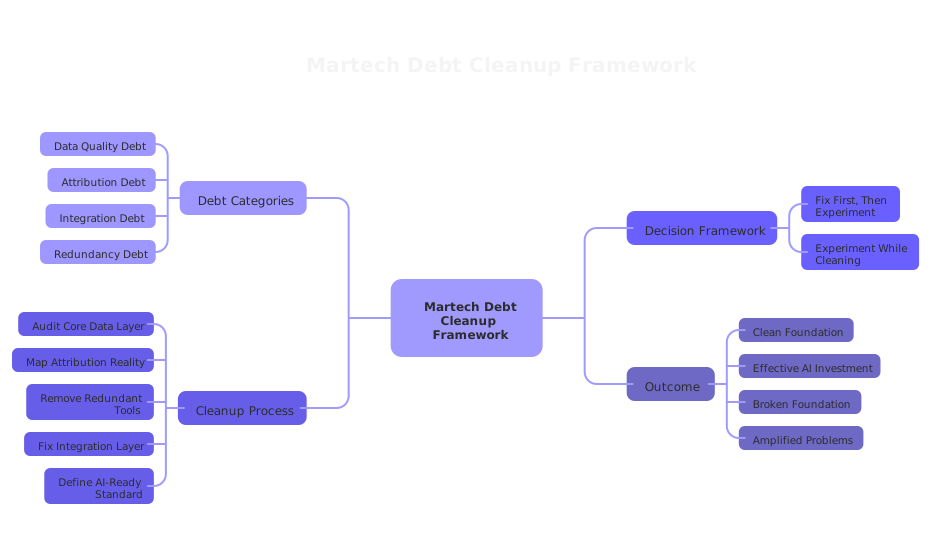
The Four Debt Categories You Need to Audit
Before you can fix martech debt, you need to know what kind you have. There are four main types, and most stacks carry all of them.
1. Data Quality Debt
This is the most common and most damaging. It includes duplicate records, missing fields, inconsistent formats, and stale data that nobody has cleaned in years.
Signs you have it:
- Your email lists have bounce rates above 2 percent
- Sales reps argue about which contact record is correct
- Your CRM has company names in fifty different formats
- You cannot run a reliable report on pipeline by segment
Data quality debt is the first thing AI tools hit. And it breaks them fast.
2. Attribution Debt
Attribution debt is what happens when your measurement does not match reality.
Most teams default to last-click attribution because it is easy to set up. But last-click gives all the credit to the final touchpoint before conversion. That usually means your paid search campaigns look like heroes and your content, email, and social efforts look useless. So you cut the wrong things.
Signs you have it:
- You cannot explain which channels actually drive pipeline
- Marketing and sales argue about where leads come from
- Your reporting changes depending on which tool you pull it from
- Campaign ROI numbers feel inconsistent from month to month
Attribution debt makes AI budget allocation tools actively harmful. They optimize toward flawed signals.
3. Integration Debt
Integration debt is the gap between how your tools are supposed to work together and how they actually work.
It lives in broken webhooks, manual exports, one-way syncs, and "good enough" connections that lose data between systems.
Signs you have it:
- Your team manually copies data between platforms
- A lead can exist in your MAP but not your CRM
- Reports from different tools give different numbers for the same metric
- Nobody fully trusts any single dashboard
Integration debt creates blind spots. And AI tools cannot see through blind spots.
4. Redundancy Debt
Redundancy debt is paying for tools that overlap, duplicate, or contradict each other.
It often comes from team growth, mergers, or just buying new tools without retiring old ones. You end up with two email platforms, three analytics tools, and a CRM that nobody agreed on.
Signs you have it:
- You are not sure who owns which tool
- Multiple teams manage contacts in separate systems
- You have active subscriptions to tools nobody logs into
- Onboarding new people takes forever because the stack is confusing
Redundancy debt is expensive in licensing and even more expensive in team confusion.
The Cleanup vs. Experiment Decision
Here is the framework question most teams skip: should we clean this up first, or can we experiment while we clean?
The answer depends on which type of debt you have and how severe it is.
Fix first, then experiment:
- Data quality debt above a certain threshold (more than 20 percent of records with critical fields missing)
- Attribution debt so severe that you cannot tell which channels drive revenue
- Integration debt that causes data loss between core systems
These are not optional fixes. Running AI experiments on top of them produces misleading results and bad decisions.
Experiment while cleaning:
- Redundancy debt (consolidation can happen in parallel with limited AI pilots)
- Mild integration gaps that affect secondary tools but not core data flow
- Attribution gaps in upper-funnel channels where AI can help surface patterns
The key is to protect the AI pilot from the debt. Run experiments on the cleanest slice of your data. Do not let a messy CRM corrupt a promising AI test.
A Practical Prioritization Framework
When you are ready to act, use this sequence to prioritize cleanup before you scale AI spend.
Step 1: Audit Your Core Data Layer
Start with the data that everything else depends on. That means your CRM and your customer data. Run a basic data quality audit:
- How many duplicate records exist?
- What percentage of contact records have complete fields?
- Is your customer data in one place, or fragmented across systems?
You do not need a perfect CRM to start. You need a clean enough CRM that your AI tools are learning from real signals, not noise.
Step 2: Map Your Attribution Reality
Pull your attribution model into the open. Ask your team: do we trust these numbers?
If the answer is no, that is your debt talking. The fix is not a new attribution tool. It is agreeing on a measurement model, tagging your campaigns consistently, and connecting your data sources properly.
Centralized marketing data is the foundation for any attribution work. If your data lives in five disconnected tools, start by bringing it together before you change how you measure it.
Step 3: Identify and Remove Redundant Tools
Pull your full tool list. For every tool, ask three questions:
- Who owns it?
- Who uses it actively?
- Does it duplicate something another tool already does?
If a tool has no clear owner, no active users, or a clear duplicate, it is a candidate for removal. Consolidation reduces cost and complexity at the same time.
This is also where you create space for AI tools. A lean stack is easier to connect. A lean stack gives AI fewer conflicting inputs.
Step 4: Fix Your Integration Layer
Once you know which tools are staying, audit how they connect. For each core integration, ask:
- Is data flowing both ways or only one way?
- Does a lead that enters through marketing always appear in sales?
- Can you trace a single contact across your full customer journey?
If you cannot trace a contact end-to-end, your AI cannot either. Fix the integration layer before you ask AI to do anything cross-channel.
Step 5: Define Your AI-Ready Data Standard
Before you run any AI experiment, define what "good enough data" means for that specific use case.
For lead scoring: what percentage of records need complete firmographic data?
For email personalization: what behavioral data is required per contact?
For budget allocation: what attribution model do you need in place first?
This step protects your AI investment. It also tells you exactly how much cleanup is required before you spend on a given tool.
What to Do With Your Audit Results
Once you have run through the four debt categories and the five prioritization steps, you will have a clear picture of where you stand.
Most teams find they have more debt than they expected, concentrated in data quality and attribution. That is normal. It does not mean AI is off the table. It means you know what to fix first.
If your debt is severe: Start with data cleanup and integration. Hold AI spend until you have a foundation worth building on. A three-month cleanup period before AI investment often produces better results than a year of AI on broken data.
If your debt is moderate: Run a limited AI pilot on your cleanest data set while cleaning continues in the background. Treat the pilot as a proof of concept, not a production system.
If your debt is low: You are in a good position. Define your AI-ready data standard, pick a focused use case, and move quickly. The advantage of a clean stack is that you learn faster.
What Is the Real Cost of Martech Debt?
The licensing cost of your martech stack is not your biggest cost. The biggest cost is what broken data and fragmented tools do to the decisions you make.
Bad attribution moves budget to the wrong channels. Duplicate CRM records cause sales to contact the same prospect twice. Integration gaps hide revenue patterns that AI could find. Redundant tools create confusion that slows your team down.
These are revenue problems dressed up as technology problems. And they do not get cheaper the longer you wait.
Cleaning up martech debt is not about being tidy. It is about making sure your investments, especially AI investments, actually work.
Frequently Asked Questions
How do I know if I have martech debt?
If your team questions the accuracy of your reports, if your tools do not share data reliably, or if you have subscriptions nobody actively uses, you have martech debt. A structured stack audit will show you exactly where it lives.
Can I use AI to fix my martech debt?
Some AI tools can help with specific tasks like deduplicating records or enriching contact data. But AI is not a substitute for a deliberate cleanup process. You still need to define your data standards, fix your integrations, and align your team on how data gets managed.
How long does martech debt cleanup take?
It depends on the severity and size of your stack. A focused audit and prioritization plan can be completed in weeks. Full cleanup and re-integration work often takes three to six months. Starting with the highest-impact fixes first lets you see results quickly while the broader work continues.
When should I start AI experiments?
Start AI experiments when you have a clean, reliable data set for the specific use case you want to test. You do not need a perfect stack. You need a clean enough slice of data that the AI is learning from real patterns.
Your Next Step
If you are unsure where your martech debt is hiding, start with a stack audit. Not a vendor-led audit designed to sell you something new. A real audit that maps your current tools, tests your data quality, checks your integrations, and identifies where the debt is costing you most.
At House of MarTech, we run these audits as a starting point for almost every client engagement. The patterns are consistent. The solutions are always specific to the business.
If you want help running a martech debt audit before your next AI investment, reach out to the House of MarTech team. We will tell you honestly what we find, and what to do about it.
AI is a real opportunity. But only if the foundation is solid.
Related Articles
Need Help Implementing?
Get expert guidance on your MarTech strategy and implementation.
Get Free Audit