
The New Era of Identity Resolution: How to Achieve a True Single Customer View
Most companies think they have a single customer view. But fragmented data, poor matching, and the wrong tools mean they're often working with an incomplete picture. Here's how to fix that—and why simpler is often smarter.


TL;DR
Quick Summary
The New Era of Identity Resolution: How to Achieve a True Single Customer View
Quick Answer
Imagine you run a coffee shop. A regular customer comes in every Tuesday. Your morning barista knows her name and her usual order. But your afternoon barista has no idea who she is. Your loyalty app shows she hasn't visited in months—because she always pays cash. And your email list has her listed twice, under two different addresses.
You have data about her. Lots of it. But none of it connects. So when you send her a "We miss you!" email, she's sitting at your counter feeling invisible.
This is the identity resolution problem. And it affects businesses of every size—from local shops to global brands.
The good news? There is a smarter way to fix it. And it doesn't require the most expensive software on the market.
What Is a Single Customer View—and Why Is It So Hard to Achieve?
A single customer view means having one complete, accurate record for each customer—across every channel, device, and touchpoint. It sounds simple. In practice, it's one of the hardest problems in marketing technology.
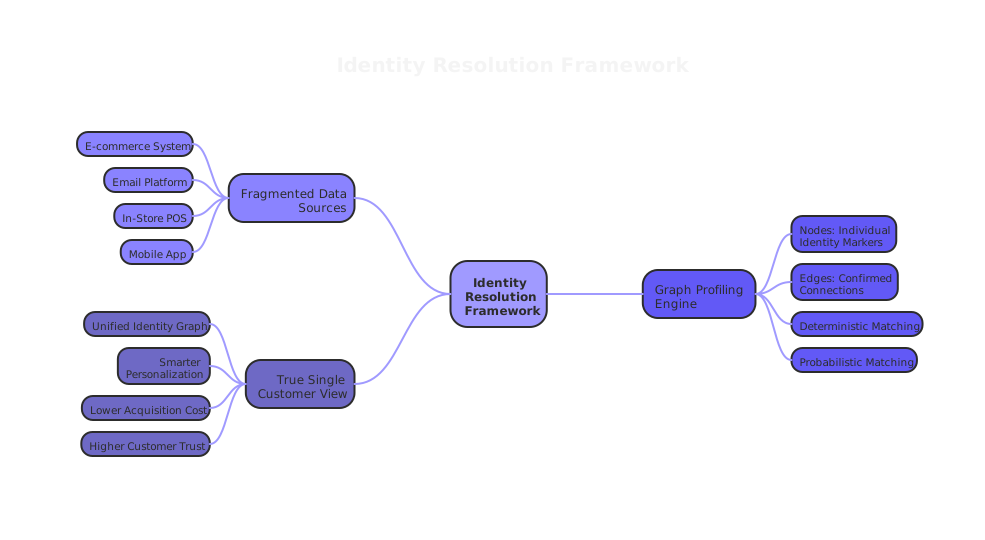
Here's why. Your customer data lives in many places at once:
- Your email platform
- Your e-commerce system
- Your CRM
- Your in-store point of sale
- Your mobile app
- Your customer support tool
Each system has its own ID for the same customer. They don't automatically talk to each other. So the same person can appear as five different "customers" across your tech stack.
Identity resolution is the process of connecting all those separate records together into one accurate profile. When done well, it gives you a true single customer view—so you can personalize experiences, reduce wasted spend, and make smarter decisions.
When done poorly, it gives you false confidence. You think you understand your customer. But you're actually looking at a partial picture dressed up as the full story.
The Problem With How Most Companies Approach This
Most companies start with a tool. They buy a Customer Data Platform (CDP), load in their data, and wait for the magic to happen.
The results are often disappointing.
Industry research shows that only 25% of companies are satisfied with how their CDP assembles customer profiles. Just 22% are happy with the personalization it enables. And nearly 61% of companies have replaced their CDP or data management platform at some point.
That's a lot of investment for very little return.
The core issue isn't the software. It's the sequence.
Most companies try to use technology to solve a problem that's actually about people and processes. If your marketing team, data team, and IT team aren't aligned on what a "customer" means—what counts as a match, how to handle duplicates, which data to trust—no platform will fix that for you.
Data quality problems cause CDP failure at 43% of companies. Misalignment between departments causes it at 39%. These aren't technical issues. They're human ones.
The fix has to start before you open the software.
What Is Graph Profiling—and How Does It Help?
This is where single customer view graph profiling becomes a powerful concept to understand.
Think of a graph as a web of connections. Each dot (called a "node") is a piece of identity data: an email address, a phone number, a device ID, a loyalty card number. Each line (called an "edge") is a confirmed connection between two of those dots.
When you map all those connections together, you get an identity graph—a visual picture of how different identifiers link back to a single real person.
Graph profiling uses this structure to resolve identity. Instead of simply matching records by email address (which misses customers who use multiple emails), graph profiling follows the web of connections. It can link:
- A mobile app login → to a loyalty card → to a home address → to a credit card → to an in-store purchase
Even if none of those data points have a direct match, the graph connects them through shared relationships.
This approach is far more accurate than simple one-to-one matching. And it's especially valuable for customers who interact with your brand across many channels over time.
Two Types of Identity Matching You Should Know
There are two main ways identity resolution works—and the best strategies use both:
Deterministic matching — This uses exact, confirmed data. Same email = same person. Same login ID = same person. High accuracy, but limited reach (only works for known customers who are logged in or identified).
Probabilistic matching — This uses patterns and signals to make educated guesses. Same device + same location + similar behavior = likely the same person. Broader reach, but lower certainty.
A smart single customer view graph profiling strategy uses deterministic matching as the foundation—your first-party data, your known customers—and probabilistic matching only when needed for specific goals.
This keeps your data trustworthy while still expanding your reach.
Why More Data Doesn't Always Mean Better Results
Here's something that surprises a lot of marketers: collecting more data doesn't automatically lead to better customer understanding.
In fact, the opposite is often true.
The companies achieving the best results with identity resolution have made a deliberate choice to collect and use less data—but to use it much more intentionally.
When you try to build a perfect, all-knowing customer profile, a few things go wrong:
- Your data becomes harder to manage. More sources mean more conflicts, more errors, and more maintenance.
- Your costs go up. Many platforms charge by the number of records or API calls—so more data means higher bills.
- Your customers feel watched. Research consistently shows that people find overly personalized messages unsettling. They don't want brands to reflect back everything they know about them. They want to feel understood—not surveilled.
The question worth asking isn't "How do we know everything about this customer?" It's "What do we actually need to know to serve them better?"
That shift in thinking leads to a much smarter single customer view graph profiling implementation.
A Practical Identity Resolution Guide: Where to Start
If you're ready to build a better single customer view, here's a straightforward path forward.
Step 1: Audit Your Current Identity Landscape
Before touching any tool, map out where your customer data currently lives. List every system that holds customer information. Identify the key identifiers each system uses (email, phone, account ID, etc.).
Ask: Where does the same customer appear as different records? That gap is your identity resolution problem in plain sight.
Step 2: Define What "One Customer" Means for Your Business
This is the step most companies skip—and it's the most important one.
Get your marketing, data, and operations teams in a room together. Agree on:
- What data points are required to confidently say "this is the same person"
- How you'll handle edge cases (family members sharing an account, customers using work and personal emails)
- Which data you'll trust first when there's a conflict
Without this alignment, your identity graph will be built on assumptions instead of agreements.
Step 3: Start With Your First-Party Data
Your most reliable identity data is data your customers have given you directly. Email sign-ups. Loyalty program registrations. Account logins. Purchase histories.
Build your identity resolution foundation on this data first. It's accurate, it's consented, and it respects your customers' trust.
Only layer in probabilistic matching or third-party enrichment after you've maxed out what your first-party data can tell you.
Step 4: Choose the Right Architecture for Your Business
Not every business needs an enterprise CDP. In fact, many businesses get better results with a simpler approach:
- Your data warehouse (like BigQuery, Snowflake, or Redshift) holds your unified customer records
- Identity stitching logic lives close to where the data is created—in your marketing automation tool, your e-commerce platform, your CRM
- A lightweight identity resolution layer connects identifiers across systems using deterministic rules first, probabilistic rules second
This "distributed" approach is less glamorous than a single platform. But it's often faster, cheaper, and easier to maintain—especially for mid-sized businesses.
Step 5: Measure What Actually Matters
Most identity resolution projects measure the wrong things. They track match rates and profile completion percentages. Those are technical metrics—not business metrics.
Measure these instead:
- Customer lifetime value — Are unified profiles helping you keep customers longer?
- Campaign response rates — Are you reaching the right people with the right messages?
- Customer acquisition cost — Are you reducing wasted spend on duplicate or misidentified records?
- Retention rates — Are customers coming back more often?
If your identity resolution work isn't moving these numbers, something needs to change.
The Privacy Question: Why Doing Less Can Build More Trust
One of the most important shifts in identity resolution right now is the move toward privacy-first approaches.
New regulations like GDPR and CCPA have changed the rules around customer data. But smart businesses aren't treating privacy as a legal hurdle. They're treating it as a competitive advantage.
Here's why it works:
When customers trust that you're not collecting data you don't need—and not sharing data without permission—they give you more of the data that actually matters. They stay logged in. They fill out preference forms. They opt into loyalty programs. They engage more authentically.
Research backs this up. About 79% of consumers are more comfortable with contextual advertising (based on what you're doing right now) than behavioral advertising (based on everything you've ever done). Brands that respect this preference build stronger relationships.
The single customer view graph profiling best practice for 2026 and beyond isn't to collect everything. It's to collect what you need, protect it well, and be transparent about how you use it.
That transparency is itself a form of connection. And it creates loyalty that no algorithm can replicate.
What Real Transformation Looks Like
One U.S. retailer spent over $3 million annually on an enterprise CDP. After three years, they had a "unified" customer profile—but it only captured about 65% of transactions. Cash purchases, family member purchases, and multi-device behavior fell through the cracks.
More frustrating: marketing campaigns had to funnel through the CDP, creating bottlenecks. The team was waiting days or weeks for data they needed to act on in hours.
They made a change. They moved identity resolution out of the centralized CDP and distributed it across their existing tools—their marketing automation platform, their data warehouse, and their loyalty program system. Less elegant on paper. Far more effective in practice.
Within six months:
- Campaign speed increased by 40%
- Customer acquisition cost dropped by 18%
- Customer lifetime value rose by 12%
The lesson isn't that CDPs are bad. It's that the right architecture for your business depends on your specific situation—not on what a vendor tells you is the industry standard.
Key Takeaways: Building Your Single Customer View the Smart Way
Here's what an effective identity resolution guide comes down to in practice:
- Start with alignment, not software. Get your teams to agree on what a unified customer record means before you pick a tool.
- Use graph profiling to connect the dots. Map identity relationships across systems using deterministic matching first, probabilistic matching second.
- Collect less, use it better. Focus on first-party data your customers have willingly shared. That data is more accurate and more trustworthy.
- Distribute your identity resolution. You don't always need a centralized platform. Sometimes, identity logic embedded in your existing tools works better.
- Measure business outcomes. Match rates are a means to an end. Customer lifetime value, retention, and trust are the end.
- Make privacy your competitive edge. Customers who trust you share more. That's a better foundation than behavioral inference.
Ready to Build a Smarter Customer View?
Identity resolution doesn't have to be overwhelming. It doesn't require the most expensive platform or the most complex architecture. What it requires is clarity—about your customers, your data, and your goals.
At House of MarTech, we help businesses design identity resolution strategies that fit their actual needs. Whether you're starting from scratch, untangling a fragmented data stack, or evaluating whether your current CDP is delivering real value, we can help you build something that works.
Get in touch with our team to talk through your specific situation. No pressure, no jargon—just a practical conversation about what's possible.
Frequently Asked Questions
Get answers to common questions about this topic
Have more questions? We're here to help you succeed with your MarTech strategy. Get in touch
Related Articles
Need Help Implementing?
Get expert guidance on your MarTech strategy and implementation.
Get Free Audit