
Behavioral Lead Scoring: Why Treating Every Lead the Same Costs You Deals
A lead who visited 15 pages and used your comparison tool is not the same as a cold form fill. Without behavioral scoring, your sales team cannot tell the difference.


Listen to summary
0:00 audio overview
Behavioral Lead Scoring: Why Treating Every Lead the Same Costs You Deals
Picture two people walking into a car dealership.
The first browsed your website for 40 minutes. They compared three models, read the financing page twice, and clicked the "Build Your Car" tool. Then they walked in.
The second picked up a flyer from a street stand and wandered in to use the restroom.
Would you send both to the same salesperson with the same pitch? Of course not. But that is exactly what most businesses do with their leads every single day.
Treating every lead the same is not a neutral choice. It is an expensive one.
What Behavioral Lead Scoring Actually Is
Behavioral lead scoring is the practice of ranking leads based on what they actually do, not just who they are.
Traditional lead scoring looks at demographics. Job title, company size, industry, location. These things tell you whether someone could be a good customer. They say nothing about whether that person is ready to buy.
Behavioral lead scoring adds a second layer. It tracks actions. Pages visited. Content downloaded. Emails clicked. Pricing pages viewed. Demo requests submitted. Trial features used.
The combination tells you two things at once: does this person fit your ideal customer profile, and are they showing signs of active interest right now?
One without the other leaves you guessing.
Why Traditional Scoring Breaks Down
Here is the core problem with pure demographic scoring. A VP of Sales at a perfect-fit company scores high. But that VP might have stumbled across your blog post while procrastinating. They are not buying anything.
Meanwhile, a director at a mid-size company visited your pricing page three times this week, compared you against two competitors on review sites, and signed up for your free trial. Traditional scoring might rate them lower because their title is less senior.
Which lead would you rather call?
This is not a hypothetical. It happens in CRMs everywhere. High-scoring leads that go nowhere. Low-scoring leads that close fast. The disconnect happens because the scoring model is measuring the wrong things.
Activity without context is just noise. Behavioral lead scoring adds the context.
The Real Cost of Getting This Wrong
Only 27% of leads sent to sales are actually qualified. That means your sales team is spending most of their time on leads that were never going to buy.
That has a direct cost. Wasted calls. Wasted follow-up emails. Deals that fall through because the right leads did not get called fast enough.
Research consistently shows that following up within the first hour makes a lead significantly more likely to qualify. Yet 70% of prospects are lost due to inadequate follow-up. Not because sales teams are lazy. Because they are buried in low-quality leads and cannot tell which ones deserve urgent attention.
Behavioral lead scoring solves this problem. It surfaces the leads that need a call today, so your team stops working a ranked list and starts working actual intent signals.
How Behavioral Lead Scoring Works in Practice
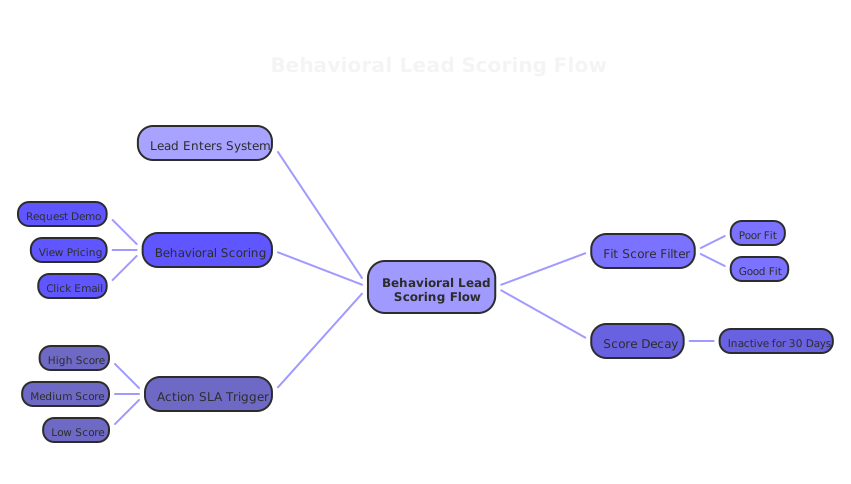
A solid behavioral lead scoring strategy assigns point values to specific actions. Higher-intent actions earn more points. Lower-intent actions earn fewer.
Here is a simple example of how those point values might look:
- Demo or trial request: 25 points
- Pricing page visit: 20 points
- Webinar attendance: 15 points
- Case study download: 10 points
- Email click: 5 points
- Email open: 2 points (and capped low, because email opens are unreliable)
The logic is straightforward. Someone requesting a demo is showing clear buying intent. Someone opening an email might just have image preloading turned on. The scoring model should reflect that difference.
But point values alone are not enough. Two more things matter just as much.
Fit Score as the Gatekeeper
Behavioral engagement means nothing if the person doing the engaging is outside your target market. A student researching your product for a thesis paper might visit 20 pages and score high on engagement. That is not a sales opportunity.
This is why behavioral scoring works best when paired with a fit score. The fit score checks firmographic criteria. Company size, industry, geography, tech stack. It acts as a filter before behavioral signals even matter.
A lead needs to clear the fit threshold before behavioral engagement becomes meaningful. Without that filter, high-activity leads from irrelevant segments flood the pipeline and waste sales time.
Score Decay
A lead that visited your pricing page six months ago and went silent is not the same as a lead that visited yesterday.
Score decay addresses this by reducing scores over time when a lead goes inactive. Practically, this might look like losing 5 points for every 30 days of no engagement. A once-hot lead that has gone cold drops down the priority list automatically.
This keeps your pipeline honest. It forces the system to surface leads showing recent, active interest rather than letting historical scores lock in forever.
The Signals That Actually Predict Buying Intent
Not all behavioral signals are equal. Some actions strongly predict that someone is evaluating a purchase. Others just mean they are curious.
High-intent signals include:
- Visiting the pricing page, especially multiple times
- Requesting a demo or a sales conversation
- Starting a free trial
- Comparing your product against competitors on review sites
- Returning to the site after a period of inactivity
These are actions buyers take when they are solving a specific problem with a real budget and a real timeline. They are worth responding to fast.
Lower-intent signals include blog post views, newsletter subscriptions, and social media clicks. These matter for understanding awareness and interest, but they should not trigger a sales call on their own.
The best behavioral lead scoring implementations put high-intent signals at the top of the hierarchy and build the rest of the model around them.
A Common Mistake That Undermines the Whole System
Many teams build a scoring model and then ignore what happens next.
The score reaches the threshold. A lead lands in the sales queue. And then nothing happens for 48 hours because no one defined a response SLA.
Behavioral scoring without response discipline is like knowing exactly which train to catch and then missing it anyway. The insight has a short shelf life. Buyers who are actively evaluating move fast. If your team responds days after the signal fires, the moment has passed.
Define response times based on score tiers. High-intent leads should hear from someone within the hour, ideally within minutes. Medium-intent leads should enter an automated nurture track immediately. Low-intent leads should be routed to long-cycle nurture, not the sales inbox.
The scoring model tells you what to do. Your SLA framework makes sure it actually gets done.
Behavioral Scoring at the Account Level
Here is something most teams miss. In B2B sales, you are not selling to one person. You are selling to a buying group, often 8 to 11 people who have to reach a collective decision.
Tracking individual lead scores in isolation can mislead you. One enthusiastic contact who scores highly might have zero purchasing authority. Meanwhile, three other people at the same company, including the CFO and the VP of Operations, have quietly been visiting your site.
Account-level behavioral scoring aggregates signals across everyone at the same company. When multiple people from the same organization show engagement across different roles, that is a buying committee activating. That pattern is worth far more than one high-scoring individual.
Sales teams working from account-level behavioral signals stop chasing solo enthusiasts and start targeting actual buying situations. That shift alone can meaningfully shorten deal cycles.
What Good Behavioral Lead Scoring Implementation Looks Like
Starting a behavioral lead scoring implementation does not require a perfect dataset or a sophisticated AI model. It requires clarity about what you are actually trying to measure.
Start with fit criteria. Define your ideal customer profile clearly enough to score against it. Then identify the five to ten behaviors that historically appear in leads that convert. Build your initial model around those behaviors only.
Run it for 60 to 90 days. Then pull the data. Are high-scoring leads actually converting at higher rates? Which behaviors in your model correlated with closed deals, and which ones did not? Adjust the weights based on what you learned.
This iterative approach outperforms a complex model built in isolation. Simple models built on real conversion data beat sophisticated models built on assumptions.
One practical check: ask your sales team which lead types they trust. If they are ignoring the scored leads and working their own list, the model is broken. Sales feedback is the most direct signal you have about whether behavioral scoring is working.
When AI-Powered Scoring Makes Sense
AI-powered behavioral lead scoring can identify patterns in large datasets that rule-based models miss. If you have thousands of leads per year and hundreds of closed deals to train on, a machine learning model can surface non-obvious correlations between specific behavior sequences and conversion outcomes.
But AI scoring has a prerequisite that often goes unmet: clean data.
Models trained on messy CRM data, bot traffic, or unreliable email open signals learn the wrong patterns. They look impressive in testing and degrade in production. A well-built rule-based behavioral scoring model running on clean data will outperform a poorly trained AI model every time.
If your team has fewer than 100 closed deals to train on, or if your CRM data quality is inconsistent, start with rules. Get the data foundation right first. AI lifts you higher from a solid base. It does not fix a broken one.
Making Behavioral Scoring Work Across Your Stack
Behavioral lead scoring only works if the signals your model needs are actually being captured and connected.
Your website needs to track page-level behavior and pass that data into your CRM or marketing automation platform. Email engagement needs to flow into the same system. If you offer a free trial or product, in-product usage signals need to connect too.
These integrations are often the hardest part of a behavioral lead scoring implementation. Data lives in separate tools. Fields do not match. Bot traffic inflates engagement numbers. Cleaning and connecting these sources takes more time than building the scoring model itself.
If you are unsure how to connect behavioral signals across your current stack, that is exactly the kind of problem the team at House of MarTech works through with clients. Getting the data architecture right before building the scoring model saves significant time and avoids the frustration of building on a leaky foundation.
What to Measure Once You Are Live
Running a behavioral scoring model without measuring outcomes is a way to feel busy without knowing if anything is working.
Track these metrics after implementation:
Conversion rate by score band. Are leads in your top tier actually converting at higher rates than leads in the middle tier? If not, your thresholds need adjusting.
Time to close by score band. High-behavioral-intent leads should close faster. If they are not, the signals you are using may not reflect genuine buying readiness.
False positive rate. How often do high-scoring leads fail to qualify on the first call? A high false positive rate means your scoring model is rewarding engagement without fit.
Sales team adoption. Are reps working scored leads first? If they are building their own workarounds, the scoring model is not giving them useful information.
These four metrics tell you whether your behavioral lead scoring strategy is actually improving revenue outcomes, not just generating reports.
The Takeaway
Behavioral lead scoring is not about building a complex system. It is about making sure your sales team knows who to call, when, and why.
Every lead is not the same. The person who visited your pricing page twice this week and downloaded your implementation guide is not the same as someone who filled out a contact form after finding you on Google. Treating them the same wastes your team's time and costs you deals.
Build a scoring model based on actual conversion data. Pair it with clear response SLAs. Check the results against real outcomes. Adjust and repeat.
That process, done consistently, will do more for your pipeline than any single tool or algorithm.
If you want help building a behavioral scoring model that connects to your existing stack and actually reflects how your buyers behave, the House of MarTech team is happy to take a look at what you have and where to start.
Related Articles
Need Help Implementing?
Get expert guidance on your MarTech strategy and implementation.
Get Free Audit