
CAPI Integrations for Marketing Ops
Marketing ops leaders: CAPI fixes signal loss only with aligned teams and data governance. Cut implementation stalls and improve ROAS. A vendor-agnostic guide for your maturity level.


Your ad campaigns are running. Your budget is being spent. But your platform data is showing fewer conversions than you know are actually happening.
That gap is signal loss. And it is quietly draining your ad performance.
The fix most teams reach for is a Conversion API, or CAPI. The problem is that CAPI gets treated like a plugin. Install it, move on. That is not how it works.
CAPI is an operating model decision. And if your marketing ops team does not treat it that way, you will spend real money on a solution that underdelivers.
This guide is for marketing ops leaders who want to get CAPI right, not just get it done.
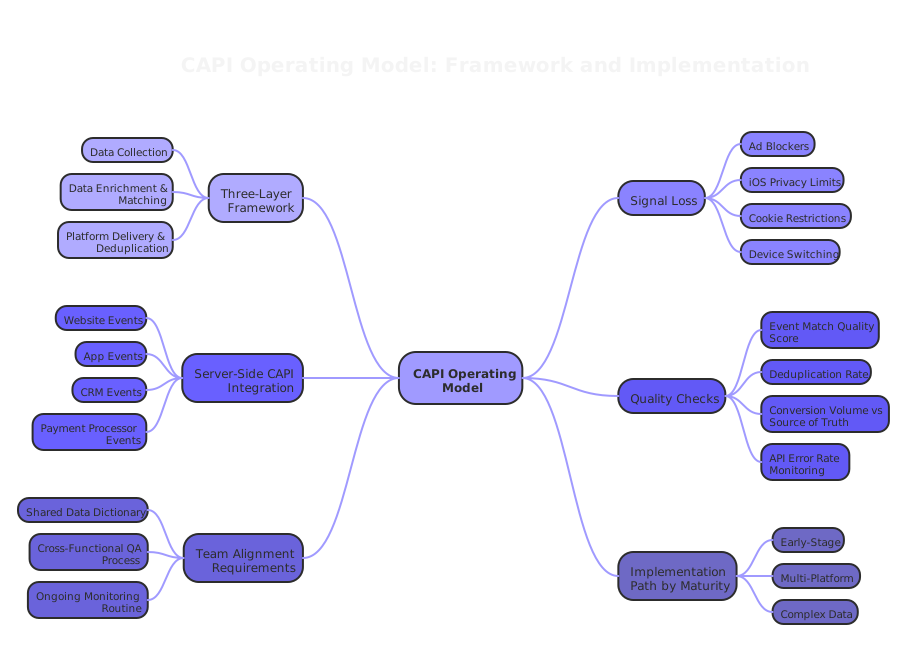
What Is Signal Loss and Why Does It Hurt Your Marketing Ops?
Signal loss happens when conversion events that occur on your website or app do not make it back to your ad platforms.
There are a few reasons this happens:
- Ad blockers prevent browser-based tracking pixels from firing
- iOS privacy changes limit what browsers can report
- Cookie restrictions reduce the window for matching clicks to conversions
- Users switch devices between seeing an ad and converting
The result is that your ad platform sees fewer conversions than actually happened. It then makes optimization decisions based on incomplete data. Your campaigns become less efficient. Your cost per acquisition rises. Your ROAS drops.
This is not a small problem. For many businesses running paid social or search, the gap between reported conversions and actual conversions can be significant. The platforms themselves acknowledge it. Meta, Google, TikTok, and others have all built server-side APIs specifically to address it.
What Is a Conversion API (CAPI)?
A Conversion API is a server-side data connection between your business systems and an ad platform.
Instead of relying on a browser pixel to fire when a user lands on a thank-you page, a CAPI sends conversion data directly from your server to the ad platform's server. Browser restrictions do not affect it. Ad blockers do not stop it.
The event still needs to happen. A purchase, a lead form submission, a phone call. But the reporting of that event travels through a more reliable channel.
Most major ad platforms now offer their own CAPI:
- Meta Conversions API
- Google Enhanced Conversions
- TikTok Events API
- Pinterest API for Conversions
- Snapchat Conversions API
- LinkedIn Conversions API
Each one has its own requirements, its own data schema, its own deduplication logic. That complexity is where most marketing ops implementations run into trouble.
Why CAPI Implementation Stalls (And What to Do About It)
Here is a scenario that plays out constantly at mid-market and enterprise companies.
A growth team sees signal loss in their Meta reporting. They bring in a developer or an agency to implement Meta CAPI. The implementation goes live. Reporting improves slightly. Then someone asks about Google Enhanced Conversions. Then TikTok. Then Pinterest.
Suddenly there are four separate CAPI integrations, each maintained independently, each sending slightly different event data, each requiring its own QA when something breaks.
The ops team is spending more time managing integrations than running campaigns.
This is the one-size-fits-all trap. Each platform pushes its own CAPI solution. That is reasonable from their perspective. It is not reasonable as an operating model for your business.
The fix is to treat CAPI as infrastructure, not a campaign tactic.
That means:
- Centralizing where your conversion events are collected and enriched
- Sending from that central layer to each ad platform
- Building deduplication logic that works across platforms
- Owning the data schema so it does not break when a platform changes its requirements
The Three Layers of a Working CAPI Operating Model
Good marketing ops is not about tools. It is about how your team, your data, and your tools work together. CAPI is no different.
Here are the three layers that determine whether your CAPI implementation actually performs.
Layer 1: Data Collection
This is where events originate. Your website, your app, your CRM, your payment processor. Every conversion event needs a reliable trigger.
The question to answer here: Do you have consistent, clean event data coming from all the places conversions happen?
If your purchase event fires from Shopify but not from your subscription billing system, you have a gap. If your lead form event fires in some browsers but not others, you have a gap.
Before you connect anything to an ad platform, your event data needs to be reliable at the source.
Layer 2: Data Enrichment and Matching
Ad platforms use customer matching to connect your server-side events to their users. They look for signals like email address, phone number, first name, last name, and IP address.
The more matching signals you send, the higher your match rate. The higher your match rate, the more conversions get attributed.
This is where many CAPI setups leave performance on the table. They send the event but not the customer data. Or they send the data in the wrong format. Meta, for example, requires emails to be hashed in SHA-256 format before sending.
Your marketing ops team needs to define what data gets collected at conversion, how it gets normalized, and how it gets hashed before it reaches the API.
Layer 3: Platform Delivery and Deduplication
Each ad platform needs to receive the event. But it also needs to know if it already received that event from your browser pixel.
Deduplication is the process of telling the platform: this server event and this pixel event are the same conversion. Do not count it twice.
If you get deduplication wrong, your conversion numbers inflate. Your optimization signals become noisy. Your campaigns optimize toward the wrong things.
Every platform handles deduplication differently. Meta uses event IDs. Google uses transaction IDs and gclid parameters. Getting this right requires understanding each platform's logic, not just wiring up the API.
What Is the Right CAPI Tool for Your Marketing Ops Team?
This is where teams often want a simple answer. Use this platform. Buy this tool.
The honest answer is: it depends on your maturity level and your stack.
Here is a practical way to think about it.
If you are early-stage or have one or two ad platforms:
A native CAPI integration for your primary platform may be enough. Shopify has a native Meta CAPI connection. Many platforms have Google Enhanced Conversions built into their checkout. Start there and QA it well.
If you are running three or more ad platforms:
A customer data platform or tag management solution that supports server-side event forwarding makes more sense. Tools in this category include options from Tealium, Segment, and others. The goal is one event collection layer that routes to multiple platforms. You are not picking a winner here. You are picking the approach that fits your team's technical capacity and your data governance requirements.
If you have complex data sources (CRM, offline, phone):
You need a more robust solution that can ingest events from multiple systems, enrich them with customer data, and deliver them reliably. This is where custom server-side implementations or enterprise CDPs become relevant.
At House of MarTech, we work with clients across all three levels. The first thing we do is audit what is actually firing, not what is supposed to be firing. The gap between those two things usually tells us everything we need to know about where to start.
How to Know If Your CAPI Is Actually Working
Most teams assume CAPI is working because they turned it on. That is not the same as confirming it is working.
Here are the checks that matter:
Event Match Quality Score (Meta)
Meta gives you an Event Match Quality score in Events Manager. A score below 6 means your matching signals are weak. Improving your data enrichment at Layer 2 is usually the fix.
Deduplication Rate
If you are running both pixel and server events, your platform should show you how many events were deduplicated. If that number is zero, something is off. Either your browser pixel is not firing, or your deduplication IDs are not matching correctly.
Conversion Volume Comparison
Compare conversions reported in your ad platform to conversions in your source of truth, whether that is your CRM, your analytics platform, or your order management system. A large gap in either direction is a signal worth investigating.
API Error Rates
Your server-side integration should be logging API responses. A high error rate means events are being rejected by the platform. This is often a data formatting issue.
The Team Alignment Problem Most Marketing Ops Guides Skip
CAPI is not a marketing project. It is not a developer project. It is both, at the same time.
The reason most CAPI implementations underperform is not technical. It is organizational. Marketing does not know what the developer built. Developers do not know why certain data fields matter to ad performance. Neither team has a shared definition of what a conversion event should contain.
The operating model behind reliable activation requires three things:
- A shared data dictionary. What does a "purchase" event mean? What fields are required? Who owns maintaining that definition?
- A QA process that marketing and engineering both participate in. Not just a developer checking that the API call succeeds, but a marketer checking that the right events are firing for the right scenarios.
- A monitoring routine. CAPI integrations break. Platforms update their APIs. Your site changes. Someone needs to own checking that everything is still working on a regular cadence.
This is marketing ops work. It is not glamorous. But it is what separates teams that get reliable signal from teams that are always chasing mystery gaps in their data.
FAQ: CAPI Integrations for Marketing Ops
Does CAPI replace the browser pixel?
No. The recommended approach is to run both in parallel. The browser pixel captures what it can. The server-side CAPI fills in what the pixel misses. Deduplication logic prevents double-counting.
Do I need a different CAPI for each ad platform?
Each platform has its own API, but you do not need a separate implementation for each one. A centralized server-side layer can send to multiple platform APIs from a single event stream.
How long does CAPI implementation take?
For a single platform with clean event data, a basic implementation can take days. For a multi-platform setup with CRM and offline data integration, a proper implementation with QA and monitoring typically takes several weeks.
Will CAPI fix all my attribution problems?
No. CAPI improves signal completeness. It does not solve all attribution questions, especially across channels. It is one part of a broader measurement strategy.
Where to Start
If you are reading this because your ad performance has been declining and you suspect signal loss, here is a simple starting point.
Open Meta Events Manager or your equivalent platform diagnostic tool. Look at your event match quality and your deduplication data. That will tell you immediately whether you have a gap worth addressing.
If the data confirms a problem, the next step is an audit of what is actually firing versus what your setup assumes is firing.
That audit is something the team at House of MarTech does regularly for clients. Not to sell them a platform, but to give them a clear picture of what is working, what is not, and what the realistic fix looks like for their team's capacity.
CAPI is not a silver bullet. But when it is implemented with the right operating model behind it, it is one of the most reliable improvements a marketing ops team can make to their paid media performance.
The signal was always there. The work is making sure it gets where it needs to go.
Related Articles
Need Help Implementing?
Get expert guidance on your MarTech strategy and implementation.
Get Free Audit