
Cross-Vertical Audience Activation: Using Existing Customer Data to Launch New Business Lines
When expanding into a new vertical, you start with zero pixel history and maximum CPL. Unless you activate your existing first-party audience. A CDP framework for cross-vertical market entry.


Listen to summary
0:00 audio overview
Cross-Vertical Audience Activation: Using Existing Customer Data to Launch New Business Lines
Picture this. You run a successful home security business. You decide to launch a smart home device line. Your paid media team sets up new campaigns. Cost per lead is brutal. Every dollar works harder than it should because the algorithm knows nothing about your new audience yet.
Meanwhile, you already have thousands of customers who bought your security cameras, set up monitoring apps, and opted into SMS alerts. They are comfortable with smart home tech. They trust your brand. They have already told you, through their behavior, that they value connected home products.
That data sits in your CRM. Unused for the new launch.
This is the gap that cross-vertical audience activation closes. You use what you already know about your existing customers to enter new markets faster, cheaper, and with more confidence.
What Is Cross-Vertical Audience Activation?
Cross-vertical audience activation means taking your existing first-party customer data and using it to find, target, and convert audiences for a new business line or product category.
It is not about spamming your current customers with offers they did not ask for. It is about identifying which customer signals transfer across categories, then building smart activation strategies around those signals.
Done well, it gives your new business line a head start that paid acquisition alone cannot buy.
Why Most Launches Ignore the Data They Already Have
Most companies treat a new vertical like a fresh start. New brand, new campaigns, new audiences. Zero history.
This feels like the right move. The new product is different, so why use old data?
Because your customers are not different. The same person who bought your security package may be your best prospect for your smart device line. But nobody connected those dots.
The reason this happens comes down to how data gets organized inside companies. Customer data lives in department silos. The marketing team owns behavioral data. The sales team owns CRM records. The product team has usage data. Nobody has a full picture, and nobody has a clear process for sharing insights across business units.
A customer data platform, or CDP, solves this. It pulls those sources together into unified customer profiles. But owning a CDP is not the same as activating it well. Many companies collect the data and still fail to use it for strategic expansion. The platform is set up. The data is there. The activation never happens.
That is the real problem.
The Three Data Types That Power Cross-Vertical Activation
Effective cross-vertical audience activation strategy depends on combining three distinct data types. Each one tells a different part of the story.
1. Behavioral Data (What Customers Do)
This is the foundation. Purchase history, product usage patterns, session frequency, feature adoption, support interactions. Behavioral data shows you which customers are actively engaged and how they engage.
When expanding into a new vertical, look for behavioral signals that suggest a customer is ready for adjacent offerings. A customer who explores premium features, purchases at high frequency, or upgrades voluntarily is showing you something important about their values.
2. Declared Data (What Customers Say)
Also called zero-party data. This is information customers share directly with you. Survey responses, preference settings, communication choices, product wishlists.
Declared data is powerful because it removes guesswork. If a customer tells you they care about sustainability, you do not need to infer it from their purchase history. You know it. And you can activate it.
For new verticals, ask existing customers direct questions that reveal adjacent interest. A short preference survey tied to a loyalty reward can generate insights worth far more than weeks of behavioral analysis.
3. Contextual Signals (What Is Happening Around Them)
Real-time circumstances that affect customer decision-making. Seasonal patterns, geographic signals, device usage, time-of-day engagement. These signals tell you when a customer is most receptive, not just whether they are a good prospect.
No single data type is enough on its own. The strongest cross-vertical audience activation combines all three.
A Practical Framework for Cross-Vertical Activation
Here is a step-by-step approach that works for most business expansions. It is not a rigid formula. Treat it as a starting checklist.
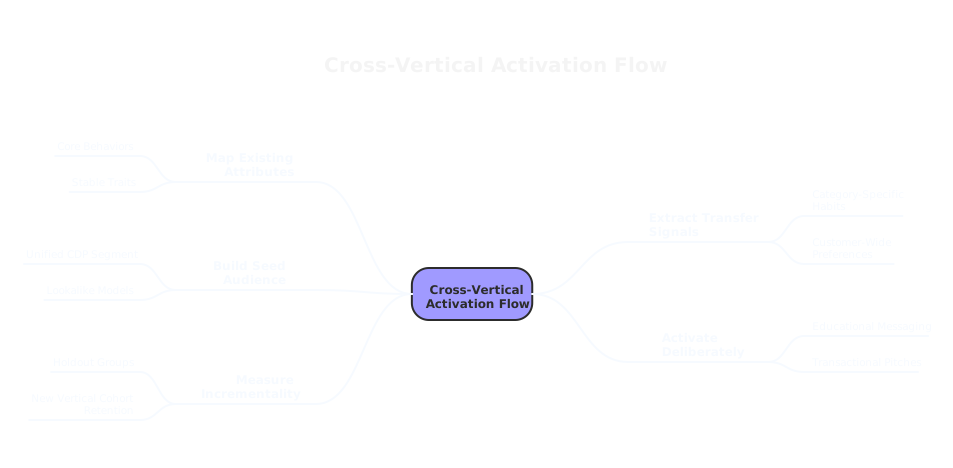
Step 1: Map Your Existing Customer Attributes
Before you touch activation, understand what your existing customers actually look like. Not demographics. Attributes.
What product features do they use most? What problems brought them to you? What values show up consistently in their behavior and preferences?
Attribute-based segmentation is more useful than demographic segmentation here. A customer who consistently buys hypoallergenic skincare products is telling you something about their priorities that transfers across categories. Age and income do not.
Look for the attributes that feel stable across contexts. Those are the signals most likely to transfer to a new vertical.
Step 2: Identify the Transfer Signals
Not every insight about your current customers will apply to a new business line. Some signals are category-specific. Others are customer-specific.
Category-specific signals: A customer buys protein powder every four weeks. That tells you about supplement buying behavior, not general purchasing behavior.
Customer-specific signals: A customer consistently chooses premium options, sets up automated reordering, and engages with educational content. That tells you about how they approach purchases in general.
Customer-specific signals transfer across verticals. Category-specific signals usually do not.
Spend time here. Talk to your best customers directly. Ask them what problems they are managing outside your current product category. Advisory conversations with real customers will surface insights that no amount of behavioral data will reveal on its own.
Step 3: Build Your Seed Audience
Once you have identified the transfer signals, build a seed audience inside your CDP. This is the group of existing customers most likely to respond positively to your new vertical offering.
Keep this group tight. Better to start with a smaller, highly qualified list than a broad audience that dilutes your signals.
Your seed audience serves two purposes. First, it gives you an initial activation target for direct outreach or campaigns. Second, it gives you the data you need to build lookalike audiences for paid acquisition in the new vertical.
A tight, well-defined seed audience generates far more useful lookalike models than a broad, loosely defined one.
Step 4: Choose the Right Activation Channel and Timing
Real-time activation is not always the right answer. For retention and upsell within existing products, fast response matters. But for cross-vertical expansion, customers often need more time to process a new category.
Do not trigger a new product offer the moment a customer finishes a transaction in your core category. That feels transactional. It rarely converts well for genuinely new offerings.
Instead, build a deliberate communication sequence. Introduce the new category in the context of their existing relationship with you. Explain why it fits. Give them time to consider before asking for a conversion.
Email and direct mail work well here because they allow for more narrative than a banner ad or push notification. Reserve paid retargeting for customers who have already shown some signal of interest in the new category.
Step 5: Measure with the Right Method
Standard last-click attribution will mislead you in a new vertical. You have no baseline. You do not know what normal looks like yet.
Use incrementality testing instead. Set up a holdout group from your seed audience. Activate the rest. Compare outcomes between the two groups. This gives you a true measure of what your activation is actually driving versus what would have happened anyway.
Combine this with simple cohort tracking. Group your early adopters from the new vertical and monitor their behavior over 60 to 90 days. Are they behaving like your best core customers? If yes, your cross-vertical activation is working.
The Governance Problem Nobody Warns You About
Here is where most cross-vertical activation efforts quietly fail.
The data exists. The CDP is running. The strategy is sound. But the new business unit cannot get access to customer data from the core business unit. Or the governance policy is unclear. Or legal is nervous about using existing customer consent for a new product category.
These are not technology problems. They are organizational problems.
You need explicit rules that answer these questions before you start:
- Which customer data can be shared across business units?
- What consent do you need before activating existing customers for a new category?
- Who approves access requests from new business teams?
If you do not establish these rules in advance, the activation stalls in internal debate. Get your legal, privacy, and marketing operations teams aligned before you build anything.
At House of MarTech, we help clients build these governance frameworks as part of CDP implementation and expansion planning. The technology is the easier half. The governance is where the real work happens.
Second-Party Partnerships Accelerate What First-Party Data Starts
Your own customer data is the foundation. But it has limits. It tells you about people who already know you.
Second-party data partnerships extend your reach. A second-party partnership means you gain access to another company's first-party data through a direct arrangement. You get their audience signals. They get yours. Both parties activate against combined intelligence.
This is particularly powerful for cross-vertical expansion because your partner may already serve the customers you are trying to reach in the new category.
An example: a fitness equipment brand expanding into nutrition supplements might partner with a wellness app. The app's users have already declared interest in health outcomes. The equipment brand's customers have already demonstrated investment in physical fitness. The overlap tells both companies something valuable.
Start small with these partnerships. Test the data quality. Validate that the signals from the partner actually predict conversion in your new vertical before building a full program around them.
What Cross-Vertical Activation Best Practices Actually Look Like in Practice
Netflix is the clearest example of a company that treats customer data as the core of its business, not a support function. When launching new content categories, Netflix does not start from zero. It uses viewing behavior, completion rates, and genre preferences from existing subscribers to predict which new categories will resonate with which segments.
They cut multiple versions of trailers for the same show, targeted to different viewer segments based on what those viewers have already watched. A viewer who watches political dramas gets a different cut than a viewer who watches director-driven films.
This is cross-vertical audience activation applied to content. The underlying principle is identical to what any business should do when launching a new product line. Use what you know about existing customers to make smarter decisions about how to introduce something new.
You do not need Netflix's scale to apply this logic. You need a unified customer profile, clear transfer signals, and a deliberate activation plan.
The Questions Worth Asking Before You Launch
Before your team builds the first audience segment for a new vertical, answer these questions honestly.
Do you have a unified customer profile, or is your customer data still scattered across multiple systems? If it is scattered, your activation plan will not work until the data infrastructure is in place.
Do you know which customer attributes are stable across contexts, or are you assuming your current customers will naturally want the new product? Assumption is expensive. Research is cheap by comparison.
Do you have governance rules in place for sharing customer data across business units? If not, build them first.
Are you measuring incrementality, or are you measuring activity? Activity metrics (opens, clicks, impressions) tell you the campaign ran. Incrementality tells you whether it worked.
If you can answer those questions confidently, your cross-vertical audience activation strategy has a real foundation to build on.
Where to Start
Cross-vertical audience activation is not a single campaign. It is a capability you build over time.
Start with your customer data. Audit what you have, where it lives, and how unified your customer profiles actually are. If there are gaps, fix those before building activation programs on top of fragmented data.
Then identify three to five customer attributes from your existing base that feel like genuine transfer signals. Talk to real customers. Combine what the data shows with what customers tell you directly.
Build a small seed audience. Test activation in one channel with an incrementality holdout. Measure the real impact before scaling.
If you want a clear picture of where your current customer data infrastructure stands relative to what cross-vertical activation requires, that is exactly the kind of assessment we run at House of MarTech. The gaps are usually specific and fixable. You just need to know where they are before you build.
Related Articles
Need Help Implementing?
Get expert guidance on your MarTech strategy and implementation.
Get Free Audit