
The Golden Record: Defining a Unified Customer Profile Before You Buy a CDP
Before evaluating CDP vendors, define what a complete customer profile looks like for your business. The Golden Record exercise surfaces gaps no vendor demo will show you.


Listen to summary
0:00 audio overview
The Golden Record: Defining a Unified Customer Profile Before You Buy a CDP
Most CDP projects fail before the contract is signed.
Not because the vendor was wrong. Not because the technology was bad. They fail because the organization never answered the most basic question: what does a complete customer profile actually look like for us?
That question sounds simple. It is not.
A home improvement retailer might need to know if a customer shops online, in-store, or both. A SaaS company needs to know which users belong to which accounts. A healthcare brand needs to separate household members who share an address. Each of those businesses has a different answer to "who is the customer," and that answer should drive every technology decision that follows.
The Golden Record exercise forces that answer before you open a single vendor proposal.
What Is a Golden Record Customer Profile?
A golden record customer profile is a single, unified view of one customer built from every data source your business owns.
It combines what you know from your CRM, your email platform, your website analytics, your purchase history, your support tickets, and any other system that touches the customer. When it works, you stop seeing the same person as five different records across five different tools. You see one person, clearly.
The term comes from data management. In older database work, the "golden record" was the one authoritative version of a record after duplicates were removed and conflicts were resolved. The same idea applies here. You pick the best, most complete, most accurate version of each customer and make that the foundation for every decision.
This is what a Customer Data Platform is designed to store and maintain. But here is the problem most vendors will not tell you: buying the CDP does not build the golden record. Your organization has to define it first.
Why Most Teams Skip This Step
Vendor demos are compelling. You see a dashboard with a beautiful customer timeline. Clicks, purchases, emails opened, support calls, loyalty points. It all flows together cleanly.
That demo was built on clean, pre-configured sample data. Your data is not that.
Your data has duplicates. It has missing fields. It has customers who gave you three different email addresses over five years. It has loyalty IDs that do not match CRM IDs. It has in-store purchase records that are not connected to any online account.
When teams skip the golden record definition exercise and go straight to vendor selection, they carry all of that mess into the new platform. The CDP becomes a mirror that reflects the chaos rather than a tool that resolves it.
Nearly half of CDP implementations report significant failure. The most common reasons cited are not technology problems. They are organizational problems: no cross-functional alignment, no journey-oriented thinking, no clear ownership of data quality. All of those trace back to one root cause. The team never defined what they were building.
The Golden Record Exercise: How to Do It
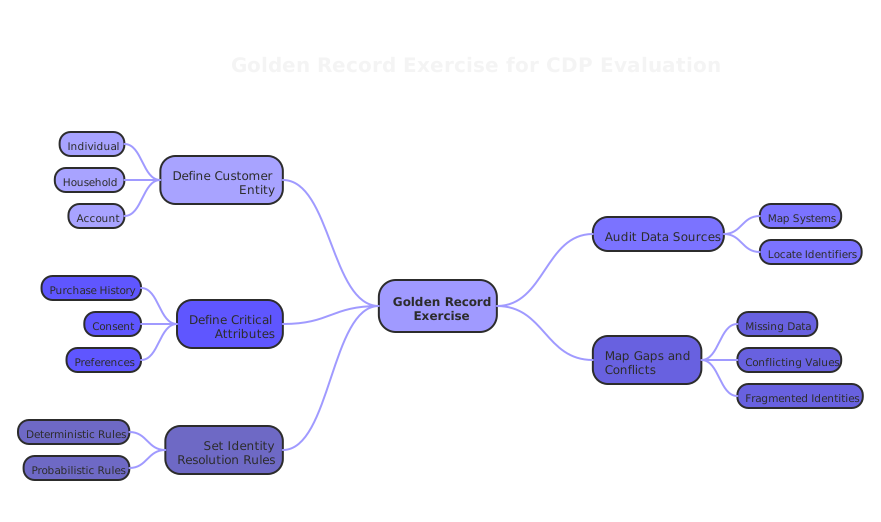
This is not a technology project. It is a business conversation. Here is how to run it.
Step 1: Define What "Customer" Means for Your Business
Before you think about data, define the entity you want to track.
For a direct-to-consumer brand, the customer is usually an individual person. For a B2B company, it might be a contact within an account, and you need both the person record and the company record. For a retail brand with family loyalty programs, you might need to decide if a household is one customer or several.
Get your marketing, sales, and service teams in a room. Ask them: who is our customer? You will get different answers. That is the point. Resolve those differences before you touch any technology.
Step 2: List Every Data Source That Touches the Customer
Write down every system that collects customer information. Common ones include:
- CRM (Salesforce, HubSpot, or similar)
- Email service provider
- E-commerce platform
- Point of sale system
- Loyalty program database
- Customer support platform
- Website analytics
- Mobile app events
- Paid media platforms
- Survey or review tools
For each source, note what identifier it uses to recognize a customer. Email address? Phone number? A custom loyalty ID? A device ID? This step alone usually reveals why you have duplicates. Every system uses a different identifier, and nobody ever mapped them together.
Step 3: Define the Attributes That Matter
Now ask: what do we actually need to know about each customer to serve them well?
This is your golden record customer profile template. A basic version might include:
- Full name and contact details
- Purchase history (online and offline)
- Current loyalty tier and points balance
- Last channel interaction (email, web, in-store)
- Product categories browsed or bought
- Customer service history
- Communication preferences and consent status
A more advanced version adds predictive attributes: likelihood to churn, predicted next purchase category, lifetime value estimate.
Do not let this list get aspirational. Focus on what you will actually use in the next six months. Unused attributes create complexity without payoff.
Step 4: Identify the Conflicts and Gaps
Now compare your ideal profile against your actual data. Ask three questions for each attribute.
Do we have this data? If yes, in which system? If it lives in multiple systems, which version do we trust?
This exercise typically reveals three categories of problems. The first is missing data, where attributes you need simply do not exist anywhere. The second is conflicting data, where two systems have different values for the same attribute and you have no rule for which one wins. The third is fragmented identity, where the same customer exists in multiple systems but there is no common identifier linking the records together.
Write all of this down. This is not a problem list to be embarrassed by. It is a requirements document for your CDP evaluation.
Step 5: Define Your Identity Resolution Rules
Identity resolution is the process of linking different records to the same person.
Your rules determine how that linking happens. For example: if two records share the same email address, treat them as the same person. If two records share the same phone number and same last name, treat them as the same person. If two records share a device ID but different email addresses, they might be different people sharing a device.
These rules are business decisions, not technology decisions. The CDP will execute whatever rules you give it. You have to define them.
There are two main approaches. Deterministic matching links records based on exact matches on known identifiers, like email or phone. It is precise but will miss links where identifiers differ. Probabilistic matching uses algorithms to infer connections based on behavioral patterns and partial matches. It finds more links but can occasionally connect the wrong records.
Most organizations need both. Deterministic matching handles the clear cases. Probabilistic matching handles the fuzzy ones.
The important part: agree on your rules before evaluating vendors. Then test each vendor against your actual data, not their sample data.
The Golden Record Customer Profile Strategy: Before vs. After CDP
Here is the difference between organizations that succeed with CDPs and those that do not.
Organizations that fail buy the CDP first. They import their data, discover the mess, and spend months trying to clean it inside the platform. They never reach the use cases they bought the platform for. Stakeholders lose confidence. The project stalls.
Organizations that succeed do the golden record exercise first. They know exactly what their unified profile should contain. They have resolved the identity conflicts on paper. They have assigned data ownership. They arrive at vendor evaluation with a clear requirements document, and they evaluate platforms against their real data rather than a polished demo.
The golden record customer profile strategy is simply this: define the output before you shop for the tool.
What This Means for Vendor Evaluation
Once you have completed the golden record exercise, vendor evaluation becomes straightforward.
You are not comparing feature lists. You are testing whether each platform can execute your specific requirements.
Take your actual messy data. Give it to each vendor in a proof-of-concept. Measure their identity resolution accuracy against your defined rules. Check whether they can ingest all of your source systems. Confirm that the unified profile they build matches the template you defined.
You will quickly find that vendors who look identical on paper perform very differently on your data.
Also check three things that vendor demos rarely show. First, how does the platform handle conflicting attribute values? When your CRM says a customer is in California and your e-commerce platform says they are in New York, what does the profile show and why? Second, how does the platform manage consent? If a customer opts out of email in your ESP, does that preference propagate to the unified profile instantly? Third, how does the profile update when a customer changes their email address or phone number? Temporal stability matters more than it gets credit for.
The Data Quality Problem You Have to Solve Upstream
One number will change how you approach this entire project.
Industry research consistently shows that 30 percent or more of CRM records are duplicates in a typical mid-market database. Some organizations discover rates as high as 43 percent. That means nearly half of your customer records may represent someone you already know under a different identifier.
No CDP fixes this for you. The platform will ingest your duplicates and try to merge them, but if the underlying source systems keep generating duplicates, the problem restores itself.
The solution is upstream. You need data quality rules at the point of entry, not just at the point of consolidation. That means working with your CRM admin, your e-commerce team, and your point-of-sale team to standardize how customer records are created and updated.
This work is unglamorous. It does not appear in vendor ROI calculators. But it is what separates a golden record customer profile that stays golden from one that degrades within months of launch.
Common Mistakes and How to Avoid Them
Defining the profile by what data you have, not what you need. This produces a profile that is comprehensive but strategically irrelevant. Start with use cases, then work backward to required attributes.
Skipping consent and privacy mapping. Every attribute in your profile has a consent chain: where was it collected, what did the customer agree to, what are you allowed to do with it? Map this during the golden record exercise, not after. GDPR, CCPA, and similar regulations make this non-negotiable.
Assigning ownership to nobody. Unified profiles degrade without ongoing stewardship. Someone needs to own data quality, identity resolution accuracy, and profile completeness as an ongoing responsibility, not a one-time project.
Building the profile for marketing only. The most durable golden records serve marketing, sales, service, and product teams. When multiple teams use and maintain the profile, data quality improves because more people have an incentive to keep it accurate.
Treating the golden record as permanent. Customers change. They move, change email addresses, change household composition, and change purchasing behavior. Your profile needs to evolve continuously, not freeze at a point in time.
Golden Record Customer Profile Best Practices
A few principles that hold across every implementation we have seen at House of MarTech.
Start narrow. Define a profile for one customer segment or one use case before expanding. A complete profile for your top 20 percent of customers is more valuable than an incomplete profile for everyone.
Measure match rate and profile completeness from day one. If your identity resolution matches 60 percent of records in month one, you have a benchmark. If it drops to 52 percent in month three, something in your source data changed. You need to know that quickly.
Build the feedback loop. When a customer service agent corrects a customer record, that correction should flow back to the unified profile. When a customer updates their preferences in your email platform, the profile should reflect it. The golden record is only golden if it stays current.
Treat zero-party data as premium. Zero-party data is information customers give you directly, like preference survey responses, stated interests, and explicit communication choices. This data is the most accurate and the most trusted by customers. Build mechanisms to collect it and prioritize it in your profile logic.
What Comes Next
If you run the golden record exercise and find your data is messier than expected, that is not a reason to delay. It is a reason to start the governance work before adding a new platform to the mix.
At House of MarTech, we help organizations run this exercise as part of a broader CDP readiness assessment. We look at your data sources, your identity conflicts, your governance gaps, and your organizational alignment, then give you a clear picture of where you stand before any vendor conversation begins.
The goal is simple. When you do sit down with a vendor, you know exactly what you are buying, exactly what you need it to do, and exactly how to measure whether it is working.
That clarity is worth more than any feature comparison chart.
Related Articles
Need Help Implementing?
Get expert guidance on your MarTech strategy and implementation.
Get Free Audit