
How to Present CDP Strategy to a CMO: Framing for Business Impact
Technical depth does not impress a CMO. Business impact does. How to frame CDP strategy for executive stakeholders who care about speed, revenue, and team formation.


TL;DR
Quick Summary
Listen to summary
0:00 audio overview
How to Present CDP Strategy to a CMO: Framing for Business Impact
Quick Answer
Picture this. Your team has spent weeks evaluating customer data platforms. You know which vendor wins on identity resolution. You can explain the difference between batch ingestion and real-time streaming. You have the connector count memorized.
Then you walk into the CMO's office.
She listens for four minutes. Then she asks: "What does this actually do for our revenue?"
You lose the room.
This happens constantly. The CDP presentation to CMO conversations that fail are almost always the same: technically thorough, strategically empty. The ones that succeed start in a completely different place.
Here is how to frame CDP strategy so it lands.
Stop Selling the Technology. Sell the Problem It Solves.
A CMO does not wake up thinking about identity resolution or data ingestion pipelines. She wakes up thinking about three things: why campaigns take too long to launch, why she cannot explain customer behavior across channels, and why marketing cannot prove its revenue contribution to the board.
Your CDP presentation needs to start there.
Before you mention a single platform or feature, name the specific operational pain your organization is living right now. Be exact.
"It currently takes our team six weeks to build a new audience segment and get a campaign live. Our closest competitor can do that in two days."
That sentence earns attention. It connects technology investment to competitive reality. It makes the CMO feel seen, not lectured.
The most effective CDP presentation to CMO conversations open with business pain, not platform capability.
Build the Economic Case in Three Layers
One ROI number is not enough. It flattens a multi-year investment into a single figure that finance will challenge and boards will dismiss.
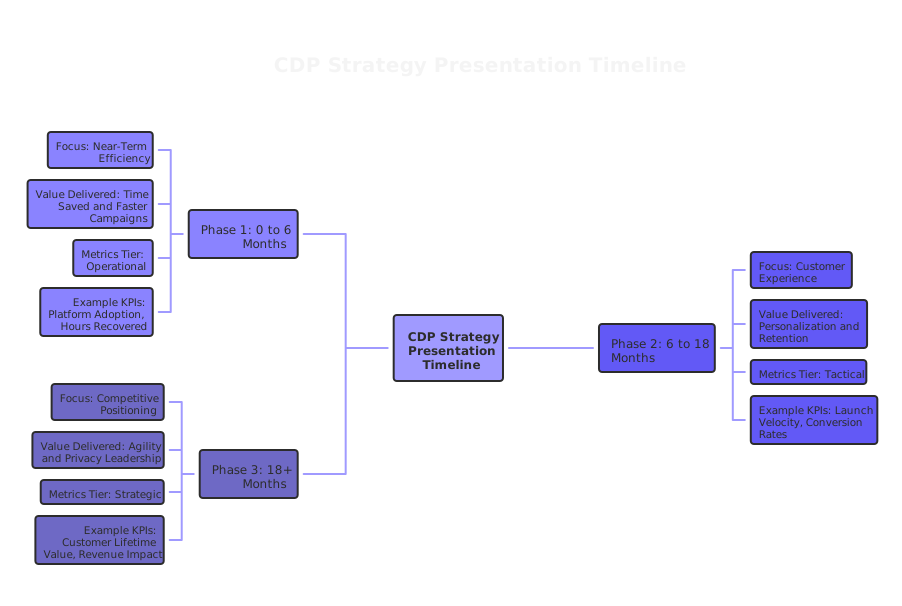
Instead, present value in three time layers.
Layer one: Near-term efficiency (0 to 6 months). This is about time saved. If your marketing team spends 40 hours a week pulling data from disconnected systems to prepare campaigns, and a CDP cuts that to 10 hours, you have recovered 30 hours of skilled labor per week. Put a dollar figure on that. It is real, it is near-term, and it requires no assumptions about conversion lift.
Layer two: Customer experience impact (6 to 18 months). This is where improved segmentation and personalization show up in retention, conversion, and average order value. Be conservative. Use your organization's own baseline numbers rather than vendor benchmarks. A 10% improvement in retention that you can defend is worth more than a 40% improvement nobody believes.
Layer three: Competitive positioning (18 months and beyond). This is organizational capability. The ability to test more hypotheses per quarter. The ability to respond to a competitor's move in days rather than months. The ability to demonstrate privacy leadership as a genuine brand differentiator.
This three-layer structure works because it creates credible progress milestones at different timeframes. You are not asking for blind faith in a three-year transformation. You are showing wins at 90 days, 12 months, and beyond.
Address the Cross-Functional Angle. Most Presentations Miss This Entirely.
Here is a pattern that repeatedly appears in successful CDP deployments, and almost never appears in CDP presentations: the biggest value often comes from outside marketing.
One B2B software company implemented a CDP primarily for marketing personalization. What they discovered was that sales and marketing had completely different views of lead quality and customer behavior. Deals were falling through the cracks because no one had a shared picture of the customer.
The unified customer view fixed that. Sales cycle shortened by 20%. Lead conversion improved by 35%. Cross-selling revenue went up 40%.
None of that showed up in a campaign metric.
When you present CDP strategy to a CMO, frame the customer data platform as a cross-functional asset, not a marketing tool. Show how unified customer data benefits sales enablement, customer service efficiency, and demand planning. That framing makes the investment case much stronger when it goes to the CFO or the board, because it distributes value across multiple P&Ls.
Be Honest About What Can Go Wrong
This is where most CDP presentations earn or lose credibility.
The research is clear. Roughly half of CDP projects encounter serious challenges. Only about 28% of failures trace back to picking the wrong platform. The rest fail because of organizational issues: unclear strategy, poor cross-functional collaboration, weak data governance, and low adoption by business users.
Say that out loud in your presentation.
When you acknowledge the failure rate and then explain specifically how your implementation plan addresses those failure modes, you sound like someone who has done the work. You sound trustworthy. That matters enormously when you are asking for a significant capital allocation.
Your mitigation plan should cover four areas.
First, a phased approach that starts with one or two achievable use cases before expanding. Second, a cross-functional center of excellence with clear ownership across marketing, IT, analytics, and compliance. Third, a data audit before any platform selection, so you understand your quality issues before they become implementation problems. Fourth, a change management program that runs alongside the technical deployment, not after it.
These are not abstract precautions. They are the specific things that separate the 51% of CDPs that succeed from the 49% that struggle.
Frame Privacy as Competitive Advantage, Not Compliance Cost
Most CDP presentations treat privacy as a defensive topic. Regulations are changing, third-party cookies are gone, we need consent management. Checkbox. Move on.
That framing leaves significant strategic value on the table.
Consumer research shows that 57% of consumers will pay more for products and services from brands they trust with their data. Privacy-first data strategy is not just risk management. It is market positioning.
When you present CDP strategy to a CMO, make this argument explicitly: "Our CDP governance framework is not just about compliance. It is about building the kind of customer trust that becomes a real brand differentiator in a market where most companies are still collecting data carelessly."
Organizations with disciplined CDP governance also report that 91% feel prepared for future privacy regulations, compared to 76% of those without CDPs. That confidence gap has real financial value when regulatory changes arrive and you are not scrambling.
The Right Metrics to Put in Front of a CMO
Avoid leading with channel metrics. Open rates and click-through rates are invisible to a CMO's executive peers. They do not travel up the org chart.
Use a three-tier metrics structure instead.
Operational metrics measure adoption and efficiency. How many teams are using the platform? How fast can we now build an audience segment? How much time has the marketing team recovered? These metrics demonstrate that the investment is being used, not shelfware.
Tactical metrics measure marketing performance improvement. Campaign launch velocity. Conversion rate changes on personalized versus non-personalized journeys. Retargeting match rate improvement. These connect the CDP to marketing execution quality.
Strategic metrics measure business outcomes. Customer lifetime value trajectory. Revenue contribution from CDP-powered campaigns. Customer churn rate. These are the numbers that belong in a board presentation.
Build your reporting cadence around all three tiers simultaneously. Operational metrics give you monthly wins. Tactical metrics give you quarterly progress. Strategic metrics give you the annual business case.
What a Successful CDP Presentation to CMO Looks Like, Section by Section
Here is the structure that works.
Section one: Business context. Why does this matter now? What competitive pressure or consumer expectation makes CDP investment necessary today rather than in two years? Keep this tight. Two slides maximum.
Section two: Our specific problem. What operational bottleneck, data fragmentation issue, or capability gap exists in your organization right now? Name it precisely. Use your own data, not industry averages.
Section three: The economic case. Three layers, as described above. Conservative assumptions. Your numbers, not vendor benchmarks.
Section four: Implementation reality. Honest assessment of challenges, failure rates, and your specific mitigation plan. This is where you demonstrate strategic maturity.
Section five: Governance and ownership. Who owns what? How will decisions be made? How will success be measured? This section shows that you have thought beyond platform selection to organizational capability.
Section six: Cost of inaction. What happens if you do not invest? Which customer experiences remain broken? Which competitors pull further ahead? The counterfactual is often more persuasive than the investment case itself.
A Note on Platform Selection Timing
One more thing worth saying directly in your CDP presentation: platform selection comes after strategy, not before it.
Too many CDP conversations start with vendor evaluation. That puts you in a position of justifying a purchase rather than solving a business problem. It also creates the wrong sequence: you end up selecting a platform and then searching for use cases to justify it.
The right sequence is the reverse. Define the business problems. Identify the two or three use cases you will start with. Audit your existing data sources and quality. Establish governance requirements. Then evaluate platforms based on fit with that specific context.
This sequencing also changes the CMO conversation. Instead of "we need to buy this platform," your message becomes "we have identified three specific problems, here is the phased approach to solving them, and here are the platform criteria that match that approach." That is a strategy presentation. It earns a different kind of response.
Start Small. Win Fast. Then Scale.
The organizations that get the most out of CDP investments almost always start with a narrow, achievable use case. One brand. One region. One audience segment. One channel.
Not because they lack ambition, but because they understand that early wins build the organizational confidence and stakeholder trust required to scale.
A retail company that consolidated purchase data from e-commerce and point-of-sale for a single region, then ran a personalized email campaign to that unified audience, saw results within 60 days. That 60-day win funded the next phase of investment. The CDP did not start as enterprise infrastructure. It started as a solved problem.
That story is far more persuasive in a CMO presentation than a comprehensive five-year roadmap with vendor logos on every slide.
The Bottom Line
A CDP presentation to CMO audiences succeeds when it moves cleanly from business pain to economic case to implementation reality to governance structure. It fails when it starts with platform features and works backward to business justification.
The technology is mature enough. The business case is real. The challenge is translation, turning a data infrastructure investment into language that lands in an executive conversation.
If you are preparing that presentation and want a second set of eyes on the framing, the team at House of MarTech works with marketing leaders on exactly this kind of strategic positioning. Not to sell a platform, but to make sure the business case is tight before you walk into that room.
The CMO's question is not "what does this technology do?" It is "what does this do for us?" Make sure you answer the right one.
Frequently Asked Questions
Get answers to common questions about this topic
Have more questions? We're here to help you succeed with your MarTech strategy. Get in touch
Related Topics
Related Articles
Need Help Implementing?
Get expert guidance on your MarTech strategy and implementation.
Get Free Audit