
Behavioral Signals to Intent Models: How to Build Conversion Prediction That Actually Works
Most businesses collect behavioral data and do nothing predictive with it. Here is how to turn raw signals into CDP-ready intent scores that drive real pipeline.


A prospect visits your pricing page three times in five days. They download your comparison guide. They open two emails but click none of your calls to action. Your CRM marks them as "engaged." Your sales team never calls.
That is not a data problem. That is an interpretation problem.
You have the signals. You just have not built the model to read them.
What Conversion Prediction Actually Means
Conversion prediction is not guesswork dressed up in machine learning language. It is the practice of assigning a probability score to a contact based on the behavioral patterns that historically precede a purchase.
Done right, it tells your sales team which accounts to call today, and tells your marketing automation which segment to move into a high-intensity nurture track.
Done wrong, it is a lead score that everyone ignores because it was built on form fills and email opens, not actual buying behavior.
The difference is in what signals you feed the model, and how those signals are structured before they ever reach the model.
The Gap Most Businesses Miss
Here is the insight most MarTech content skips: behavioral data and intent data are not the same thing.
Behavioral data is raw. A page view is a behavioral event. A video play is a behavioral event. These are facts about what happened.
Intent data is interpreted. It says something about why it happened, or more precisely, what it predicts about what happens next.
The gap between the two is where most conversion prediction projects fail. Teams build scoring models on top of behavioral data without first transforming those signals into meaningful features. They feed noise into the model and wonder why the output is unreliable.
Before you build an intent model, you need to answer a structural question: what does your behavioral data actually mean?
What Is a Behavioral Signal?
A behavioral signal is any trackable action a prospect takes that indicates interest, friction, or momentum in their buying journey.
Common first-party behavioral signals include:
- Page visits: Which pages, how many times, in what sequence
- Content consumption: Downloads, video plays, time on page
- Email engagement: Opens, clicks, reply behavior
- Product or demo interactions: Feature exploration, trial activity, return visits
- Search and navigation patterns: What they search for on your site, where they drop off
Each of these is a data point. None of them is an intent signal on its own.
A pricing page visit from a first-time visitor means something different from a pricing page visit by someone who has already attended a webinar and downloaded your ROI calculator. Context and sequence are everything.
From Raw Events to Intent Features
This is where operationalizing behavioral signals gets practical.
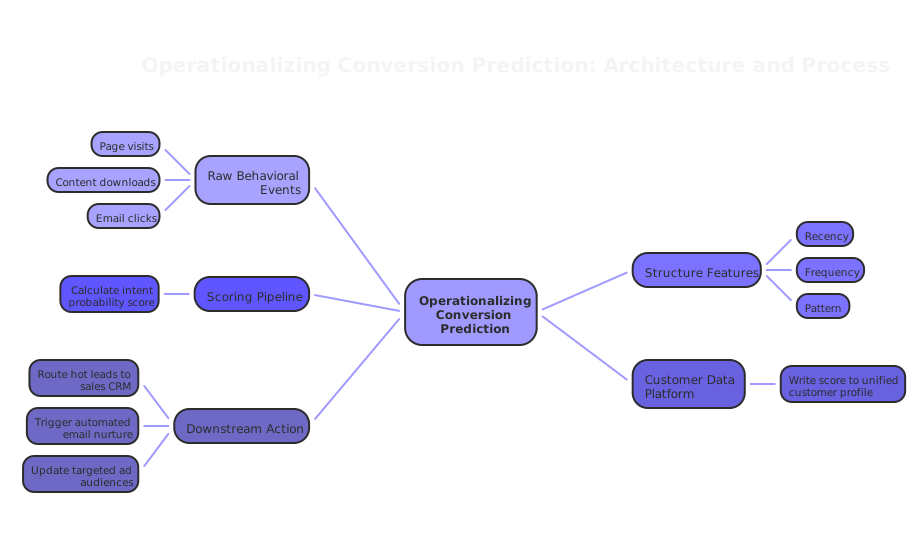
To build a conversion prediction model that works, you need to transform raw events into features your model can actually use. That means structuring your behavioral data around three dimensions.
Recency. When did the behavior happen? A pricing page visit last week matters more than one six months ago. Your feature should capture time decay, not just presence.
Frequency. How many times has this behavior occurred? A single visit is curiosity. Five visits in a week is something else. Build a count or rate feature, not a binary flag.
Pattern. What sequence of behaviors preceded this event? A prospect who visits the blog, then the use case pages, then pricing is showing a very different pattern from someone who lands directly on pricing from a paid ad. Sequence features are harder to build but dramatically improve model accuracy.
Once you have structured your behavioral data into these three dimensions, you have features worth modeling.
Building the Intent Model
You do not need a data science team to start. A logistic regression model trained on historical conversion data, with well-structured behavioral features, will outperform a complex model built on poorly structured inputs every time.
Here is a practical starting point.
Step 1: Define your conversion event. Be specific. "Requested a demo" is better than "converted." "Closed as won within 90 days" is better still. Your model is only as useful as the outcome it predicts.
Step 2: Pull your historical data. You need a population of contacts who converted and a population who did not. Aim for at least 500 examples in each group before you model anything.
Step 3: Build your behavioral features. Using the recency, frequency, and pattern dimensions above, create one feature per meaningful signal. Pricing page visits in the last 30 days. Total content downloads in the last 60 days. Whether they attended a live event. Keep it to 10 to 15 features to start.
Step 4: Train and validate. Split your data into training and test sets. Train your model. Check precision and recall on the test set. A model with 70% accuracy on a balanced dataset is a real business tool. Do not chase perfection at the cost of deployment.
Step 5: Output a score, not a label. Your model should output a probability, something like 0.74, not a label like "hot lead." Probabilities let you set your own thresholds based on sales capacity and pipeline goals. Labels remove that control from you.
Making Intent Scores CDP-Ready
A conversion prediction score sitting in a spreadsheet is useless. You need it where your teams and tools can act on it.
This is where your Customer Data Platform becomes the distribution layer.
A CDP like Segment, mParticle, or a composable alternative can ingest your intent scores as profile attributes. Once the score lives on the unified customer profile, you can trigger workflows, segment audiences, personalize content, and route leads, all in real time.
The architecture looks like this:
- Behavioral events are collected and sent to your CDP
- The CDP forwards events to your scoring pipeline (this can be a simple cloud function or a more sophisticated ML endpoint)
- The pipeline returns an intent score
- The score is written back to the customer profile in the CDP
- Downstream tools, your email platform, your CRM, your ad audiences, read the score from the profile and act on it
This loop closes the gap between insight and action. The score is not a report you check. It is a live attribute that drives automation.
House of MarTech works with teams at exactly this layer, connecting the modeling logic to the CDP infrastructure so scores become operational, not ornamental.
A Real Scenario Worth Learning From
Consider a B2B SaaS company with a 45-day average sales cycle. Their marketing team had built a lead score in HubSpot based on email opens, job title, and company size. Sales ignored it because it kept surfacing contacts who never responded.
The problem was the model had no behavioral sequence in it. A VP of Marketing who opened an email was scored the same as a VP of Marketing who had visited the pricing page four times, watched a customer story video, and searched for "implementation timeline" on their site.
When they rebuilt the scoring model using first-party behavioral features structured around recency, frequency, and pattern, the score distribution changed. A smaller pool of contacts scored above 0.7. Sales called them first. The response rate on outbound went up because the contacts were actually in an active research phase.
No new tools. No new data sources. Same CRM, same CDP, better features.
That is what conversion prediction is supposed to do.
What Is First-Party Intent Data and Why Does It Matter Now?
First-party intent data is behavioral data you collect directly from your own properties. Your website, your app, your emails, your events.
It matters now because third-party intent data, the kind you buy from data brokers or B2B intent platforms, is under increasing pressure from privacy regulation and signal degradation. Cookies are unreliable. Third-party signals are noisy and shared with every competitor who buys the same dataset.
First-party behavioral data is private to you. It is collected with consent. It reflects actual engagement with your specific brand, not generic category research. And it compounds over time as you collect more of it.
Building your conversion prediction model on first-party signals is not just a privacy-smart choice. It is a competitive one.
Common Mistakes to Avoid
Scoring without a defined outcome. Your intent model needs a target variable. If you have not defined exactly what "converted" means in your business context, your score is measuring the wrong thing.
Treating all behaviors equally. Not every action is equally predictive. A pricing page visit in the last 14 days is more predictive than an email open six weeks ago. Weighting matters. Let your historical data tell you which signals have predictive power.
Building one model for all segments. Enterprise prospects and SMB prospects behave differently before they buy. A single intent model trained on mixed data will underperform for both. If your segments are meaningfully different, build separate models or include segment as a feature.
Scoring and forgetting. Intent scores decay. A contact who scored 0.8 three months ago and took no further action is not a hot lead. Build time-decay logic into your scoring so old signals lose weight automatically.
Skipping validation. A model that has not been tested on held-out data is not a model. It is a hypothesis. Test it before you route leads based on it.
Frequently Asked Questions
How is an intent model different from a lead score?
A traditional lead score is usually a rule-based system. Assign points for job title, deduct points for a competitor domain, add points for a form fill. An intent model is probabilistic. It is trained on historical data to predict the likelihood of a specific outcome. Intent models adapt to patterns in your data. Lead scores reflect your assumptions about what matters.
Do I need a data science team to build this?
No. A well-structured dataset and a logistic regression model are enough to start. Tools like Python with scikit-learn, or even some CRM and CDP platforms with built-in predictive scoring, can get you operational without a dedicated data science hire. The harder work is structuring your behavioral data correctly, not the modeling itself.
How often should I retrain the model?
At minimum, quarterly. If your product, pricing, or audience mix changes significantly, retrain sooner. Intent models drift when the world changes and the model does not.
What if I do not have enough historical data?
Start collecting it now with the conversion event clearly defined. In the meantime, use a simpler rules-based intent score while you build your dataset. Three to six months of clean, labeled behavioral data is enough to train a useful first model.
Where to Start This Week
You do not need to build a full ML pipeline before Monday. You need to take one concrete step.
Audit your current behavioral data collection. Open your analytics platform or your CDP. List every behavioral event you are currently capturing. Note whether each event includes the context needed to make it useful: timestamp, session sequence, user identifier, and relevant page or content metadata.
If your events are clean and structured, you are closer to modeling than you think. If they are not, that is your first project.
From there, define your conversion event, pull your historical data, and build your first set of features. The model follows naturally once the data foundation is solid.
If you want to pressure-test your data architecture before you build, or if your CDP and CRM are not yet connected in a way that makes scoring actionable, that is the kind of structural problem House of MarTech solves. Behavioral data is only as valuable as the infrastructure that puts it to work.
The signals are already there. The question is whether your stack is built to hear them.
Related Articles
Need Help Implementing?
Get expert guidance on your MarTech strategy and implementation.
Get Free Audit