
CDP Use Case Prioritization: The Scoring Framework for When Everything Feels Urgent
A practical scoring framework for prioritizing CDP use cases. Impact vs effort, lifecycle stage mapping, and how to cut through internal politics.


TL;DR
Quick Summary
Listen to summary
0:00 audio overview
CDP Use Case Prioritization: The Scoring Framework for When Everything Feels Urgent
Quick Answer
Picture your team six weeks after a CDP launch. You have a list of fifteen use cases. Everyone agrees they all matter. The CMO wants personalization. The retention team wants churn prediction. The paid media team wants audience suppression. The compliance officer needs consent management done yesterday.
Everything is urgent. Nothing moves.
This is one of the most common places CDP projects stall. Not for technical reasons. Not because of the platform. Because the team cannot agree on what to do first.
CDP use case prioritization is not about picking winners. It is about building a sequence that your team can actually execute. This post gives you a practical scoring framework to do that.
Why Simple Impact-Effort Scoring Breaks Down
The classic approach is a two-by-two matrix. High impact, low effort goes first. Low impact, high effort gets cut. Simple.
The problem is that impact and effort are not independent. A use case that looks low-effort only stays low-effort if your data is already clean. If your customer records have duplicate issues, missing identifiers, or inconsistent formats, that "quick win" becomes a months-long project.
Most teams score use cases in a conference room without checking the data first. They get burned when implementation starts and the foundation is not ready.
There is a second problem. The matrix treats all use cases as equal in terms of organizational readiness. A one-person marketing ops team cannot run ten campaigns simultaneously, regardless of how they score on a grid. Frameworks that ignore team capacity set teams up to fail.
A solid CDP use case prioritization strategy needs more than two dimensions.
The Six Dimensions That Actually Matter
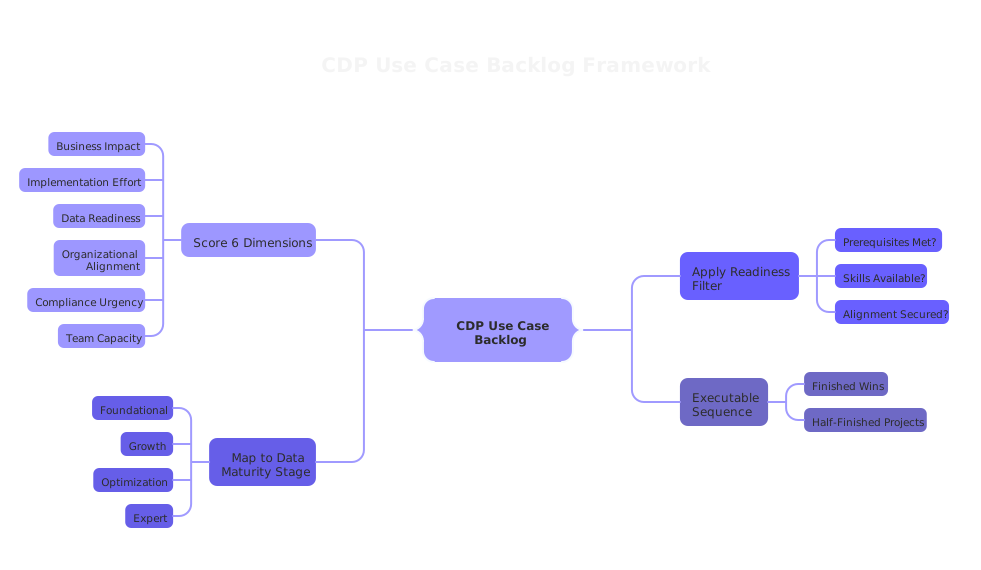
Good CDP use case prioritization implementation scores each candidate across six factors. Here is each one in plain terms.
1. Business Impact
But be specific. Not all impact is equal. Group your use cases into three buckets.
Revenue protection. These use cases stop customers from leaving. Churn prevention, win-back campaigns, suppressing bad offers. You see results in 30 to 90 days.
Revenue generation. These grow what customers spend. Personalization, cross-sell, upsell triggers, lookalike audiences. Results take 60 to 120 days.
Capability building. These do not generate revenue directly. Data quality work, identity resolution, audience library setup. But they unlock everything else. Without them, the revenue use cases underdeliver.
Score each use case on impact within its category. Do not compare a capability-building use case against a revenue-generation one. They serve different purposes and run on different timelines.
2. Implementation Effort
Break effort into its real components. Do not estimate "weeks to build." Instead, estimate four things separately.
- Technical configuration effort
- Data integration and mapping effort
- Data quality remediation effort
- Cross-team coordination effort
A use case requiring two weeks of configuration but three months of data cleanup should score as high effort. A framework that only measures configuration time will mislead you.
3. Data Readiness
Rate each use case on a three-point scale.
Green. The data is integrated, clean, and validated. You can launch now.
Yellow. The data exists but needs targeted cleanup. You can launch after focused remediation work.
Red. Critical data is missing or unreliable. Defer until the foundation is ready.
This single dimension prevents one of the most common CDP mistakes: launching use cases against bad data, getting disappointing results, and losing team confidence in the entire platform.
4. Organizational Alignment
Does this use case connect directly to something leadership is publicly committed to? A CMO-sponsored personalization initiative has a different organizational path than a technically sound use case nobody is championing.
This is not about playing politics. It is about being realistic. Use cases with explicit executive support move faster. They get resources. They survive reprioritization. Score alignment honestly and factor it in.
5. Compliance Urgency
Some use cases exist because of regulatory requirements, not revenue ambition. Consent management, data access workflows, and suppression for privacy compliance often score lower on business impact frameworks but cannot be deferred.
Create a separate track for compliance-driven use cases. They operate on a legal timeline, not a business impact timeline. Do not let them compete with revenue use cases in the same scoring column.
6. Team Capacity
This is the most underestimated variable in CDP use case prioritization best practices.
Count the actual hours your team has available next quarter. Be conservative. Now add up the effort estimates for your top-ranked use cases. If the total exceeds available capacity, cut the list until it fits.
A team with 200 hours of available capacity should not commit to four use cases totaling 350 hours. The result is three half-finished projects, not four wins.
The Readiness Filter: What Frameworks Miss
Once you have your scored list, run every use case through three questions before finalizing the sequence.
What prerequisites does this use case need? If a lookalike audience use case depends on reliable lifetime value data, and that data does not exist yet, the LTV work goes into your roadmap first, even if it scores lower on business impact.
Does your team have the skills to execute this right now? If a real-time decisioning use case requires expertise your team does not have, you need to either hire, train, or defer. A framework score does not change what your team can execute.
What organizational changes does this use case require? A unified customer journey use case might need marketing, sales, and customer service to agree on a common customer definition. That alignment work is a prerequisite. Score it that way.
This readiness filter is what converts a theoretical priority list into a practical roadmap.
Matching Use Cases to Your Data Maturity Stage
CDP use case prioritization strategy should reflect where your organization actually is, not where you want to be.
Foundational stage. You have recently launched your CDP or are in early deployment. Your priority is data quality, source integration, and identity resolution. Resist the urge to jump to personalization. Clean data now means faster, better results later. Early use cases should be contained, low-risk, and confidence-building.
Growth stage. Your data foundation is validated. Now you sequence basic personalization, customer segmentation, and churn prediction. These use cases assume clean profiles exist. If they do not, you are in foundational stage, not growth stage, regardless of how long you have had the platform.
Optimization stage. You have proven personalization and segmentation working. Now you expand into multi-channel orchestration, advanced analytics, and predictive modeling. Cross-departmental use cases belong here, where your team has the coordination experience to execute them.
Expert stage. Real-time decisioning, AI-driven journeys, multi-touch attribution. These require mature data infrastructure and experienced teams. Attempting expert-stage use cases at a foundational stage is one of the clearest paths to CDP disappointment.
A Real Sequencing Example
An Italian cheese producer with limited technical resources and a traditional business model faced exactly this problem. They had a CDP, a list of use cases, and a small team. They chose not to attempt predictive churn modeling or sophisticated omnichannel journeys. Instead, they prioritized targeted retention campaigns based on purchase recency, something their team could manage without continuous technical support.
The result was a 167 percent increase in last-click sales year over year. Not because the use case was the most technically sophisticated option. Because it matched their organizational capacity and data readiness.
The lesson: a slightly simpler use case executed well beats a sophisticated use case executed poorly.
Building Organizational Confidence Early
If your team has experienced failed implementations or internal skepticism about your CDP investment, business impact scores alone should not drive your early sequence.
You need visible, fast wins. Choose a use case that is low-risk, quick to deploy, and generates a measurable result within 30 to 60 days. It does not have to be your highest-impact use case. It has to be something your team completes successfully and can point to.
One European fashion retailer prioritized abandoned cart emails as their first CDP use case. Technically, it was straightforward. By framework scoring, other use cases might have ranked higher. But the team had zero CDP experience and needed organizational proof that the platform worked. That early win opened the door to more ambitious use cases within six months.
Building confidence is a legitimate prioritization variable. When organizational belief in the platform is fragile, a guaranteed small win often delivers more long-term value than an ambitious use case that struggles.
The Quarterly Review: Treat Prioritization as Ongoing
One common mistake is treating the use case roadmap as a fixed document. You score everything in January, commit to a sequence, and revisit it at the end of the year.
Organizational reality does not cooperate with that approach. Team capacity changes. Business conditions shift. A use case you planned for Q3 might become urgent in Q2 because a competitor moves or a regulation changes.
Set a quarterly review cycle. Reassess your scored list against current team capacity, data readiness, and business priorities. Adjust the sequence when context changes. Treat it as continuous improvement, not a one-time planning exercise.
A Practical Scoring Template
Here is a simplified scoring approach you can use in a spreadsheet today.
For each use case, score these six dimensions from 1 to 5, with 5 being most favorable.
| Dimension | Score (1-5) | Notes |
|---|---|---|
| Business Impact | Protect revenue, generate revenue, or build capability? | |
| Implementation Effort | Lower effort scores higher | |
| Data Readiness | Green = 5, Yellow = 3, Red = 1 | |
| Organizational Alignment | Executive-sponsored scores higher | |
| Compliance Urgency | Track separately for regulatory use cases | |
| Team Capacity Fit | Does this fit within available hours? |
Add the scores. Use the total as a starting rank. Then run the readiness filter questions over your top candidates before locking in the sequence.
Adjust weights to reflect your organization's current priorities. A company in a privacy-sensitive industry might weight data readiness and compliance higher. A company facing competitive pressure might weight business impact more heavily.
Where House of MarTech Fits In
CDP use case prioritization implementation is one of the highest-value conversations we have with clients at House of MarTech. The platform decision gets the attention. The use case sequence often does not.
We help teams score their use case backlog, apply the readiness filter, and build a roadmap that fits their actual team capacity. If you are sitting on a CDP that is not delivering the expected return, the sequence is often the place to look first.
The Bottom Line
When everything feels urgent, the instinct is to try to do everything at once. That instinct produces incomplete work, frustrated teams, and disappointing CDP results.
Good CDP use case prioritization is not about scoring the perfect list. It is about building a sequence your team can execute, with data that is ready, within capacity that actually exists.
Start with what you can complete. Build confidence. Expand from there.
The teams achieving the best CDP outcomes are not the ones with the most ambitious roadmaps. They are the ones who finish what they start.
Frequently Asked Questions
Get answers to common questions about this topic
Have more questions? We're here to help you succeed with your MarTech strategy. Get in touch
Related Topics
Related Articles
Need Help Implementing?
Get expert guidance on your MarTech strategy and implementation.
Get Free Audit