
Treasure Code Transforms CDP Operations
Treasure Data's Treasure Code redefines CDP operations with AI-native CLI. Cut complexity, boost governance, free teams for strategy. Transform data work now.


Most CDPs are built for marketers who click buttons. Treasure Data just built something for engineers who type commands.
That distinction matters more than it sounds.
Treasure Data's Treasure Code is a command-line interface, a CLI, for a customer data platform. If you know what a CLI is, you already see why this is interesting. If you don't, here is the short version: instead of clicking through menus in a browser, you write short text commands in a terminal window. Developers love this. It is faster, more precise, and far easier to automate.
The bigger question is not what Treasure Code is. It is what it signals about where enterprise CDPs are heading.
What Is Treasure Data Treasure Code?
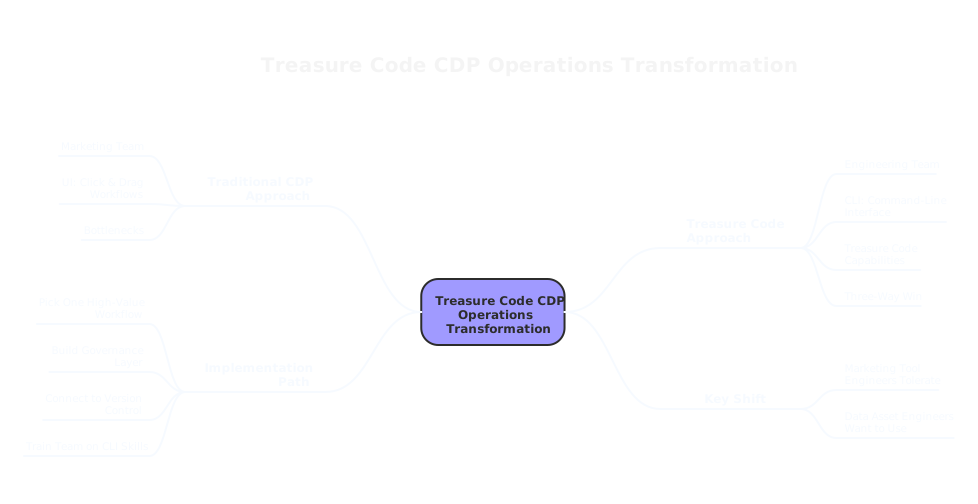
Treasure Code is Treasure Data's agentic AI layer, built directly into the CDP and operated through a command-line interface. Released in early 2026, it lets technical teams write, run, and manage data operations, AI workflows, and customer segmentation logic without ever opening a browser-based UI.
Think of it as the difference between driving a car with automatic transmission and driving one with a manual gearbox. The automatic gets most people where they need to go. The manual gives drivers precise control over every gear shift. Treasure Code is the manual gearbox for your customer data.
Key capabilities include:
- AI agent orchestration. Treasure Code lets you build and run agentic AI workflows that act on customer data automatically, triggering actions based on behavior, signals, or rules you define.
- CLI-based data operations. Run queries, manage segments, and execute workflows from a terminal. No UI required.
- Treasure Code Studio. A companion environment for teams who want structure around their CLI work, including concept mapping, version control, and collaborative development.
- Governance built in. Every command is logged. Every workflow is auditable. Compliance teams get visibility without slowing engineers down.
This is not a cosmetic update. It is a architectural shift in how a CDP can be operated.
Why a CLI for a CDP Is a Big Deal
Most marketing technology is built to hide complexity. Drag-and-drop builders, visual workflow editors, point-and-click audience builders. These tools are good for accessibility. They lower the barrier to entry. But they also create a ceiling.
When your data operations get complex enough, visual tools become the bottleneck. You end up with workflows nobody can fully explain, segments that are impossible to version-control, and AI models that live in a black box. Your team spends more time managing the tool than doing the work.
A CLI removes that ceiling.
Developers can script repeatable workflows. Teams can store data logic in version control, the same way they manage software code. Changes are reviewable. Rollbacks are possible. Testing becomes systematic rather than manual.
This is how engineering teams already manage infrastructure, databases, and software deployments. Treasure Code brings that same discipline to customer data.
The practical result: your CDP stops being a marketing tool that engineers tolerate and starts becoming a data asset that engineers actually want to work with.
The Real Problem Treasure Code Is Solving
Here is what most CDP conversations miss.
The bottleneck in most enterprise data operations is not the absence of data. Companies have more customer data than they know what to do with. The bottleneck is operationalizing that data at speed and at scale, while keeping it governed and auditable.
Marketing teams want to move fast. Compliance teams want everything documented. Engineering teams want clean, reproducible processes. These three groups pull in different directions, and the CDP usually ends up serving one at the expense of the others.
Treasure Code addresses that triangle directly.
By making data operations scriptable and auditable at the CLI level, it gives engineers the control they need, gives compliance the logging they require, and gives marketing faster execution because engineering is no longer the bottleneck. The workflow is automated and repeatable. The AI agents handle the routine triggers. The humans focus on strategy.
That is not a feature update. That is a structural fix.
Treasure Data Treasure Code: What It Means for Your CDP Strategy
If you are evaluating CDPs, or already running Treasure Data, here is how to think about Treasure Code practically.
For technical teams
Treasure Code is a strong signal that Treasure Data is building for engineering-led data organizations. If your CDP implementation is already driven by a data engineering team, this fits your workflow. If it is driven primarily by a marketing team with limited engineering support, the learning curve is real.
A CLI is not intuitive for non-technical users. That is a feature, not a flaw, for the right organization. But it means you need to be honest about who will actually operate this tool day to day.
For governance and compliance
The auditability built into Treasure Code is genuinely useful. Every action is logged. That matters for regulated industries, for GDPR compliance, for any organization where data provenance needs to be defensible. If your current CDP setup produces workflows that are hard to explain to a compliance officer, a CLI-based approach changes that.
For AI and automation strategy
Agentic AI is the term Treasure Data uses, and it is worth taking seriously. The idea is that AI agents can take actions, not just generate recommendations. They can trigger campaigns, update segments, fire workflows, all based on real-time data signals. Treasure Code is the interface through which those agents are built and managed.
If your AI strategy right now is "we use AI to write copy," you are operating at a different level than what Treasure Code is designed for. That is fine. Most organizations are. But it is useful to know where the ceiling is in your current setup, and where tools like this start to become relevant.
What Good Treasure Code Implementation Looks Like
You do not flip a switch and go CLI-native overnight. Here is a realistic implementation path for teams considering Treasure Code.
Start with one workflow. Pick a single, high-value data operation, a recurring segment refresh or an automated trigger campaign, and rebuild it in Treasure Code. Get your engineering team comfortable with the syntax and the Studio environment before expanding.
Build your governance layer first. The logging capabilities are only useful if someone is reviewing them. Define who owns audit review, how often, and what constitutes an anomaly worth escalating. This is less about the tool and more about process.
Connect Treasure Code to your version control system. Treat CDP workflows the way you treat code. Pull requests. Code reviews. Deployment pipelines. This is where the real operational maturity lives.
Plan for the skills gap. Not every marketing operations professional knows how to work in a terminal. That is not a criticism. It is a planning reality. Identify who on your team will own Treasure Code operations, and invest in their training. If that gap is large, external support can help you stand it up faster.
At House of MarTech, we help teams map their current CDP operations to the capabilities they actually need, before they commit to implementation. The tool decision is secondary to the workflow design.
What Treasure Code Does Not Replace
It is worth being direct about the boundaries.
Treasure Code is an operational interface, not a strategy. It gives you more precision and control over your CDP workflows. It does not tell you what workflows to build, which customer segments matter, or how to structure your data model.
The organizations that get the most from tools like this are the ones who already know what they want their customer data to do. They have a clear use case. They know what "success" looks like in their CDP. They have engineering resources to operate a CLI-based environment.
If those foundations are not in place, Treasure Code adds complexity before it adds value.
The strategic work, defining use cases, auditing your data quality, aligning marketing and engineering on what "good" looks like, that comes before the tool selection. Always.
How Treasure Code Fits the Broader CDP Shift
CDPs are not a new category. But the way they are being built is changing fast.
The early wave of CDPs was about unification, pulling customer data from many sources into one place. The second wave was about activation, using that unified data to drive campaigns and personalization. The wave that is building now is about operations, making the CDP itself more programmable, more automated, and more governable.
Treasure Code sits squarely in that third wave. It treats the CDP less like a marketing application and more like a data infrastructure layer. That is the right direction for organizations that are serious about customer data as a long-term asset.
Composable CDPs, API-first architectures, CLI-based management. These are not competing ideas. They are converging on the same underlying truth: the organizations that win with customer data will be the ones that treat it with engineering rigor, not just marketing intuition.
Questions Teams Are Asking About Treasure Data Treasure Code
Is Treasure Code only for large enterprises?
Treasure Data itself is an enterprise CDP, priced and scoped accordingly. Treasure Code is designed for organizations with technical teams capable of operating a CLI environment. Smaller organizations without dedicated data engineering resources will find the learning curve steep.
Does Treasure Code require replacing existing workflows?
No. You can adopt Treasure Code incrementally. Start with new workflows rather than migrating existing ones. Build confidence in the environment before committing to a full operational shift.
How does Treasure Code handle AI governance?
Every agentic AI action executed through Treasure Code is logged and auditable. This is one of its most significant advantages for regulated industries. The CLI approach creates a natural paper trail that UI-based tools often lack.
What skills does my team need?
Comfort with command-line environments is essential. SQL knowledge helps significantly, since data queries are a core part of CDP operations. Familiarity with version control systems, particularly Git, makes the workflow substantially more effective.
The Decision in Front of You
Treasure Data Treasure Code is not the right tool for every team. It is the right tool for teams that are ready to treat their CDP as infrastructure, not just software.
If your organization has engineering resources, a clear data strategy, and governance requirements that demand auditability, Treasure Code deserves serious evaluation. It represents a genuine step forward in how enterprise customer data can be operated.
If you are still working through foundational questions, what data you have, what you want it to do, how your teams will actually use it, those questions come first.
The best CDP implementation we ever see is not the one with the most sophisticated tooling. It is the one where every team member knows exactly what the platform is supposed to do and why.
If you want help thinking through whether Treasure Code or Treasure Data fits your current stack and your actual use cases, that is exactly the kind of evaluation work House of MarTech does. No pressure to reach a particular conclusion. Just a clear-eyed look at what your data operations actually need.
Start there. The tool decision gets easier once the strategy is clear.
Related Topics
Related Articles
Need Help Implementing?
Get expert guidance on your MarTech strategy and implementation.
Get Free Audit