
Common Pitfalls in Single Customer View Projects—and How to Avoid Them
Most Single Customer View projects fail not because of bad technology, but because of avoidable mistakes in planning, ownership, and data governance. Here is how to get it right.


TL;DR
Quick Summary
Listen to summary
0:00 audio overview
Common Pitfalls in Single Customer View Projects, and How to Avoid Them
Quick Answer
Picture a retail brand with three years of customer data sitting in five different systems. Their email platform knows purchase history. Their CRM tracks support tickets. Their e-commerce site records browsing behavior. Their loyalty app holds redemption data. Their point-of-sale system logs in-store visits.
Each system has a version of the customer. None of them agree.
That is exactly where most Single Customer View (SCV) projects start. And it is also where most of them quietly fall apart.
A Single Customer View is supposed to solve this. One profile per person. One source of truth. Every team working from the same data. The promise is real. The execution is where things go wrong.
The good news: the mistakes are predictable. And predictable mistakes are avoidable.
What Is a Single Customer View, Really?
A Single Customer View is a unified customer profile that pulls together data from every touchpoint. Purchases, emails opened, support calls, website visits, in-store activity. All connected to one person.
Done well, it helps you stop sending a discount to someone who just paid full price. It helps you recognize a loyal customer when they call support. It helps you spend your marketing budget on the right people.
Done poorly, it becomes an expensive database no one trusts.
The difference usually comes down to how you handle project risk and data governance from the start.
The Biggest Mistake: Starting with Unification Instead of a Business Goal
This is the most common trap. Teams get excited about building the unified profile. They treat the profile itself as the goal.
It is not.
The profile is a tool. The goal is a business outcome.
Do you want to reduce churn by 15 percent? Increase repeat purchase rates? Improve customer service response times? Start there. Then ask: what data do we actually need to make that happen?
Most organizations discover they need to unify 20 to 30 percent of their data to solve the problem they actually have. Instead, they spend months unifying everything, exhaust their budget, and never reach the activation stage.
Define the decision you need to make. Then build the data you need to make it.
Nine Pitfalls That Sink SCV Projects
1. Skipping the Data Audit
Before you unify anything, you need to know what you have.
Where does your customer data live? What condition is it in? Do your systems use the same customer identifiers, or does each platform have its own ID format?
One healthcare organization found this out the hard way. They had three enterprise systems built by different vendors. Each used a different patient identifier. No standard mapping existed between them. They moved forward anyway and ended up with profiles full of irreconcilable conflicts.
Audit your data before you build anything. It is boring work. It is also the work that saves the project.
2. Overcomplicating the First Use Case
You do not need real-time personalization, predictive analytics, and omnichannel orchestration on day one.
Start simple. Build one use case that is achievable, measurable, and useful. Prove value. Then expand.
Organizations that try to build the full vision upfront often create systems too complex to manage. Campaigns fail mysteriously. Data flows break. The team gets demoralized. The project stalls.
Think of it like learning to drive. You start in a parking lot. You do not begin on the highway.
3. No Clear Owner
Who is accountable when this project succeeds or fails?
If the answer involves a committee, three departments, and a shared responsibility matrix, you are in trouble.
Marketing wants the platform. IT wants to govern it. Data science wants to build models on top of it. Without one person with real authority and accountability, decisions stall at every boundary.
Assign a single owner. Give them the authority they need. Make them responsible for business outcomes, not just platform adoption.
4. Marketing and IT Are Not Aligned
This is different from ownership. You can have a clear owner and still have two teams working against each other.
Marketing wants to move fast. IT wants to move carefully. Both are right. Neither can win without the other.
When marketing and IT do not collaborate, you end up with parallel data strategies. Different databases. Different definitions of the same customer. The unified profile fragments before it is even built.
Get both teams in the same room early. Agree on definitions. Agree on process. Build together or expect to rebuild later.
5. No Measurement Plan
One media company ran a CDP use case test across multiple markets. They skipped involving their analytics team in the planning. When the test ended, they could not attribute results back to the CDP actions they had taken.
All that work. No proof.
Measurement is not something you bolt on after launch. It is something you design into the project from the start. Define what success looks like before you build. Make sure you can actually track it.
6. Momentum Dies After Launch
This one is quiet and deadly.
The implementation team does great work. The platform launches. Use cases go live. Then the A-team moves to the next project. The platform gets handed to operations. Resources thin out.
Within six to twelve months, the organization looks at a platform delivering minimal value and writes it off as a failed investment.
Plan for the post-launch phase with the same rigor you apply to implementation. Who owns ongoing optimization? What is the roadmap for the next six months? What budget supports it?
7. Measuring the Wrong Things
Tracking how many users got trained is not success. Counting campaigns launched is not success.
Revenue influenced, churn prevented, customer lifetime value increased: those are success metrics.
Teams that optimize for platform adoption without tying it to business outcomes will find themselves explaining to leadership why a heavily used platform is not moving the needle.
Tie every CDP metric to a business outcome. If you cannot connect it, question whether you should be tracking it.
8. Choosing the Wrong Platform
Vendor selection only causes about 28 percent of SCV failures. But when it goes wrong, it goes very wrong.
Choosing a platform that cannot scale to your data volume, lacks the integrations your stack requires, or uses a data model incompatible with your architecture is a foundational error. Discovering this 12 months into implementation is painful and expensive.
Take time during evaluation to stress-test your specific requirements. Not the average customer's requirements. Yours.
If you want help matching your stack to the right platform, the team at House of MarTech does independent platform assessments. No vendor relationships that cloud the recommendation.
9. Treating Data Quality as a Technical Problem
Here is the uncomfortable truth about bad data: technology did not cause it, and technology alone will not fix it.
Data is bad because of how people enter it, how teams define it, and whether the organization actually values it.
Different teams use different naming conventions. Nobody owns deduplication. Customer records are never refreshed. These are organizational problems dressed up as technical ones.
The organizations with the best data quality treat it as a cultural practice. They measure it. They report on it. They include it in performance conversations. They celebrate improvements. They make data quality everyone's job, not the data team's problem.
The Identity Problem Is Harder Than It Looks
Identity resolution is the core technical challenge in any SCV project. It means figuring out that the person who bought something online, called customer support, and opened three emails last week is the same person.
This sounds straightforward. It is not.
Names are misspelled. Email addresses get recycled. People share accounts. Someone buys on their phone and returns in-store. A household of three adults shares one loyalty card.
Traditional matching worked by finding exact matches on email addresses or third-party cookies. That approach is breaking down. Privacy regulations are tightening. Tracking tools are less reliable. Customer behavior is more fragmented than ever.
The smarter approach is probabilistic matching. Instead of insisting two records are definitely the same person, you calculate the likelihood they are the same person. You assign a confidence score.
High confidence: merge the profiles and personalize accordingly.
Lower confidence: keep them separate or link them at the household level without forcing a single identity.
This is a better model than chasing the perfect match. It accepts that some ambiguity is unavoidable and builds a system that makes smart decisions despite that ambiguity. That is good data governance strategy in practice.
Why Your Data Governance Strategy Determines Whether This Project Succeeds
Project risk in SCV work is mostly data governance risk in disguise.
When there is no governance, you get competing definitions of the same customer. You get data no one trusts. You get teams pulling in opposite directions. You get a platform full of profiles that do not reflect reality.
A real data governance implementation does not have to be complicated. At minimum, you need:
Clear data ownership. Someone is responsible for each data domain. Customer identity, purchase history, engagement data. Know who owns what.
Agreed definitions. What is a "customer"? What counts as "active"? What is a "high-value" account? If two teams answer these questions differently, your unified view is not unified.
A process for data quality. How do you catch bad data? How do you fix it? Who decides when a record is trustworthy enough to act on?
Access controls. Who can see what? Who can activate on what? Especially important as privacy regulations tighten.
Data governance best practices are not about building bureaucracy. They are about building trust. Your platform is only as useful as the trust people place in the data inside it.
What Better Looks Like: A Practical Path Forward
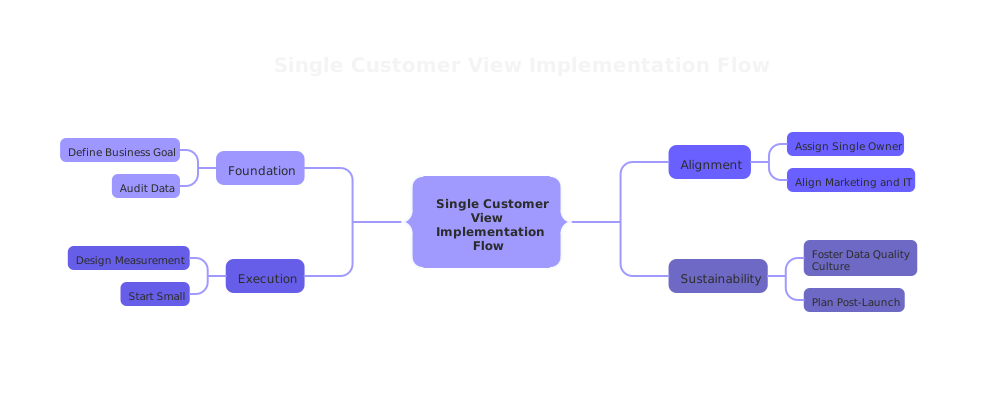
If you are starting an SCV project, here is a sequence that works.
Start with a decision, not a dataset. What is the specific business decision this project needs to support? Start there.
Audit before you build. Know what data you have, where it lives, and what condition it is in. Do not skip this step.
Assign a single owner. With real authority and business accountability.
Align marketing and IT before any vendor is selected. Shared definitions, shared goals, shared ownership.
Design measurement into the project from day one. Not after launch.
Start small. One use case. Prove value. Expand from there.
Invest in data quality culture, not just data quality tools. The tools help. The culture sustains it.
Plan the post-launch phase. Momentum after go-live is not automatic. Build it deliberately.
If you want an outside perspective before you commit to an approach, House of MarTech offers SCV readiness assessments. We look at your existing data, your stack, your organizational structure, and your business goals. We tell you what will work, what will not, and where the real risks are. No jargon. No generic frameworks. Just a straight read on your situation.
The Real Goal Is Not a Perfect Profile
The organizations seeing the best results from SCV work have stopped chasing the perfect unified record. They have accepted that some ambiguity is permanent.
What they focus on instead is making better decisions faster, with the data they actually have.
That means high-confidence profiles drive personalization. Lower-confidence profiles get handled differently. Feedback loops catch errors and improve the data over time. Governance keeps things from falling apart as the organization grows.
The goal is not a flawless system. The goal is a trustworthy one.
That is the project risk and data governance mindset that actually delivers results.
Start there.
Frequently Asked Questions
Get answers to common questions about this topic
Have more questions? We're here to help you succeed with your MarTech strategy. Get in touch
Related Articles
Need Help Implementing?
Get expert guidance on your MarTech strategy and implementation.
Get Free Audit