
Behavioral Signals to Conversion Prediction
Turn behavioral signals into intent models that predict conversions. Learn how to build CDP-ready intent scores that move clicks into pipeline.


TL;DR
Quick Summary
Quick Answer
Your pipeline report says 400 leads came in this month. Your sales team says only 12 were worth calling. The other 388 clicked something, filled something out, and disappeared.
That gap is not a sales problem. It is a signal problem.
Most marketing teams are collecting behavior. Page visits. Email opens. Form fills. But they are treating all of it the same way, assigning points and calling it lead scoring. The result is a list of names sorted by activity, not by intent.
Conversion prediction works differently. It asks a harder question: based on what this person actually did, what is the probability they will buy?
What Conversion Prediction Actually Means
Conversion prediction is the process of using behavioral data to calculate the probability that a specific user will take a desired action, usually a purchase, demo request, or qualified sales conversation.
It is not lead scoring. Lead scoring adds points. Conversion prediction builds a model.
The difference matters. A lead score says, "This person visited the pricing page twice, so they get 20 points." A conversion prediction model says, "Users who visit the pricing page twice within 72 hours of reading a comparison post convert at 34% when they also open a follow-up email. Users who do not open that email convert at 6%."
One gives you a number. The other gives you a pattern.
The Signal Problem Most Teams Ignore
Here is the scenario that plays out in hundreds of B2B companies every quarter.
A SaaS company runs paid campaigns, builds a nurture sequence, and routes leads to sales based on a score threshold. The score is built on demographic fit plus engagement activity. High score leads get called. Low score leads stay in nurture.
Six months later, they audit closed-won deals. A significant portion of closed revenue came from accounts that never crossed the score threshold. They were never called. They eventually found a competitor or bought on their own after the third nurture email.
The signals were there. The model just was not reading them correctly.
This is the behavioral signal gap. It is not that you lack data. It is that the relationship between your signals and actual conversion is not what you assumed it was.
Three Types of Behavioral Signals Worth Modeling
Not all behavioral data carries equal weight. Before you build anything, you need to know what you are working with.
1. First-Party Behavioral Signals
These come directly from your own properties. Website visits, session depth, page sequences, in-app actions, email engagement, support ticket history. This is your most reliable data because you control it and you know the context.
First-party signals are the foundation of any honest conversion prediction strategy. They are deterministic where third-party signals are often probabilistic guesses.
2. Second-Party Signals
These come from direct partnerships. A media partner sharing engagement data. A platform co-op. Syndicated content programs where you can see who read what. These signals add context when used carefully.
3. Third-Party Intent Data
This is data purchased from providers who aggregate behavior across many sites, often through bidstream data, publisher networks, or panel research. It can indicate category-level interest, but it is inherently probabilistic. Someone reading articles about CRM software does not mean they are evaluating yours.
Third-party intent data is most useful as a filter, not as a foundation. Use it to prioritize outreach within an account list you already have reason to target. Do not use it as the primary signal in your conversion model.
How to Build a CDP-Ready Intent Score
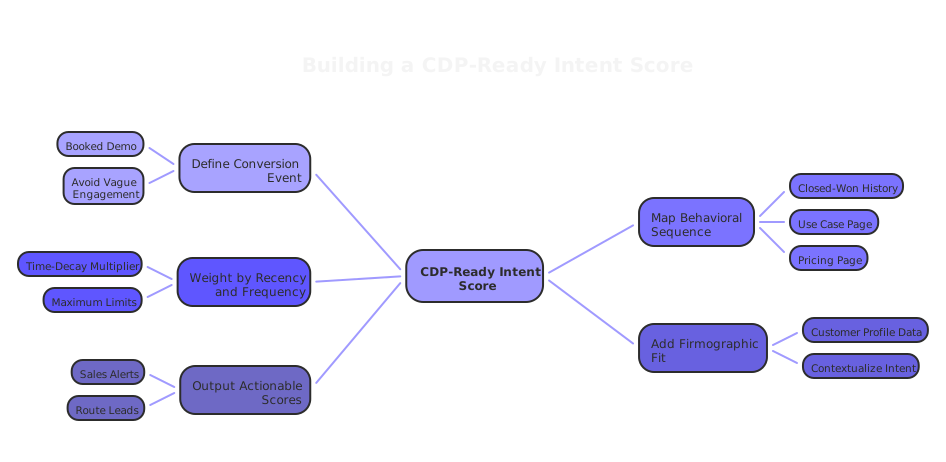
A CDP-ready intent score is one your Customer Data Platform can ingest, update in real time, and use to trigger downstream actions. Here is a practical approach.
Step 1: Define the Conversion Event You Are Predicting
This sounds obvious. It is rarely done well.
"Conversion" means different things in different contexts. For your model to be useful, pick one specific event. A booked demo. A free trial activation. A purchase. Do not try to predict "engagement" or "interest." Those are not conversions.
Step 2: Map the Behavioral Sequence That Precedes That Event
Pull historical data from closed-won accounts. Look at what happened in the 30, 60, and 90 days before conversion. You are looking for patterns in the sequence, not just the presence of individual events.
Common patterns that matter more than individual page visits:
- Pricing page visited after reading a use case page (not before)
- Return visit within 48 hours of the first session
- Email opened within 2 hours of send time
- Multiple contacts from the same account visiting in the same week
- Feature comparison page visited more than once
The sequence is the signal. A pricing page visit means something different depending on what came before it.
Step 3: Weight Signals by Recency and Frequency
Recent behavior matters more than old behavior. Someone who visited your pricing page yesterday is more interesting than someone who did it three months ago.
Build decay into your model. A simple approach: apply a time-decay multiplier that reduces signal weight by 50% every 14 days. This keeps your scores current without requiring a data science team to maintain.
Frequency also matters, but with a ceiling. Three pricing page visits is meaningful. Thirty visits might indicate a bot, a researcher, or an existing customer doing due diligence. Set upper bounds on frequency weights.
Step 4: Add Firmographic or Contextual Fit
A behavioral signal is more predictive when it comes from someone who matches your ideal customer profile. A pricing page visit from a 10-person startup means something different than the same visit from a 500-person enterprise, assuming you sell to enterprises.
Combine behavioral signals with fit data. This is where most CDPs earn their value. The platform can hold both behavioral events and firmographic attributes, and your model can use both.
Step 5: Output a Score Your Systems Can Act On
Your intent score needs to be actionable. That means it needs to live somewhere your sales and marketing tools can read it.
A score sitting in a spreadsheet is not a conversion prediction system. It is a report.
Build the output into your CDP so it can trigger sales alerts, adjust ad audiences, change email cadence, or escalate an account to a different nurture track. The score only matters if something changes because of it.
What Is the Difference Between Lead Scoring and Conversion Prediction?
This is the question we hear most often, and it is worth a direct answer.
Lead scoring is typically rule-based. You assign point values to actions and attributes, add them up, and use the total to rank leads. It is transparent and easy to explain to sales teams. It is also static. The rules reflect assumptions you made when you built the model, not what the data actually shows.
Conversion prediction is model-based. It uses historical conversion data to find which combinations of signals actually preceded conversion. It is more accurate over time, especially with sufficient data volume. It is also more complex to build and maintain.
For most teams, the right answer is a hybrid. Use a rule-based score for early-stage prioritization. Layer probabilistic conversion prediction on top for accounts showing active buying signals. Let the model handle the nuance that rules cannot.
The Biggest Mistake in Intent Modeling
Teams overfit to engagement signals and underfit to behavioral sequences.
Engagement signals tell you someone is paying attention. Behavioral sequences tell you someone is moving toward a decision.
An account that has opened every email you sent for six months but never visited your product pages is engaged. They are not necessarily buying. An account that visited your site twice, read a comparison post, and then searched for your integration capabilities is showing a decision-making pattern. That is a buying signal, even if their email engagement is low.
Most lead scoring systems reward the first account and ignore the second. That is the mistake.
Build your model around decision-stage behaviors: comparison activity, return visits, multi-contact engagement, feature-specific page depth. These predict conversion. General engagement predicts attention.
Privacy and Signal Quality in 2026
Third-party cookies are functionally gone for most use cases. Identity resolution across devices and sessions is harder than it was two years ago. This affects the quality and completeness of your behavioral signal data.
The practical response is to invest in first-party signal collection. Gate content selectively to build known profiles. Use progressive profiling in forms. Build post-conversion surveys into your product experience to understand what actually drove the decision.
First-party data collected with clear consent is more valuable than inferred third-party data, not just ethically, but analytically. You know what it means. You know where it came from. You can trust it in your model.
At House of MarTech, this is a core part of how we help clients structure their CDP data architecture. The goal is not to collect everything. It is to collect the right signals with enough context to make them predictive.
How to Know If Your Conversion Prediction Model Is Working
Three things to measure:
Precision. Of the accounts your model scores as high-intent, what percentage actually convert? If you score 100 accounts as high-intent and 8 convert, your precision is 8%. If industry average conversion rate for your stage is 3%, you have a useful model. If it is still 3%, you have a noise generator.
Recall. Of the accounts that actually converted, what percentage did your model identify in advance? If you miss half your conversions, your model has a recall problem. You are leaving pipeline on the table.
Score drift. Monitor whether your high-intent scores are staying calibrated over time. Market conditions change. Buyer journeys shift. A model trained on 2024 data may not reflect 2026 behavior. Plan to retrain or recalibrate quarterly.
Practical Next Steps
You do not need a machine learning team to start. You need clean behavioral data, a defined conversion event, and the discipline to look at what actually happened before accounts closed.
Start here:
- Pull 90 days of closed-won data from your CRM
- Map the behavioral sequence that preceded each closed deal using your web analytics and email data
- Identify the three to five signals that appear most consistently before conversion
- Build those signals into a simple scoring model in your CDP or marketing automation platform
- Measure precision after 60 days and adjust weights based on what the data shows
If your data is fragmented across platforms and you cannot see the full behavioral sequence, that is the first problem to solve. A CDP that connects your web, email, CRM, and product data gives you the unified view that makes conversion prediction possible.
If you are not sure where to start or your current stack is not giving you the signal clarity you need, that is exactly the kind of architecture problem the team at House of MarTech works through with clients. The goal is always the same: make your behavioral data useful, not just abundant.
The Bottom Line
Clicks do not equal pipeline. Behavior does not equal intent. But behavioral sequences, modeled against real conversion history, come closer to predicting intent than anything else available.
The teams winning on conversion prediction are not necessarily the ones with the most data. They are the ones who decided what they were trying to predict, mapped the behavior that actually precedes it, and built systems that act on the score.
That is conversion prediction. It is analytical. It is operational. And it is one of the highest-return investments you can make in your MarTech stack right now.
Frequently Asked Questions
Get answers to common questions about this topic
Have more questions? We're here to help you succeed with your MarTech strategy. Get in touch
Related Articles
Need Help Implementing?
Get expert guidance on your MarTech strategy and implementation.
Get Free Audit