
Conversion Prediction with Behavioral Signals
Turn behavioral signals into intent models that predict conversions. House of MarTech shows business leaders how to build models that drive pipeline from clicks. Simple steps, real revenue impact.


Most marketing teams are still guessing who will buy.
Not consciously. They have lead scores. They have MQL thresholds. They have sales handoff rules written in a shared doc nobody updates. But underneath all of it, the logic is basically: "this person filled out a form, so they must care."
That is not conversion prediction. That is optimism with a spreadsheet.
Real conversion prediction works differently. It takes what people actually do, not just what they fill out, and turns those actions into a probability score. It answers one question: how likely is this specific person to convert, right now, given everything we know about them?
The answer changes everything about how you spend money and time.
What Behavioral Signals Actually Tell You
A behavioral signal is any action a user takes that hints at intent. Page views. Return visits. Time on pricing pages. Video completions. Email opens at 11pm. Document downloads. Search queries on your site.
None of these signals mean much alone. A single pricing page visit could be a competitor, a curious student, or a VP who is three weeks from signing a contract. Context is what makes the signal meaningful.
When you stack signals over time, patterns emerge. The VP who visited your pricing page visited it four times in two weeks. They also downloaded your integration guide. They opened every email. They attended your webinar. That pattern is qualitatively different from the student who bounced after ninety seconds.
Behavioral signals, when read together, tell you something closer to the truth about where someone is in their decision process.
The Gap Between Clicks and Pipeline
Here is the core problem most businesses face. There is a gap between what your analytics show and what your CRM reflects.
You can see thousands of sessions, dozens of high-engagement visits, clear behavioral patterns pointing toward purchase intent. But your pipeline stays flat. Sales says leads are cold. Marketing says they sent plenty.
The gap exists because the signals never became actionable intelligence. They stayed locked in Google Analytics or your marketing automation platform, visible but unconnected to anything your sales team could act on.
Closing that gap is what conversion prediction is actually about. It is not a reporting project. It is an operational one.
What Is Conversion Prediction?
Conversion prediction is the process of using behavioral data and statistical models to estimate how likely a specific person or account is to complete a desired action, whether that is a purchase, a demo request, or a contract signature.
It works by assigning weights to behaviors based on how closely they correlate with conversion in your historical data. High-intent behaviors get higher weights. Low-signal actions get lower ones. The model produces a score. That score tells your team where to focus.
The best implementation puts that score directly in your CDP, your CRM, or your marketing automation platform, so it triggers real actions. Not just dashboards. Actual emails, sequences, alerts, and sales tasks.
That is the difference between a reporting feature and a revenue feature.
First-Party Signals Are Your Strongest Foundation
There are three types of intent data: first-party, second-party, and third-party.
First-party data comes from your own properties. Your website, your app, your email system. It is the most accurate because you collected it directly from the people engaging with you.
Second-party data comes from a partner sharing their first-party data with you. Third-party data comes from aggregated sources outside your direct relationship with the buyer.
For conversion prediction, first-party behavioral signals should do most of the heavy lifting. They reflect actual engagement with your brand, your content, your products. They are also less affected by privacy regulation changes, which makes your model more durable.
Third-party intent data can add useful context, especially for account-level signals in B2B. But treat it as a supplement, not a substitute. A model built on third-party data alone tends to break the moment a data provider changes its methodology.
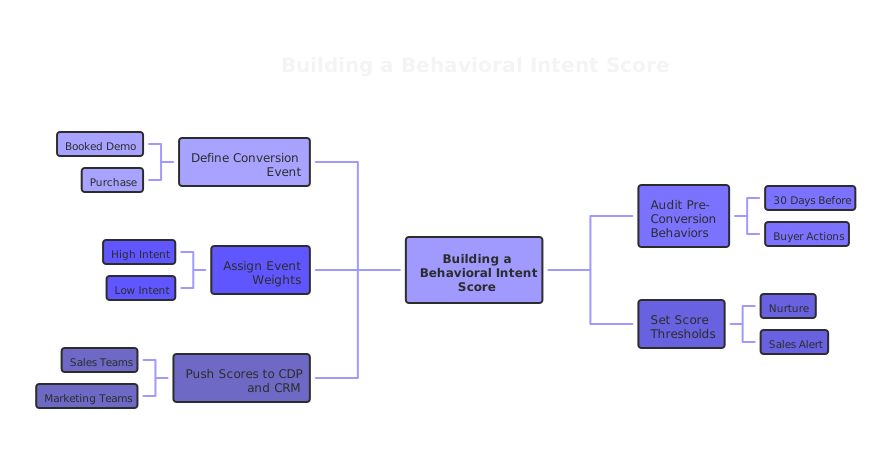
How to Build a Behavioral Intent Score
Step 1: Define Your Conversion Event
Pick one conversion event to optimize toward first. Demo booked. Trial activated. Purchase completed. Do not try to predict everything at once. A model with one clear target works better than one trying to satisfy multiple goals.
Step 2: Audit the Behaviors That Precede Conversion
Look at your existing converted customers. What did they do in the thirty days before converting? Which pages did they visit? Which emails did they open? How many sessions did they have? How long did they spend on your site?
This is your signal library. You are not inventing what matters. You are reading what already happened.
Step 3: Assign Event Weights
Not all behaviors are equal. Visiting your homepage is lower intent than visiting your pricing page. Opening a newsletter is lower intent than clicking through to a product comparison page.
Assign point values to each event based on how strongly that event correlates with conversion. This can start simple. A pricing page visit might be worth 15 points. A return visit within seven days might add 10. Clicking a demo CTA but not completing the form might add 20.
Over time, you can use logistic regression or a machine learning model to set these weights more precisely. But starting with a well-reasoned point system is better than waiting for perfect data.
Step 4: Set Score Thresholds
Define what score means what action. A score above 70 might trigger a sales alert. A score between 40 and 70 might trigger a nurture sequence. Below 40, keep them in standard marketing flow.
These thresholds should reflect your pipeline capacity and your sales team's follow-up speed. A threshold that floods your sales team with low-quality alerts is as bad as no scoring at all.
Step 5: Push Scores Into Your CDP or CRM
A score that lives in a spreadsheet or a standalone analytics tool does not move pipeline. It needs to live where action happens.
Your CDP is the right home for this. It unifies behavioral data from multiple sources, maintains a persistent profile per person, and can push scores downstream into your CRM, your email platform, your ad audiences, and your sales engagement tools.
If you do not have a CDP yet, this is one of the clearest business cases for getting one. The operational value of having intent scores flow automatically to sales is direct and measurable.
A Real Scenario: When Scoring Changes the Conversation
Consider a B2B software company with a healthy website, modest paid media budget, and a sales team frustrated by low conversion rates from marketing leads.
They had traditional lead scoring based on job title and form fills. A VP who downloaded a whitepaper got a high score. Their sales team called those leads. Half of them had no recollection of downloading anything.
They rebuilt their scoring around behavioral signals. Return visits to the pricing page within fourteen days became the single highest-weight signal. Followed by email click-throughs to product pages. Then webinar attendance.
The new model surfaced a smaller number of leads. But the leads it surfaced converted at a meaningfully higher rate. Sales calls became shorter because the conversations were warmer. The pipeline math improved not because they generated more leads, but because they stopped wasting effort on the wrong ones.
That is the operational shift conversion prediction enables.
Common Mistakes to Avoid
Scoring recency without decay. A lead who was highly active six months ago but has gone quiet since is not a hot prospect. Your model needs a decay function that reduces scores for contacts who have not engaged recently.
Treating all channels equally. A pricing page visit from an organic search carries different intent weight than the same visit from a retargeting ad click. Source context matters.
Ignoring negative signals. Unsubscribes, support complaints, and long dormancy are signals too. A good intent model should be able to lower scores, not just raise them.
Building a score and forgetting it. Markets change. Buyer behavior shifts. A model trained on last year's data will drift. Plan a quarterly review of your signal weights and thresholds.
What Propensity Scoring Adds to the Picture
Propensity scoring is a specific form of conversion prediction that estimates the probability of a future action using historical patterns. Where basic event scoring adds points for actions taken, propensity scoring uses a statistical model to produce a true probability, a number between 0 and 1 that reflects how likely conversion is.
CDPs with built-in machine learning capabilities can generate propensity scores automatically as new behavioral data comes in. This is what makes real-time scoring possible. As a contact browses your site, their score updates. When they cross a threshold, the downstream action fires immediately.
Real-time propensity scoring is the difference between calling someone the day after they peaked in intent and calling them while they are still on your site.
Privacy, Compliance, and First-Party Discipline
Any intent model built on behavioral data carries compliance responsibilities. Regulations like CCPA require transparency about data collection and clear opt-out mechanisms. GDPR equivalents apply across other markets.
The practical answer here is first-party discipline. Collect what you need. Be transparent about it. Give users control. A well-governed first-party data strategy is not just a legal requirement. It is also a competitive advantage, because it produces cleaner, more reliable signals than data collected through opaque third-party means.
Build your compliance posture into your CDP architecture from the start, not as an afterthought.
Frequently Asked Questions
What is the difference between lead scoring and conversion prediction?
Lead scoring typically uses static attributes like job title, company size, and form activity to rank leads. Conversion prediction uses dynamic behavioral signals and statistical models to estimate the probability of a specific future action. Conversion prediction is more accurate and more actionable because it reflects what someone is doing right now, not just who they are.
How many behavioral signals do I need to start?
Five to ten well-chosen signals are enough to build a working model. More signals do not automatically mean better predictions. What matters is that your signals are closely tied to actual conversion behavior in your historical data.
Can small businesses use conversion prediction?
Yes. You do not need enterprise infrastructure to start. A marketing automation platform with basic event tracking, a well-structured CRM, and a clear point-based scoring model can get you meaningful results. Complexity can come later, once you have proven the value.
How often should I retrain or review my model?
Review your signal weights and score thresholds at least quarterly. If your conversion rates shift significantly, review sooner. Model drift is real, and a stale model can do more harm than no model at all.
Where to Go from Here
The most important decision you can make is to start with your own data.
Pull a list of your last fifty converted customers. Look at what they did in the thirty days before conversion. That analysis alone will show you which signals matter most in your specific market.
From there, the path is straightforward. Define your target event. Weight your signals. Set your thresholds. Connect your scoring to the systems where sales and marketing actually work.
If your current stack makes that difficult, or if your data is scattered across tools that do not talk to each other, that is a solvable architecture problem. At House of MarTech, we help teams build the CDP and integration layer that makes intent scoring operational, not theoretical.
The goal is simple. Stop guessing who will buy. Start knowing.
That shift, from clicks to probability scores to pipeline, is where conversion prediction earns its place in your stack.
Related Articles
Need Help Implementing?
Get expert guidance on your MarTech strategy and implementation.
Get Free Audit