
Behavioral Signals to Intent Models: How to Turn Clicks Into Conversion Prediction
Turn behavioral signals into intent models that predict conversions. Business leaders: operationalize CDP-ready scores from raw data to revenue impact.


Listen to summary
0:00 audio overview
Behavioral Signals to Intent Models: How to Turn Clicks Into Conversion Prediction
Your pipeline looks healthy on paper. Plenty of clicks, solid open rates, leads moving through the funnel. Then end of quarter arrives, and the numbers don't match the activity.
That gap is a data problem. Not a volume problem.
Most marketing teams collect enormous amounts of behavioral data. Page visits, email opens, video views, form interactions. They sit inside your analytics platform or your CRM, mostly unused for anything beyond reporting. The insight buried in that data, which pages signal real buying intent versus casual curiosity, which sequences of actions reliably precede a purchase, gets ignored because nobody built the bridge between raw behavior and a usable score.
That bridge is an intent model. And building it correctly is one of the highest-value things you can do with your customer data platform.
What Is an Intent Model, Exactly?
An intent model is a scoring system that assigns a probability to each contact or account. The probability answers one question: how likely is this person to convert right now?
It is not a simple lead score based on job title and company size. Those are demographic signals. Intent models run on behavioral signals, the actions people take, not just who they are.
The difference matters. A VP of Marketing at a 500-person SaaS company is a good demographic fit. But if she visited your pricing page three times this week, downloaded your ROI calculator, and opened four emails in five days, she is showing buying intent. That combination of behaviors is worth far more than her job title alone.
A well-built intent model reads those behavioral sequences and outputs a score your sales and marketing teams can actually act on.
The Signal Types That Actually Matter
Not all behavioral data carries equal weight. Before you can build a conversion prediction model, you need to understand the signal hierarchy.
High-intent signals are actions that happen close to a purchase decision:
- Pricing page visits
- Demo requests or scheduling tool interactions
- ROI or cost calculator usage
- Comparison content consumption (your product vs. alternatives)
- Return visits within a compressed timeframe
Mid-intent signals show active research without immediate urgency:
- Multiple blog posts read in one session
- Case study or customer story downloads
- Webinar registration and attendance
- Email click-through on product-specific content
Low-intent signals indicate awareness without clear direction:
- Single blog post visits from organic search
- Social media content engagement
- Newsletter opens with no subsequent click
The mistake most teams make is treating all signals equally, or worse, only scoring explicit form fills. Real conversion prediction requires weighting signals by their proximity to purchase behavior.
Probabilistic vs. Deterministic Intent: Which Approach Is Right?
This is where intent models get interesting, and where most off-the-shelf tools fall short.
Deterministic intent is clean and simple. A contact fills out a form, books a demo, or responds to a sales email. You know exactly what they did. The intent is confirmed by an explicit action.
Probabilistic intent is messier and more valuable. It combines multiple indirect signals to estimate buying likelihood before someone takes an explicit action. You are predicting conversion, not just confirming it after the fact.
The honest truth: deterministic signals are too late for proactive selling. By the time someone books a demo, they have already made most of their decision. Probabilistic intent models let you identify and engage high-likelihood converters days or weeks earlier.
The trade-off is accuracy. Probabilistic models carry uncertainty. A contact with a high intent score might still not convert. That is expected. The goal is not perfection. The goal is shifting your odds, focusing sales attention on the 20% of your pipeline most likely to close.
What Is a CDP-Ready Intent Score?
A CDP-ready intent score is an intent score that lives inside your customer data platform as a usable attribute, not a number trapped inside a siloed analytics tool.
Here is why that distinction matters. An intent score your sales team cannot see in their CRM is useless. An intent score that does not trigger automation in your email platform is decoration. A score becomes operational when it flows into every system that touches the customer.
A properly structured CDP-ready intent score has three components:
- A numerical value (0-100 works; percentiles also work) representing conversion probability at a point in time
- A recency component that decays the score if engagement drops off, because old intent is not intent
- A segment tag that places the contact into an actionable bucket (High Intent, Warming, Cooling, Cold)
That segment tag is what makes the score useful downstream. You can build email sequences, ad suppression lists, sales task triggers, and content recommendations directly from it.
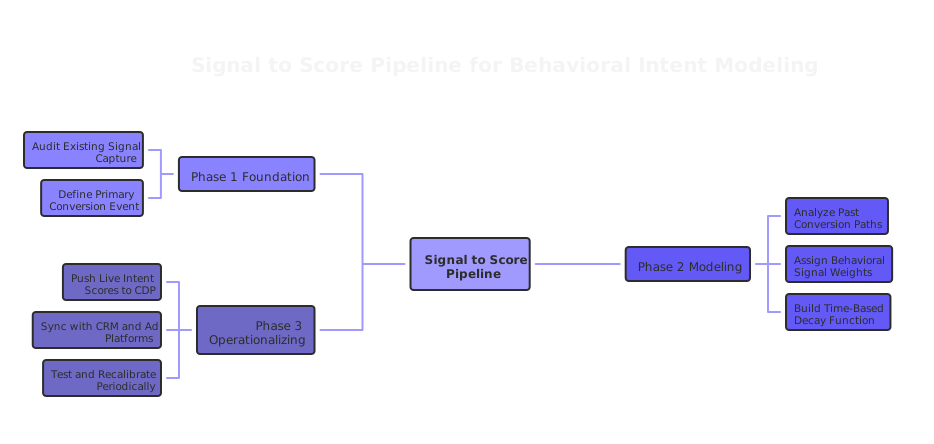
Building the Signal-to-Score Pipeline: A Practical Approach
Here is the operational sequence that moves you from raw behavioral data to a working conversion prediction system.
Step 1: Audit your existing signal capture
Before you build a model, know what you are actually collecting. Map every touchpoint: website analytics, email platform, CRM activity logs, ad platform engagement, product usage data if you have it. Identify the gaps. Many teams discover they are missing pricing page visit data, or that their email platform and CRM are not syncing behavioral events properly.
Step 2: Define your conversion event
What does "conversion" mean in your context? A closed deal, a demo booked, a free trial started? Pick one primary conversion event as your model target. You can build additional models later. Start with the event that directly impacts revenue.
Step 3: Analyze the historical path to conversion
Pull your last 6-12 months of converted customers. Look backward. Which behaviors consistently appeared before conversion? How many pricing page visits? What was the typical time between first visit and conversion? Which content assets appeared in most conversion paths? This analysis is the foundation of your scoring weights.
Step 4: Assign signal weights
Based on your historical analysis, assign point values to each signal type. High-intent signals might carry 15-25 points each. Mid-intent signals 5-10. Low-intent signals 1-3. Your scoring model should reflect the actual predictive power of each signal in your specific business, not a generic template.
Step 5: Build the decay function
Intent fades. A contact who visited your pricing page 90 days ago and has been silent since is not a hot lead. Build time-based decay into your model. A simple approach: full score value within 7 days, 50% at 30 days, 20% at 60 days, zero at 90 days.
Step 6: Push scores to your CDP as a live attribute
This is the step that most teams skip or under-build. Your intent score needs to update automatically, at least daily, and write to a named field in your CDP. From there, it syncs to your CRM, your email platform, and your ad audiences. The score is only valuable when systems can read it.
Step 7: Test and recalibrate
After 60-90 days, compare your high-intent cohort's actual conversion rate against your overall baseline. If your model is working, high-intent contacts should convert at a meaningfully higher rate. If the lift is weak, revisit your signal weights. Models improve with iteration.
A Scenario Worth Walking Through
Consider a B2B software company selling project management tools. Their sales team complained that leads from their content marketing program were cold and rarely converted.
The problem was not the content. It was that the team was treating all content leads the same. Someone who read one SEO blog post and bounced was getting the same follow-up sequence as someone who read three articles, downloaded a comparison guide, and visited the pricing page.
When they built a behavioral intent model, separating passive content consumers from active researchers, the high-intent segment converted at four times the rate of the overall content lead pool. The sales team did not have to work harder. They had to work on the right people.
That is what conversion prediction actually does. It is not magic. It is prioritization at scale.
Common Mistakes That Break Intent Models
Scoring activity volume instead of signal quality. Ten email opens without a click is less meaningful than one pricing page visit. Volume-based scoring rewards engagement theater, not buying intent.
Ignoring negative signals. Contacts who unsubscribe, visit your careers page repeatedly, or engage only with top-of-funnel thought leadership content are probably not buyers. Build score reducers for these behaviors.
Building the model once and never updating it. Your customer's buying behavior shifts. Your product changes. New content attracts different audiences. Intent models require quarterly review at minimum.
Keeping scores in analytics silos. A score that does not flow to every system touching the customer is a missed opportunity. CDP integration is not optional. It is the whole point.
Frequently Asked Questions
What data do I need to start building an intent model?
At minimum: website behavioral data (page visits, time on site, specific page flags), email engagement data (opens and clicks by content type), and CRM activity data. More signal sources improve accuracy, but you can build a useful starting model with those three.
How is this different from traditional lead scoring?
Traditional lead scoring weights demographic and firmographic data heavily, company size, industry, job title. Intent models weight behavioral signals, the actions a person takes, more heavily. The two approaches work well together. Behavioral intent scoring tells you who is ready. Demographic scoring tells you if they are the right fit.
Do I need a CDP to run intent models?
You need a system that can unify data from multiple sources, calculate and store a score as a contact attribute, and push that attribute to downstream tools. A properly configured CDP is the cleanest infrastructure for this. It is possible to approximate this with a CRM and marketing automation platform, but the data unification gets harder without a dedicated CDP layer.
Where House of MarTech Fits In
Building intent models is not just a data science project. It is a systems design project. The model needs clean, unified behavioral data flowing in. It needs to output scores that every downstream tool can use. It needs governance so the model gets reviewed and improved, not abandoned.
This is the operational work House of MarTech does with clients. We help you audit your behavioral signal capture, design the scoring architecture, integrate scores into your CDP and connected platforms, and build the review process that keeps the model accurate over time. If you are sitting on good behavioral data but not doing anything productive with it, that is a solvable problem.
The Takeaway
Behavioral signals are not a novelty. They are the most honest signal you have about what a buyer is actually thinking. Every session on your pricing page, every returned visit, every email click on product-specific content is a data point that says something real.
Conversion prediction is the discipline of reading those signals systematically instead of anecdotally. When you build that discipline into your CDP infrastructure, you stop guessing which leads to prioritize. You know.
Start with your historical conversion data. Find the behavioral patterns that precede your best deals. Build scores that reflect those patterns. Push them into every system that needs them.
That is the whole model. The execution is where it gets precise, and where the revenue impact becomes real.
Related Articles
Need Help Implementing?
Get expert guidance on your MarTech strategy and implementation.
Get Free Audit