
Data Privacy Compliance in MarTech 2026: GDPR, CPRA, and Global Consent Management Architecture
Navigate GDPR, CPRA, and global privacy laws in your MarTech stack. Complete consent management architecture and compliance framework for 2026.


TL;DR
Quick Summary
Listen to summary
0:00 audio overview
Data Privacy Compliance in MarTech 2026: GDPR, CPRA, and Global Consent Management Architecture
Quick Answer
Picture this. Your marketing team just launched a retargeting campaign. It runs for two weeks. Then your legal team calls. A state regulator noticed your site was not honoring Global Privacy Control signals. You were collecting data on users who had already opted out. The campaign is paused. Legal fees stack up. And customers who trusted you now have a reason not to.
That scenario is not hypothetical anymore. It happened to real companies in 2025. And it is happening more frequently in 2026.
Martech data privacy compliance is no longer a legal checkbox. It is an operational requirement baked into how your marketing technology stack works, day to day.
Here is what you need to know, and what you need to do.
The Regulatory Landscape Is Not Getting Simpler
There is no single federal privacy law in the United States. That means you are navigating a patchwork of state laws, and that patchwork is growing.
As of early 2026, twenty U.S. states have comprehensive privacy laws. Indiana, Kentucky, and Rhode Island joined the list on January 1, 2026. Each state has its own rules. Different thresholds. Different definitions of sensitive data. Different timelines for honoring consumer requests.
Waiting for federal harmonization is not a strategy. It has not happened in decades, and it is not happening soon. Your martech data privacy compliance approach has to work across multiple, overlapping frameworks at the same time.
On the European side, GDPR enforcement has matured well past the early warning phase. Total fines exceeded 4.5 billion euros by end of 2025. Enforcement is moving downstream, away from only the largest tech platforms and toward mid-market businesses that process EU personal data without solid compliance infrastructure. The European Commission is also proposing updates to GDPR itself, with AI-specific provisions that would embed algorithmic accountability directly into data protection law.
California remains the most active enforcement state in the U.S. The California Privacy Protection Agency (CPPA) now operates with the largest team of privacy enforcement litigators and technologists in the country. Their 2025 annual report made the direction clear: they have moved from rulemaking to sustained enforcement.
The message across all jurisdictions is the same. Regulators are done waiting.
What Regulators Are Actually Checking Now
The enforcement shift in 2026 is not just about who gets fined. It is about what regulators are looking for.
They are checking technical truth, not just policy documents.
A privacy policy that says you respect opt-outs means nothing if your pixels still fire after a user opts out. Regulators in California, Colorado, and Connecticut coordinated enforcement sweeps in September 2025, using automated website scanning to find businesses that accepted Global Privacy Control (GPC) signals but continued collecting data anyway. They sent warning letters. Enforcement actions followed.
This is systematic. It is not manual. Regulators are running technical audits at scale.
The specific areas under enforcement scrutiny right now include:
- GPC signal honoring. If a user's browser sends a GPC opt-out signal, you must stop collecting and selling their data. Full stop.
- Children's data. CCPA now classifies data from users under 16 as sensitive personal information. COPPA amendments from April 2025 tightened requirements for under-13 data. This is a top enforcement priority.
- Automated decision-making. California's new ADMT rules require opt-out mechanisms for significant automated decisions and risk assessments for high-risk AI uses. Compliance begins in 2027, but documentation must start now.
- Data broker registration and deletion. California's DROP platform went live in 2026. Registered data brokers must honor deletion requests within 90 days. Audit trails are required.
If your martech data privacy compliance strategy is built around a cookie banner and a privacy policy PDF, you are exposed.
The Core Problem: Client-Side Consent Is Breaking Down
Most companies still rely on client-side consent management platforms (CMPs). A JavaScript tag loads on your site. A banner appears. The user clicks. Consent is stored in a browser cookie.
That model has a fundamental flaw. Ad blockers, Safari's Intelligent Tracking Prevention, and Firefox's privacy mode can all interfere with client-side scripts. Your CMP may think consent was captured. Your analytics platform may think a user consented. But the actual enforcement, the part that decides which pixels fire, can break silently.
This is not a theoretical risk. It is the technical gap that regulators are now trained to find.
The answer is server-side consent architecture.
Server-Side Consent Architecture: How It Works
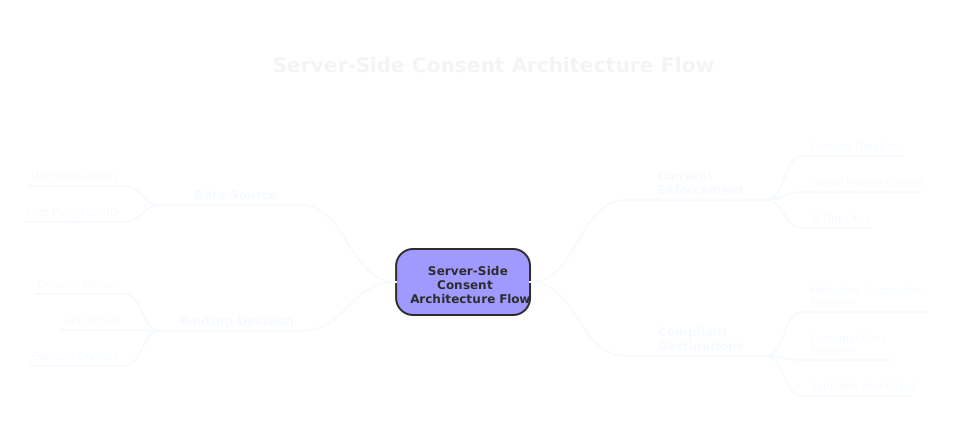
Server-side consent moves the enforcement decision from the browser to your own servers. Here is the practical difference.
In a client-side model, consent is stored in a browser cookie. Every tag on your page checks that cookie before loading. If the cookie is blocked or cleared, the tag may load anyway.
In a server-side model, consent is stored on your server, tied to a user identifier. Every data request, whether from web, mobile, or a backend process, queries the server for that user's consent status before collecting or passing data. The decision happens on infrastructure you control, not inside a browser you cannot control.
This is harder to set up. It requires API-first data pipelines, first-party identity solutions like email hashing or your own user IDs, and documented governance around how consent records are stored, synced, and audited. But it gives you something client-side CMPs cannot: a verifiable audit trail proving that consent was honored.
That audit trail is what regulators are increasingly asking for.
If you are working with a MarTech partner like House of MarTech on your consent architecture, the conversation starts with your data flows, not your banner settings.
Data Minimization Is Not a Constraint. It Is a Strategy.
Here is the part most marketing teams resist: collecting less data is often better for performance.
Personalization does not improve automatically because you collect more data. It improves when you collect the right data, data that is accurate, purposeful, and tied to a clear use case. Excessive collection creates noise, increases breach risk, and makes it harder to justify each data point under GDPR's purpose limitation principle.
Organizations that have adopted data minimization as an operational discipline report measurable results. One mid-sized ecommerce company switched from cookie-based retargeting to first-party data collected through surveys and feedback flows. Repeat purchases increased by 22%. Engagement scores increased by 18%.
Another company updated its opt-in flows to be clearer and less coercive. Churn dropped by 15%.
These are not edge cases. They reflect a pattern: privacy-first data is smaller but more trustworthy, and trustworthy data performs better.
Practical martech data privacy compliance implementation around data minimization looks like this:
- Audit your forms. Remove fields you are not actively using in campaigns or models. Use progressive profiling to capture data gradually.
- Audit your CRM and MAP fields. Delete custom fields that have no documented use case.
- Review retention schedules. Data kept longer than necessary is data you are liable for.
- Document every AI training dataset. If you cannot justify why a specific field is in a model, it should not be there.
First-Party and Zero-Party Data: Your Most Defensible Asset
Third-party data has become less reliable. Regulatory constraints, browser restrictions, and declining consumer tolerance for invisible tracking have all contributed. The sustainable alternative is data customers give you directly.
Zero-party data is information customers volunteer in exchange for value. Loyalty programs that offer early access or personalized offers. Post-purchase surveys. Style quizzes. Preference centers. These are not just compliance tools. They are relationship tools.
Customers who share data through an explicit value exchange are telling you something real. That signal is more accurate than inferred behavior from cookies. It is also fully consent-based, which makes it defensible under every jurisdiction you operate in.
Build your martech data privacy compliance strategy around this principle: every data request should come with a proportionate benefit. If the customer cannot see what they gain by sharing something, you are asking for surveillance, not insight.
Privacy Maturity Has a Dollar Value
The Cisco Privacy Maturity Benchmark Study found that privacy-mature organizations experience an average sales cycle delay of 3.4 weeks compared to 16.8 weeks for privacy-immature organizations. That is an 80% reduction.
Think about what that means for revenue. If a $100,000 monthly contract closes twelve weeks sooner, that is $300,000 in accelerated revenue from privacy infrastructure alone.
Privacy-mature companies also experience data breach losses exceeding $500,000 at 39% frequency, compared to 74% for privacy-immature companies.
These numbers make the business case plainly. Martech data privacy compliance best practices are not just about avoiding fines. They are about operating faster, losing less, and building customer relationships that last.
What Good Governance Actually Looks Like
Most organizations do not fail at privacy because they are careless. They fail because privacy is owned by nobody and nobody is accountable for the details.
Good governance changes that. It means:
A cross-functional committee with real authority. Legal, compliance, IT, and marketing need to meet regularly and make actual decisions together. Not just share updates.
A living data inventory. You need to know what data you collect, why you collect it, where it lives, who has access, how long you keep it, and with whom you share it. If that document does not exist, nothing else in your compliance program can work.
Vendor accountability. Every vendor that touches customer data needs a current Data Processing Agreement. Vendor audits should be scheduled, not reactive.
Documented AI use cases. If you use AI for targeting, segmentation, scoring, or recommendations, document the data inputs, the decision criteria, and the testing process. California's ADMT rules require it. Good governance demands it regardless.
Regular testing. Your GPC signal handling, opt-out flows, and consent enforcement should be tested the same way you test your website. Scheduled. Documented. Fixed when broken.
At House of MarTech, we help teams build this infrastructure from the ground up, connecting the governance layer to the actual technology stack so compliance is operational, not theoretical.
AI and Privacy Are Now the Same Problem
The EU AI Act and California's ADMT rules have made something clear: if your AI touches customer data, your AI is a privacy compliance problem.
That means every predictive model, recommendation engine, and scoring algorithm in your martech stack now needs to be documented, risk-assessed, and in some cases subject to customer opt-out rights.
This is not a future concern. Risk assessment documentation for high-risk AI uses must be started now in California, even though enforcement begins in 2027. The EU AI Act is already in effect for high-risk categories.
Governance frameworks for AI and privacy are converging. Organizations that treat them as separate programs will build redundant processes and miss coverage gaps. The better approach is a single framework that covers both, with shared ownership and integrated documentation.
Your Next Steps Are Specific, Not General
Martech data privacy compliance strategy works when it is tied to concrete actions, not broad commitments.
Start here:
- Map your data flows. Identify every point where customer data enters, moves through, or leaves your stack.
- Test your GPC signal handling. Use a GPC-enabled browser and verify your site stops data collection when the signal is present.
- Audit your CMP. Is it client-side only? Does it produce a verifiable consent log? Can it honor server-side requests?
- Inventory your AI uses. Document every automated decision that touches a customer. Assess which ones require opt-out mechanisms under California law.
- Review your vendor agreements. Every vendor processing personal data needs a current DPA.
- Schedule a data minimization audit. Remove data you are not using. Update retention schedules. Cut fields that have no documented use case.
Privacy compliance in 2026 is technical, operational, and organizational. It cannot be solved with a banner and a policy page.
If your current setup cannot produce a verifiable consent log, honor GPC signals at a technical level, or document every AI use case touching customer data, you have work to do. The good news is that doing this work builds a stronger marketing foundation, not just a cleaner compliance record.
Organizations that get this right collect less data, trust it more, and do more with it. That is the actual opportunity in martech data privacy compliance. Not avoiding fines. Building something better.
Frequently Asked Questions
Get answers to common questions about this topic
Have more questions? We're here to help you succeed with your MarTech strategy. Get in touch
Related Articles
Need Help Implementing?
Get expert guidance on your MarTech strategy and implementation.
Get Free Audit