
CDP ROI: Systematic Analysis
Most CDP projects fail not because of bad technology, but because of bad measurement. Here is a systematic way to evaluate what your CDP is actually worth.


Listen to summary
0:00 audio overview
CDP ROI: A Systematic Way to Measure Real Returns
You bought the CDP. The vendor promised unified data, better personalization, and higher revenue. Now your CFO wants to know what the thing actually cost and what it returned.
This is the moment most marketing teams dread. Not because the CDP did nothing. Because they never built a system to measure what it did.
CDP ROI is not a mystery. It is a measurement problem. And measurement problems have solutions.
Why Most CDP ROI Conversations Go Badly
The vendor pitch focuses on possibilities. The implementation focuses on data pipelines. Nobody stops to define what "success" looks like in dollars before the contract is signed.
Then, six months later, you are trying to reverse-engineer value from a platform that was never set up with measurement in mind.
This is not a technology failure. It is a planning failure.
The good news: you can fix it, even after the fact. But you need a systematic approach.
What CDP ROI Actually Means
CDP ROI is the financial return your business gets from unifying customer data, compared to what you spent to build and run that system.
It sounds simple. It rarely is.
The challenge is that a CDP does not generate revenue directly. It enables other things to generate revenue. That one layer of separation is where measurement falls apart.
You need to trace the path from data to decision to outcome. Every time.
Here is a useful way to think about it:
CDP ROI = (Revenue Enabled by Better Data) minus (Total Cost of Ownership) divided by (Total Cost of Ownership)
That formula is basic. What matters is how you fill it in honestly.
The Three Things a CDP Can Actually Improve
Before you measure anything, get clear on what your CDP was supposed to do. Most CDPs create value in one of three ways:
1. Better Segmentation
When your customer data is unified, you can build segments that were impossible before. A customer who bought in-store, browsed online, and called support three times is one person with a full story. Without a CDP, they look like three separate contacts.
Better segmentation leads to more relevant campaigns. More relevant campaigns lead to higher conversion rates. That is a measurable path.
2. Faster Activation
With a CDP, your marketing team does not have to wait for the data team to pull a list. They can build and activate a segment themselves. That speed has real value.
If a campaign that used to take two weeks to launch now takes two days, you have 12 extra campaign cycles per year. At even modest revenue per campaign, that compounds quickly.
3. Reduced Waste
Suppression is one of the most underrated CDP use cases. When you know a customer already converted, you stop spending money showing them ads to convert. When you know someone churned, you can route them to a win-back flow instead of a retention flow that does not apply.
Wasted ad spend is a real cost. A CDP that eliminates it has real ROI.
A Systematic Framework for Measuring CDP ROI
Here is the process that actually works. It is not glamorous. It is structured.
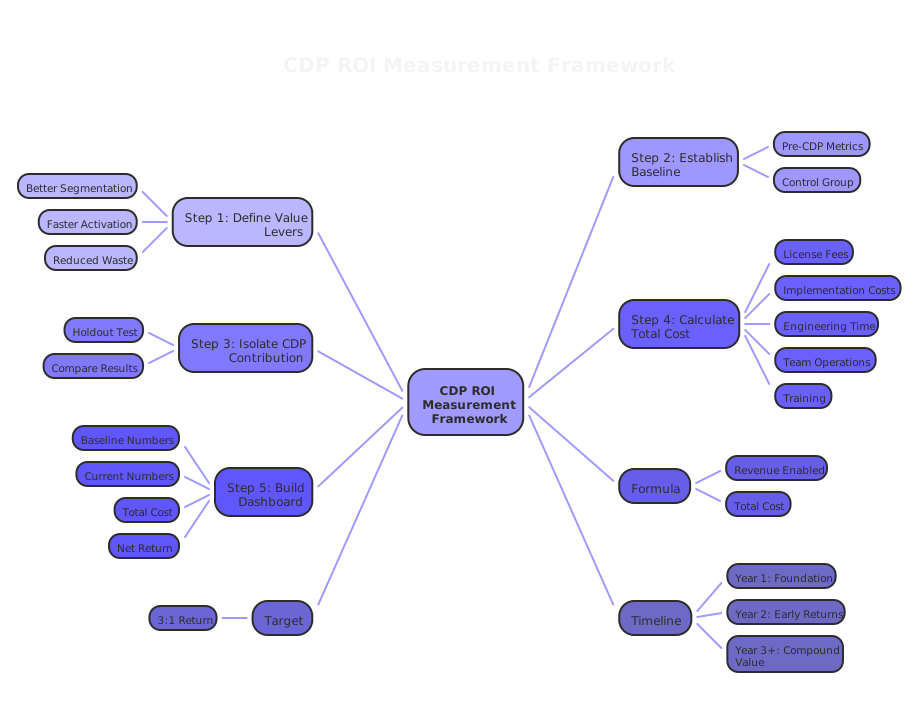
Step 1: Define Value Levers Before You Measure
Pick no more than three specific outcomes you expect the CDP to improve. Write them down. Examples:
- Email conversion rate on segmented campaigns
- Cost per acquisition on paid social
- Time from data request to campaign launch
If you try to measure everything, you measure nothing. Pick the levers that matter most to your business right now.
Step 2: Establish a Baseline
What were those numbers before the CDP? If you do not have pre-CDP data, find a proxy. Use the campaigns or segments that are not yet running through the CDP as a control group.
You need something to compare against. Without a baseline, you have a story, not evidence.
Step 3: Isolate the CDP's Contribution
This is the hardest part. Other things change at the same time as your CDP implementation. New team members. New creative. New market conditions.
You cannot control all of it. But you can be honest about what you are attributing to the CDP and why.
One practical approach: run a holdout test. Take a segment you are activating through the CDP and split it. Send half through the CDP-powered workflow. Send the other half through the old workflow. Compare the results.
This is not perfect science. It is good enough for business decisions.
Step 4: Calculate Total Cost of Ownership
Most CDP ROI analyses undercount costs. Make sure you include:
- Licensing or subscription fees
- Implementation and integration costs
- Ongoing data engineering time
- Internal team time to manage the platform
- Training and change management costs
If your CDP costs $80,000 per year in software but requires $120,000 in engineering support, the real cost is $200,000.
Step 5: Build a Simple Dashboard
You do not need a complex model. You need a single document that shows:
- The value levers you chose
- The baseline numbers
- The current numbers
- The cost of the platform
- The net return
Review it quarterly. Update it honestly. Share it with leadership before they ask for it.
A Real Scenario Worth Walking Through
Consider a mid-size e-commerce brand with a customer database spread across three systems: their e-commerce platform, their email tool, and their loyalty program.
Before the CDP, their retargeting ads were hitting recent buyers because the e-commerce and ad platforms did not sync in real time. They were spending money on people who had already converted.
After implementing a CDP and connecting those three data sources, they built a real-time suppression list. Customers who purchased in the last 30 days were removed from paid retargeting automatically.
The result was not a new revenue stream. It was a cost reduction. The same ad budget reached more unconverted prospects. Cost per acquisition dropped. That is a real return.
And it is easy to measure. Compare ad spend and CPA before and after suppression was activated. The CDP's contribution to that change is clear.
This kind of win is not flashy. But it is quantifiable, defensible, and repeatable.
What a Healthy CDP ROI Looks Like by Stage
CDP ROI is not static. It grows as your team gets better at using the platform.
Year 1: You are mostly paying to unify data and fix integration issues. ROI is low or negative. This is normal. You are building the foundation.
Year 2: Your team starts activating the unified data. Campaigns improve. You see early returns on the value levers you defined. ROI starts to turn positive.
Year 3 and beyond: You have real data to work with. You can personalize at scale. You can test and iterate quickly. ROI compounds.
If you are in Year 3 and still waiting for the value, the problem is not the technology. It is the strategy around it.
The Mistakes That Kill CDP ROI
These are the patterns we see most often at House of MarTech when we audit stalled CDP implementations:
Measuring too broadly. "Our CDP improved marketing" is not a measurable outcome. "Our CDP reduced cost per acquisition by 18% on paid social" is.
Ignoring the cost of complexity. A CDP that requires three full-time engineers to maintain is not delivering the same ROI as one your team can operate independently. Factor in complexity.
Skipping the baseline. You cannot prove value you did not measure before you started.
Confusing activity with outcome. Segments created, profiles unified, integrations built. These are inputs. Revenue, cost reduction, and time savings are outputs. Measure outputs.
Setting it and forgetting it. A CDP needs ongoing attention. Segment logic drifts. Data quality degrades. Connections break. If nobody owns the platform, it stops delivering value quietly.
How to Have the CDP ROI Conversation With Your CFO
Your CFO does not want to hear about unified profiles. They want to hear about money.
Come to that conversation with:
- What you invested (total cost of ownership, not just license fees)
- What changed (specific metrics before and after)
- Why you believe the CDP caused the change (your measurement methodology)
- What the next 12 months of investment will return
If you cannot answer those four questions, you are not ready for the conversation. If you can, it goes well.
What Is a Good CDP ROI?
There is no universal benchmark. It depends on your industry, your data volume, and what you were doing before the CDP.
That said, a reasonable target for a mature CDP implementation is a 3:1 return on total investment. For every dollar spent on the platform, including engineering and operations, you want three dollars back in measurable value.
If you are below that, look at your value levers first. Are you using the CDP for the things that actually move revenue? If you are above it, look for ways to expand usage before you invest in additional tools.
FAQ: CDP ROI
What is CDP ROI?
CDP ROI is the financial return your business gets from a customer data platform relative to what you spent to implement and run it. It is measured by tracking specific business outcomes that the CDP enables, like better segmentation, reduced ad waste, or faster campaign activation.
How long does it take to see CDP ROI?
Most organizations see limited returns in Year 1, when the focus is on implementation and data unification. Meaningful ROI typically appears in Year 2 and grows through Year 3 as teams build capability around the platform.
How do I calculate CDP ROI?
Start with total cost of ownership, including software, implementation, engineering, and team time. Then identify two to three specific business outcomes the CDP improved. Measure the financial value of those improvements and compare it to your total cost.
Why is CDP ROI hard to measure?
CDPs do not generate revenue directly. They enable other marketing and sales activities to perform better. That one layer of separation makes attribution harder. The solution is to define clear value levers before implementation and measure them with a baseline and a holdout group where possible.
Your Next Step
If you are struggling to prove CDP ROI, start small. Pick one value lever. Build a baseline. Run one test. Document the result.
You do not need a perfect measurement system on day one. You need a habit of honest, consistent measurement.
If your CDP implementation is stalled, or you are about to start one and want to build measurement in from the beginning, that is exactly the kind of work we do at House of MarTech. We help teams connect the strategy to the system and make sure the investment is traceable to real business outcomes.
The technology is the easy part. The measurement discipline is where value gets made.
Related Topics
Related Articles
Need Help Implementing?
Get expert guidance on your MarTech strategy and implementation.
Get Free Audit