
Measuring CDP Success & ROI
Most teams measure their CDP wrong from day one. Here is how to build a measurement approach that shows real results in months, not years.


TL;DR
Quick Summary
Listen to summary
0:00 audio overview
Quick Answer
You invested in a Customer Data Platform. You unified customer profiles. You connected the data sources. Now someone in leadership asks the inevitable question: "So what is it actually doing for us?"
If you hesitate before answering, you are not alone.
Most CDP measurement approaches fail before they start. Not because the platform is bad. Not because the data is wrong. Because teams measure the wrong things, in the wrong order, with no clear line back to revenue.
This post gives you a systematic way to fix that.
Why Most CDP ROI Efforts Fall Apart
Here is the honest problem: most teams treat CDP measurement like a report card. They wait six months, pull some numbers, and try to reverse-engineer a story about impact.
That is not measurement. That is guessing with extra steps.
The real issue is a missing baseline. If you did not document what your customer data looked like before the CDP, you have nothing to compare against. You cannot prove improvement without a starting point.
The second issue is measuring platform activity instead of business outcomes. "We unified 400,000 profiles" is not ROI. "We reduced customer acquisition cost by 18% because we stopped targeting people already in our database" is ROI.
Activity tells you the CDP is running. Outcomes tell you the CDP is working.
What Does CDP ROI Actually Mean?
Measuring success and ROI of a Customer Data Platform means connecting three things: what the platform does, what your team does with it, and what your business gains as a result.
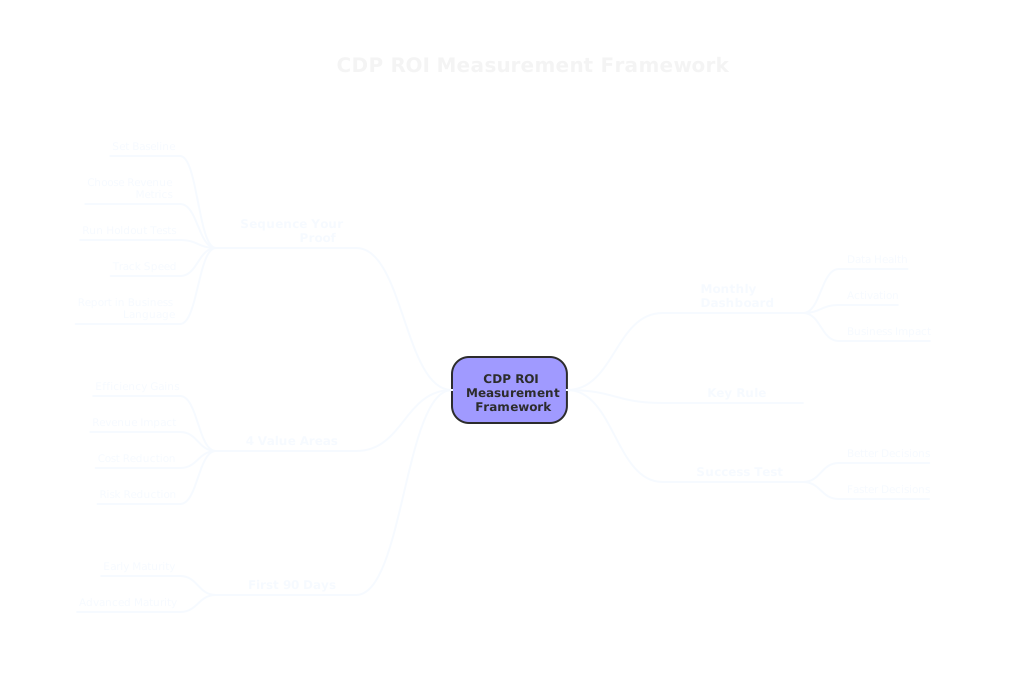
A CDP creates value in four main areas:
1. Efficiency gains. Your team spends less time pulling and cleaning data. Campaigns launch faster. Fewer hours go into manual segmentation.
2. Revenue impact. Better data leads to better targeting. Better targeting leads to higher conversion. Higher conversion means more revenue from the same ad spend.
3. Cost reduction. You stop paying for duplicate records, wasted ad impressions, and disconnected tech that no longer serves a purpose.
4. Risk reduction. Consent management, data governance, and compliance become easier to demonstrate. That has real financial value, especially if you operate across markets with different privacy laws.
The mistake most teams make is measuring only one of these. A complete picture needs all four.
The Measurement Mistake Nobody Talks About
Here is the insight most CDP content skips entirely: your measurement approach must match your data maturity level.
A company with fragmented data, no identity resolution, and limited analytics capacity should not be measuring the same things as a company with a mature data stack and a dedicated analytics team.
If you are early in your CDP journey, your ROI proof points look like this:
- Time saved on data prep tasks
- Reduction in duplicate customer records
- Faster audience build times
- Fewer manual exports between tools
If you are further along, your ROI proof points shift toward:
- Lift in campaign conversion rates from unified segments
- Reduction in customer acquisition cost
- Increase in customer lifetime value from better personalization
- Faster time to insight for your marketing team
Measuring advanced outcomes before you have built the foundation is a recipe for disappointing numbers. Not because the CDP failed. Because you measured prematurely.
At House of MarTech, we call this sequencing your proof. You earn the right to measure big outcomes by first proving small, consistent wins.
A Practical Framework for Measuring CDP Success
You do not need a complicated scorecard. You need a clear sequence.
Step 1: Set Your Baseline Before You Measure Anything
Before your CDP goes live, or right now if it is already running, document the current state of your key metrics.
Write down:
- How long it takes to build a customer segment manually
- Your current email open and click rates by segment
- Your customer acquisition cost by channel
- Your known duplicate record rate
- Your current data prep time per campaign
These numbers do not have to be perfect. They just have to exist. Without them, you cannot show movement.
Step 2: Choose Three Metrics That Connect to Revenue
Pick three. Not ten. Three.
Each metric should have a direct line to either revenue generated, cost avoided, or time saved that gets reinvested into growth work.
Good examples:
- Conversion rate lift from CDP-powered segments vs. non-CDP segments
- Reduction in cost per acquisition from suppressing existing customers in paid campaigns
- Increase in repeat purchase rate from triggered post-purchase journeys
Weak examples:
- Number of unified profiles (activity, not outcome)
- Number of data sources connected (activity, not outcome)
- Segment count (activity, not outcome)
If the metric does not have a dollar sign attached to it somewhere, it belongs in a technical report, not an ROI conversation.
Step 3: Build a Clean Comparison
The strongest CDP ROI case is a side-by-side comparison. CDP-driven campaign vs. non-CDP campaign. CDP-powered segment vs. manually built segment. Same time period, same channel, different approach.
This is called a holdout test. It is simple. Run one group of customers through your CDP-powered journey. Run a similar group through your old approach. Compare results after 30 or 60 days.
The difference in performance is your proof of value.
One retail brand that did this found their CDP-driven abandoned cart emails converted at nearly double the rate of their previous approach, simply because the CDP correctly identified which customers had already purchased the item they abandoned in a different channel. No more emails selling someone what they just bought. The improvement was not in the copy or the design. It was in the data quality.
That is a real story. The mechanism is simple. Better data, fewer wasted messages, higher conversion.
Step 4: Track Time-to-Value, Not Just End-State Value
One of the most overlooked measures of CDP success is speed. How fast can your team act on customer data now compared to before?
If your team used to take three days to build a campaign segment and now it takes three hours, that is a compounding advantage. Over a year, that time difference adds up to dozens of additional campaigns, faster responses to market changes, and less analyst burnout.
Speed is a form of ROI. Do not ignore it.
Step 5: Report in Business Language, Not Platform Language
When you present CDP results to leadership, translate everything out of platform-speak.
Do not say: "We processed 2.3 million events and resolved 180,000 identity conflicts."
Do say: "We identified 180,000 customers we were treating as strangers. We now market to them differently, and repeat purchase rate from that group is up 12%."
Same data. Completely different conversation.
The business case for your CDP lives or dies on how you tell the story, not just what the numbers say.
What a CDP ROI Dashboard Should Include
A working CDP measurement setup does not need to be complex. It needs to be consistent.
Here is what to track monthly:
Data health metrics
- Identity match rate (what percentage of your customers have a unified profile)
- Data freshness (how current is the data flowing into your CDP)
- Source coverage (how many of your key touchpoints are feeding the CDP)
Activation metrics
- Segment build time
- Campaign activation speed
- Number of active use cases running through the CDP
Business impact metrics
- Conversion rate by CDP-powered segment vs. baseline
- Customer acquisition cost trend
- Repeat purchase rate trend
- Revenue attributed to CDP-triggered journeys
Review these monthly. Present them quarterly. The story gets stronger every quarter you stay consistent.
Common Measurement Traps to Avoid
Trap 1: Measuring everything at once.
You end up with a spreadsheet full of numbers that nobody acts on. Pick your three core metrics and go deep on those first.
Trap 2: Claiming attribution you cannot prove.
If your CDP-powered email went out the same week your brand ran a major paid campaign, you cannot cleanly attribute the revenue spike to the CDP. Be honest about correlation vs. causation. Leadership will trust you more for it.
Trap 3: Ignoring the cost side.
CDP ROI is not just revenue up. It is also cost down. Suppressing existing customers from paid prospecting campaigns is often the fastest, most provable ROI in the first 90 days. Do not overlook it.
Trap 4: Waiting too long to show results.
If you cannot show some form of business value in the first 90 days, the internal narrative around your CDP starts to drift. Find a quick win, document it clearly, and share it early. Even a small win builds momentum.
How to Know If Your CDP Is Actually Working
Measuring success and ROI of a Customer Data Platform comes down to one question: are you making better decisions faster because of it?
If your team is spending less time on data prep and more time on strategy, that is a working CDP.
If your campaigns are reaching the right people at the right time instead of blasting everyone with the same message, that is a working CDP.
If you can answer "who are our most valuable customers and what do they have in common?" in hours instead of days, that is a working CDP.
The platform is a means, not an end. Measure what it enables, not what it contains.
Where to Start If You Are Behind on Measurement
If you have a CDP running and no clear measurement plan, start here.
This week: document your baseline. Pull your current numbers for the three metrics you care most about. Write them down somewhere permanent.
This month: set up one holdout test. Run a CDP-powered campaign alongside your old approach. Compare the results in 30 days.
This quarter: build a simple monthly dashboard with no more than eight metrics. Share it with your leadership team. Commit to updating it every month.
Measuring success and ROI of a Customer Data Platform is not a one-time project. It is a habit you build over time. The teams that do this consistently are the ones who keep their CDP budget, expand their use cases, and turn their data investment into a genuine competitive advantage.
If you are not sure where your measurement gaps are, or if you want a second opinion on whether your current CDP setup is actually built to deliver the outcomes you are tracking, that is exactly the kind of work we do at House of MarTech. No pressure. Just a practical conversation about what you have, what you need, and what to do next.
Start with the baseline. Everything else follows from there.
Frequently Asked Questions
Get answers to common questions about this topic
Have more questions? We're here to help you succeed with your MarTech strategy. Get in touch
Related Topics
Related Articles
Need Help Implementing?
Get expert guidance on your MarTech strategy and implementation.
Get Free Audit