
B2B Intent Data Activation: Connecting Behavioral Signals to Revenue with CDP and Marketing Automation
Learn how to capture, enrich, and activate B2B intent signals across your martech stack to drive qualified pipeline and accelerate deal velocity.


TL;DR
Quick Summary
Listen to summary
0:00 audio overview
B2B Intent Data Activation: Connecting Behavioral Signals to Revenue with CDP and Marketing Automation
Quick Answer
Picture this. Your sales team is working a list of 500 target accounts. They have no idea which five are actively researching your solution right now. They send the same email to all 500. They get a 2% reply rate. Meanwhile, three of those five hot accounts signed with a competitor who reached out first.
That gap, between knowing who is ready and knowing it in time to act, is the exact problem B2B intent data activation solves.
But here is what most companies get wrong. They buy an intent data platform. They watch dashboards fill up with signals. Then nothing changes in pipeline. The data sits there. The sales team keeps working the same list.
Collecting intent signals is not the hard part. Activating them is.
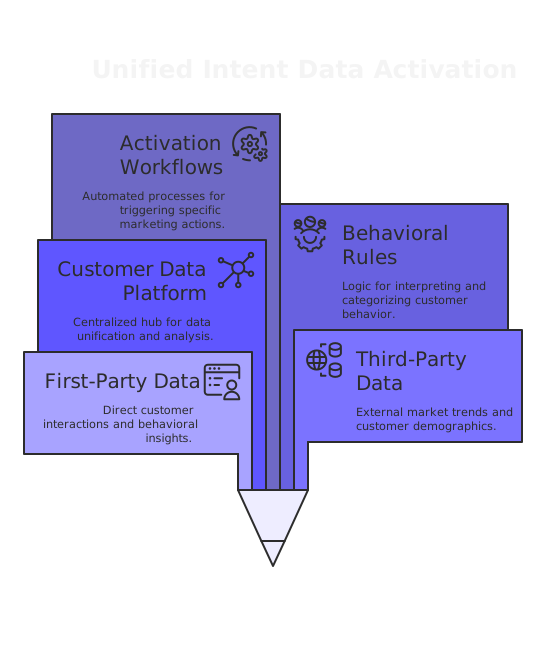
What B2B Intent Data Activation Actually Means
Intent data tells you which companies are researching topics related to your product. Activation means doing something useful with that information, fast, in the right channel, with the right message.
A complete B2B intent data activation strategy connects three things.
First, signal detection. You identify which accounts are showing buying behavior. This comes from first-party sources like your own website and CRM, and third-party sources like publisher networks and review sites.
Second, prioritization. You filter signal noise and focus on accounts that show real buying momentum. Not everyone reading a blog post is ready to buy.
Third, coordinated outreach. You reach the right people at those accounts, through the right channels, before your competitors do.
Most teams nail step one and fumble steps two and three. That is where revenue gets left on the table.
Why the Activation Gap Exists
The intent data market has a strange contradiction. The vast majority of B2B marketers using intent data report positive results. Yet only about one in four B2B companies has deployed an intent solution at all.
The reason is not distrust of the data. It is the cost and complexity of acting on it.
Most enterprise intent platforms tell you who is in-market. They do not execute outreach for you. You still need separate tools for advertising, email sequences, LinkedIn outreach, and sales alerts. You still need content. You still need coordination between marketing and sales.
For a mid-market company, that total activation investment often runs three to five times the cost of the intent platform itself.
The result is a pattern we see repeatedly at House of MarTech. Companies subscribe to a strong intent tool, generate impressive account lists, then fail to act on them consistently. The data is good. The execution infrastructure is missing.
The Role of Your CDP in Intent Activation
Your Customer Data Platform is the connective tissue that makes B2B intent data activation work at scale. Without it, intent signals live in one system, contact data lives in another, campaign logic lives in a third. Nothing talks to anything else cleanly.
A CDP that is built for activation, not just storage, does four things.
It unifies your customer records. Every contact at a target account gets tied to a single account profile. Website visits, email engagement, CRM history, and intent signals all live in one place.
It resolves identity across channels. When someone visits your website from a company in your target account list, the CDP connects that anonymous visit to the account profile. You see the full picture, not just fragments.
It triggers automation based on behavioral rules. When a target account's engagement crosses a defined threshold, the CDP fires a workflow. That workflow might alert a sales rep, enroll the account in a targeted ad sequence, or trigger a personalized email series.
It maintains a clean, consistent data foundation. Garbage in, garbage out. A CDP removes duplicates, enforces consent rules, and keeps your activation logic running on accurate data.
Without this unified foundation, your marketing automation platform is guessing. It fires campaigns based on incomplete profiles and misses the context that makes outreach relevant.
Building Your B2B Intent Data Activation Strategy
A strong B2B intent data activation strategy is not complicated. It is disciplined. Here is how to build one that actually produces pipeline.
Step 1: Define What a Real Signal Looks Like
Not all behavioral signals carry equal weight. A single blog visit is exploratory. Three pricing page visits combined with a whitepaper download and a LinkedIn ad click from the same account is a pattern.
Separate your signals into two categories.
Explicit signals are direct buying indicators. Demo requests, pricing inquiries, contact form submissions, RFP submissions. These merit immediate sales outreach, within minutes, not hours.
Implicit signals are behavioral indicators. Blog visits, webinar attendance, email clicks, review site activity, competitor research. These require clustering. One implicit signal triggers nothing. Three implicit signals from the same account within two weeks trigger escalation.
Define these thresholds before you build any workflows. If you skip this step, your sales team gets flooded with noise and stops trusting the system.
Step 2: Connect Your Intent Sources to Your CDP
Your CDP needs to ingest signals from multiple sources to give you a complete picture.
First-party sources include your own website (visitor tracking by company IP), your marketing automation platform (email and content engagement), your CRM (historical deal activity and account interactions), and your product (if you have a freemium or trial layer).
Third-party sources include intent data networks like Bombora, account intelligence platforms like 6sense or Demandbase, review sites like G2, and social platforms.
The CDP aggregates all of this into a single account score. You are not relying on one data stream. You are reading behavioral momentum across multiple channels.
Step 3: Build Activation Workflows That Match Signal Strength
Here is where most B2B intent data activation implementations go wrong. Teams build one generic workflow. High-intent account detected. Send one email. Done.
That is not activation. That is email blasting with extra steps.
Real activation matches the response to the signal strength and signal type.
For accounts crossing your explicit signal threshold, trigger immediate sales routing. The rep gets an alert with account context. They reach out within five minutes. Companies that reach prospects within five minutes of a qualifying signal are dramatically more likely to connect than those who wait even an hour.
For accounts building implicit signal clusters, trigger a multi-channel nurture sequence. Enroll them in account-specific LinkedIn ad campaigns. Add them to a targeted email track that references the specific topics they have been researching. Do not send generic content. If they have been reading your security-focused case studies, your next email should speak to security outcomes.
For accounts showing early-stage curiosity but low signal depth, add them to awareness-level ad campaigns. Do not involve sales yet. Let the channels warm them up.
Step 4: Align Sales and Marketing on Shared Metrics
Intent activation fails when marketing hands off a list and sales ignores it. That happens when both teams are measured on different things.
Marketing chasing lead volume will flood sales with low-quality accounts. Sales chasing close rate will ignore marketing-sourced accounts they did not source themselves.
Fix the structure. Both teams should share accountability for pipeline generated from target accounts. Marketing owns pipeline sourced and influenced. Sales owns pipeline closed and velocity. When both teams are measured on the same revenue outcome, the coordination happens naturally.
Set a weekly meeting where both teams review the current high-intent account list together. Sales confirms which accounts are already in pipeline. Marketing confirms which accounts need more outreach before a sales touch makes sense. This alignment meeting is the operational heartbeat of signal-driven revenue work.
The Buying Committee Problem Most Teams Ignore
B2B purchases rarely involve one decision-maker. Most enterprise deals involve six to ten people, each evaluating the purchase from a different angle. Finance cares about risk and budget. IT cares about implementation. Operations cares about adoption. Executives care about outcomes.
When your intent data activation only reaches one person at an account, you are building on a single point of failure. That one champion may get excited but face internal resistance you never addressed.
Multi-threaded activation changes this. Instead of routing one signal to one rep for one contact, you map the full buying committee at target accounts and activate outreach across multiple roles simultaneously.
Your CDP makes this possible by maintaining an account-level profile that includes all known contacts, their roles, their individual engagement history, and their relationship to each other. When you activate a high-intent account, you know who from finance has engaged, who from IT has visited your integration documentation, and who the likely executive sponsor might be.
This is not spray-and-pray email to every contact at the company. It is coordinated, role-specific outreach that speaks to each stakeholder's specific concerns. That coordination is what compresses sales cycles.
First-Party Intent: Your Most Underused Asset
Most teams jump straight to purchasing third-party intent data. That is often the right move. But your own first-party behavioral data is frequently more accurate and always more private.
Every company visit to your website is a first-party intent signal. Every email that gets opened and clicked. Every demo recording that gets watched. Every pricing page that gets visited three times in a week.
This data lives in your marketing automation platform, your CRM, and your web analytics. Your CDP unifies it. Your activation workflows respond to it.
First-party intent data activation strategy starts with one question. What does a high-intent account look like in your own channels, and are you currently doing anything when you see that pattern?
If the answer is no, you do not need to spend on third-party intent yet. Build your first-party activation layer first. Identify the behavioral patterns that precede your best deals. Configure your CDP to detect them. Build workflows that respond.
This is faster to implement, less expensive, and often more accurate than starting with purchased intent feeds. House of MarTech helps clients build this first-party foundation before adding third-party data layers on top. The sequence matters.
What Good B2B Intent Data Activation Looks Like in Practice
Consider a software company selling to mid-market finance teams. Their CDP integrates their website analytics, HubSpot, and a third-party intent feed. They have defined explicit and implicit signal thresholds.
An account visits the pricing page three times in five days. Two contacts from that account attended a webinar last week. The third-party feed shows an uptick in research around financial automation software from that company's IP range.
The CDP detects that this account has crossed the multi-signal threshold. It fires three things automatically. A Slack alert goes to the account executive with full context on what the account has been doing. A LinkedIn ad campaign activates, serving role-specific creative to known contacts at that account. An email sequence starts, referencing the finance automation topics the account has been researching.
The account executive reaches out within the hour. They reference a case study directly relevant to the prospect's industry. The prospect replies the same day. They already feel known, not cold-called.
That is B2B intent data activation implementation working the way it should. Signal to coordinated response in hours, not weeks.
Common Implementation Mistakes to Avoid
Activating on volume instead of patterns. One signal is noise. Multiple correlated signals from the same account over a short window represent real momentum. Set your thresholds accordingly.
Treating all accounts the same. A cold account that has never heard of you needs different activation than a warm account that requested a demo six months ago and went quiet. Segment your activation logic.
Skipping the sales handoff design. Even the best intent workflow fails if the sales alert contains no useful context. Every sales notification should include what the account has been doing, how long, which contacts are known, and what they have engaged with. Give reps a reason to call, not just a name.
Measuring clicks instead of pipeline. Intent activation is not a content engagement strategy. Measure it on pipeline sourced, deals accelerated, and revenue closed from activated accounts. If those numbers are not moving, the workflow is not working.
The Bottom Line on B2B Intent Data Activation
The technology to identify in-market accounts exists and it is genuinely good. The gap is not data quality. It is activation discipline.
Your CDP is the platform that makes activation possible at scale. Your marketing automation layer is what executes coordinated, multi-channel outreach. Your sales team is what converts momentum into meetings. When those three elements work together, with shared metrics and shared account intelligence, signal-driven revenue becomes a repeatable system.
The companies that win are not the ones with access to the most signals. They are the ones who act on the right signals faster, with more relevant context, and with full buying committee coverage.
If you are not sure where your activation process is breaking down, House of MarTech offers CDP and intent data audits that map your current signal flow and identify exactly where pipeline is leaking. Start there.
Frequently Asked Questions
Get answers to common questions about this topic
Have more questions? We're here to help you succeed with your MarTech strategy. Get in touch
Related Articles
Need Help Implementing?
Get expert guidance on your MarTech strategy and implementation.
Get Free Audit