
Customer Data Ownership vs Platform Reach
Platform reach grabs traffic fast. Customer data ownership builds lasting advantage. House of MarTech reveals why leaders own data over vendor lock-in. Contrarian strategies for 2026 MarTech wins.


Listen to summary
0:00 audio overview
Customer Data Ownership vs Platform Reach
Most marketers chase reach. More impressions. More clicks. More top-of-funnel volume. That instinct makes sense. Reach is visible. Reach feels like growth.
But reach rented from a platform is not an asset. It is a subscription. And subscriptions can be cancelled, repriced, or restructured, on someone else's timeline.
Customer data ownership is the contrarian bet. It is also the right one.
The Reach Trap Is Real
Imagine you spend two years building a paid social program. Your ROAS looks solid. Your acquisition costs are manageable. You have found your audience.
Then the platform changes its targeting rules. Or your account gets flagged. Or a privacy regulation reshapes the ad ecosystem overnight. Suddenly, the audience you thought you owned turns out to belong entirely to someone else.
This is not a hypothetical. It is the pattern that plays out repeatedly for brands that build growth on rented infrastructure.
Platform reach scales the top of your funnel quickly. No one is disputing that. The problem is what happens after the click. If your system cannot capture, unify, and activate customer identity, every dollar you spend on reach disappears the moment someone closes a browser tab.
Reach without identity resolution is just expensive traffic.
What Customer Data Ownership Actually Means
Customer data ownership means your business controls the canonical record of who your customers are, what they have done, and what they care about. No platform intermediary sits between you and that information.
This is not just about having a database. It is about having a unified, portable, and actionable identity layer that belongs to you.
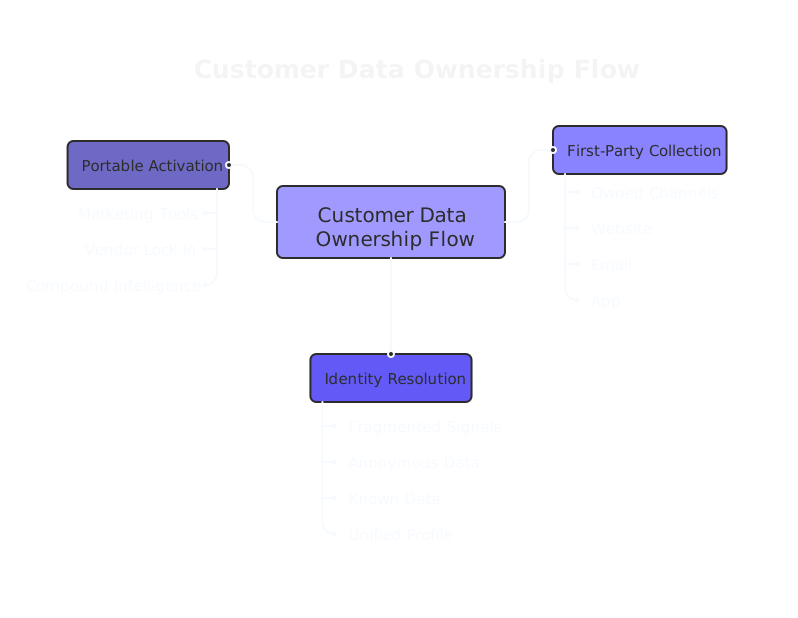
In practice, customer data ownership requires three things:
First-party and zero-party data collection. You gather data directly from customers through your own channels: website, email, app, in-store, surveys, and preference centers. Nobody else collects it for you, and nobody else holds the keys.
Identity resolution. You connect fragmented signals, anonymous visits, email opens, purchase history, support tickets, into a single coherent customer profile. This is the hardest part, and it is also the most valuable.
Portable activation. You can move that data into any channel, any tool, any campaign without being held hostage by a single vendor's data model.
When all three are in place, your customer intelligence compounds over time. It gets more accurate. It gets more predictive. And it belongs entirely to your business.
What Is a CDP and Why Does It Matter Here?
A Customer Data Platform, or CDP, is the technology layer that makes customer data ownership operational. It ingests data from multiple sources, resolves identity across touchpoints, and makes unified profiles available for activation.
The critical distinction: a CDP stores data in a structure your business controls, not in a walled garden owned by an ad network or a marketing suite vendor.
That structural difference has real consequences. Brands that build on a CDP-first architecture retain their customer intelligence even when they switch tools, add channels, or face regulatory changes. Brands that skip this layer and rely entirely on platform-native data tools often discover, too late, that they cannot export what they thought they owned.
A good reference point: our post on defining a unified customer profile before you buy a CDP walks through what the underlying data architecture needs to look like before any technology purchase makes sense.
The Contrarian Case: Own Data First, Scale Reach Second
The conventional growth playbook says: build reach first, worry about data infrastructure later. Paid channels scale fast, so invest there early. Data systems are complex, so defer them until you have the budget.
This logic feels practical. It is actually backwards.
Here is why. Platform reach is most valuable when it feeds a closed-loop system. When someone clicks your ad and converts, the useful question is not just "did they convert?" It is: Who is this person? What else do I know about them? How do I recognize them next time?
If you cannot answer those questions, every acquisition is a cold start. You pay full price to acquire the same customer segment, repeatedly, because you have no way to recognize and build on prior interactions.
Customer data ownership changes that math. When your identity layer is solid, every platform interaction adds to a durable asset. Your media spend gets smarter over time because your customer model gets richer. You build lookalike audiences from real, high-quality first-party signals instead of platform proxies. Your email and direct channels convert better because you know more about the person you are talking to.
Reach and owned data are not competitors. But the sequence matters. Build the data foundation first. Then scale the reach.
The Vendor Lock-In Risk Nobody Talks About Loudly Enough
When your customer data lives primarily inside a platform's native ecosystem, that vendor has more leverage over your business than most marketing leaders realize.
This is not about vendor bad faith. It is about structural incentives. A platform that holds your customer data is a platform you cannot leave easily. Migration becomes expensive. Re-platforming becomes terrifying. Pricing negotiations shift in the vendor's favor.
The antidote is portability. If your customer profiles, identity graph, and behavioral history exist in a system your business controls, you can work with any activation layer you choose. You are not locked in. You have genuine flexibility.
This is the underlying argument for composable architecture and CDP-first design. You separate the data layer from the activation layer. Vendors compete for your activation budget. Nobody holds your customer intelligence hostage.
At House of MarTech, we see this play out in client conversations regularly. The businesses with the most MarTech options are the ones that built the data layer first.
How to Build a Customer Data Ownership Strategy
A customer data ownership strategy does not require a massive budget or a year-long implementation project. It requires clear thinking about a few foundational decisions.
Step 1: Audit Where Your Customer Data Actually Lives
Map every place customer data is stored today. CRM, email platform, ad accounts, e-commerce system, support tools, data warehouse. For each, ask: who controls this data? Can you export it? Can you act on it outside this tool?
This audit usually reveals the problem faster than any consultant report.
Step 2: Define Your First-Party Data Collection Points
Identify every touchpoint where you interact with customers directly. Website, email, SMS, app, events, loyalty programs, support interactions. These are your owned channels. Every one of them should be contributing to your customer record.
If you are not capturing identity at these touchpoints, start there. It does not require sophisticated technology. A disciplined approach to email capture and preference collection goes a long way.
Step 3: Prioritize Identity Resolution
The hardest problem in customer data management is connecting the dots. The anonymous website visitor who later converts via email. The in-store buyer who also shops online. The customer using different devices.
This is where a CDP earns its cost. A well-implemented CDP stitches these identities together into a golden record. Without that stitching, you have data silos, not customer intelligence.
Step 4: Design for Portability from Day One
Whatever technology you choose, build in data portability as a non-negotiable requirement. Your customer data should be exportable in standard formats. Your identity graph should not be locked inside a single vendor's proprietary model. Your activation tools should read from your owned data layer, not replace it.
This is a procurement and architecture decision, not just a technology choice.
First-Party Data Is the Moat
Zero-party data, information customers voluntarily share, and first-party behavioral data are the two inputs that no competitor can replicate exactly. Your customer relationships, interaction histories, and preference signals are unique to your business.
Third-party data can be purchased by anyone. Platform audiences can be targeted by anyone with a budget. But the customer who told you they prefer email over SMS, who has bought from you three times, who opened your last five campaigns, that signal set belongs only to you.
That is the moat. And it compounds. Every interaction adds to it. Every campaign that reads from it gets smarter. Every new channel you open benefits from it.
Platform reach can help you fill that moat faster. But the moat has to exist first.
Practical Customer Data Ownership Best Practices
These are the decisions that separate businesses building durable advantage from those renting it:
- Treat your email list as a strategic asset, not a marketing tool. It is owned reach. Guard list quality aggressively.
- Collect preferences explicitly. Ask customers what they want. Documented consent and preference data is both a compliance asset and a personalization engine.
- Build your data model before you buy your tech. Know what a "customer record" means in your business before you evaluate any CDP or CRM platform.
- Establish data governance early. Who owns each data field? Who can access it? How long is it retained? These decisions are easier to make before a system is live than after.
- Audit vendor contracts for data rights. Who owns the data you put into a platform? Can you export it? What happens to it if you cancel? These clauses matter enormously.
Frequently Asked Questions
What is customer data ownership?
Customer data ownership means your business controls, stores, and can activate your customers' information directly, without relying on a third-party platform as the primary custodian. You hold the data. You set the rules. You take it with you if you change tools.
Why does customer data ownership matter in 2026?
Platform targeting has become less precise due to privacy regulation and signal loss from cookie deprecation. Brands that built first-party data infrastructure are less exposed to these shifts. Brands that relied on platform-native data are discovering the limits of rented audiences.
Is a CDP required for customer data ownership?
A CDP makes customer data ownership operationally practical at scale, but it is not the only path. Smaller businesses can start with disciplined CRM hygiene and first-party data collection. A CDP becomes essential when identity resolution across multiple channels and touchpoints is the core problem to solve.
How does customer data ownership affect marketing ROI?
When your customer model is built on owned, accurate, first-party data, your targeting improves, your personalization improves, and your retention improves. Over time, owned data reduces reliance on expensive top-of-funnel paid acquisition because you know more about who to talk to and how.
The Bottom Line
Platform reach is a tool. Customer data ownership is a strategy.
The businesses building durable competitive advantage in 2026 are not the ones with the biggest ad budgets. They are the ones whose customer intelligence compounds with every interaction, regardless of which platforms they use or avoid.
Build the data layer first. Then scale the reach on top of it.
If you are working through where your customer data actually lives, or trying to decide whether a CDP makes sense for your current stage, the team at House of MarTech works through exactly these questions with clients. Start with the architecture before you evaluate any technology. That sequence makes every decision downstream easier.
House of MarTech is a marketing technology consultancy helping business leaders build data strategies and technology stacks that they own, understand, and can grow on their own terms.
Related Articles
Need Help Implementing?
Get expert guidance on your MarTech strategy and implementation.
Get Free Audit