
Building the Single Customer View: Blueprint for Data-Driven Marketing
Most companies chase a complete customer profile and never get there. Here is what actually works instead, and why less data, used better, outperforms more data every time.


TL;DR
Quick Summary
Listen to summary
0:00 audio overview
Building the Single Customer View: Blueprint for Data-Driven Marketing
Quick Answer
Picture this. A customer emails your support team about a billing issue. Then they call. Then they browse your pricing page for ten minutes. The next day, your automated system sends them a cheerful upsell email.
They cancel the same afternoon.
Your data existed. It just never connected. That gap between scattered data and a real picture of your customer is exactly what the single customer view is supposed to solve.
But here is the honest version of this story: most companies build their unified data and customer profile the wrong way. They chase everything instead of the right things. They consolidate data instead of connecting it. And they end up with a bloated system that nobody trusts.
This guide will walk you through what a single customer view actually is, why most implementations fail, and how to build one that drives real results.
What Is a Single Customer View, Really?
A single customer view (SCV) is a unified record of everything you know about one customer. It pulls together data from your CRM, your website, your email platform, your support tools, and your billing system into one coherent picture.
When it works, your teams stop working in silos. Marketing knows what sales knows. Support sees the full history. Personalization gets sharper. Churn gets easier to spot.
That is the promise. Here is the reality check.
A unified customer profile is not a single giant database where everything lives. It is a connected view. The data can stay in different systems. What matters is that you can pull a consistent, accurate picture when you need it.
The companies that get this right do not try to copy every piece of data into one place. They build connections, not warehouses.
Why Most Single Customer View Projects Stall
A 2024 survey by Intermedia Global found that 97% of CMOs reported technology issues affecting their customers. Nearly a quarter lost customers directly because of MarTech failures. Most of those failures did not happen because the company lacked data. They happened because the data was poorly connected and impossible to act on.
Here is what goes wrong most often.
Trying to Unify Everything at Once
Companies treat the unified customer profile as a destination. They spend months mapping every data source, cleaning every record, building the perfect schema. By the time the project is halfway done, the business has changed, new tools have been added, and the original plan no longer fits.
Start smaller. Pick the data that drives your most important business decision right now. Build around that first.
Treating Identity as Simple
Your customer might have three email addresses. They share an account with a spouse. They emailed support under a different name. They signed up for a webinar with their work address.
That is not one record. It is five. Identity resolution, the process of linking those records to one person, is harder than most companies expect. Forcing everything into one record destroys context. Keeping records linked but distinct preserves it.
Building for Completeness Instead of Accuracy
A customer profile that is 100% complete but 60% accurate is worse than a profile that is 60% complete but 95% accurate. Wrong data does not just fail to help. It actively misleads your team and your algorithms.
Focus on the data you can verify. Preference data your customers tell you directly. Purchase history from your own systems. Engagement data from channels you own. That data is clean. Behavioral inferences scraped from third-party sources are often noise.
The Real Foundation: Unified Data and Customer Profile Strategy
Before you touch a single tool, you need a strategy. Here is a simple framework that works.
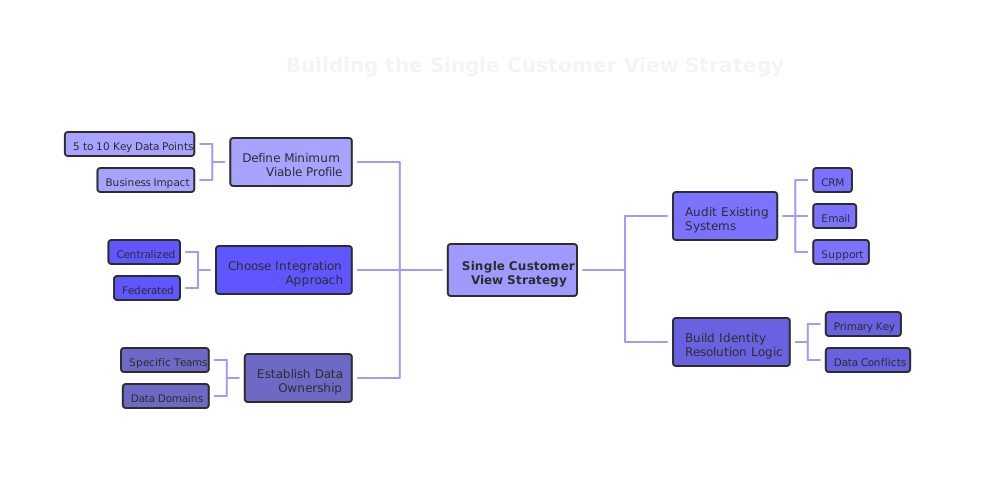
Step 1: Define Your Minimum Viable Profile
What is the smallest set of customer information that would meaningfully improve your most important marketing or sales decision?
For an e-commerce brand, that might be purchase history, product category preferences, and email engagement status. For a B2B company, it might be company size, role, past interactions, and current contract status.
Write it down. That is your target. Everything else is a future phase, not a launch requirement.
Step 2: Audit What You Actually Have
List every system that holds customer data. Your CRM. Your email platform. Your website analytics. Your support tool. Your billing system.
For each system, answer three questions.
What data does it hold? How fresh is that data? Who owns it?
This audit will show you where your best data lives and where the gaps are. It will also show you which systems you actually need to connect versus which ones you have been assuming matter.
Step 3: Choose Your Integration Approach
You have two main options.
The first is a centralized customer data platform. A CDP pulls data into one place, resolves identities, and gives you a single record per customer. This works well when you have a small number of high-quality data sources and clear governance.
The second is a federated approach. Data stays in its original system. You use APIs, a cloud data warehouse, or a query layer to pull unified views on demand. This works better when you have many data sources, complex governance needs, or regulatory restrictions on centralizing certain data types.
Neither approach is right for every company. The choice depends on your data volume, your team's technical capacity, and your compliance requirements. At House of MarTech, we help companies make this call based on their actual situation, not on vendor demos.
Step 4: Build Your Identity Resolution Logic
Decide how you will link records across systems. At minimum, you need a primary key. Usually that is email address or phone number.
Then decide what happens when records conflict. If your CRM says a customer's company is one name and your billing system says another, which wins? Build explicit rules for this. Write them down. Make sure every team agrees.
As your system matures, you can add more sophisticated matching. Machine learning models can link records by name variations, address proximity, and behavioral similarity. But start with clear, simple rules. They are easier to audit and easier to fix when something breaks.
Step 5: Establish Data Ownership
This is the step most companies skip. It is also the step that determines whether your unified customer profile stays clean over time.
Assign one team as the owner of each data domain. Marketing owns behavioral and engagement data. Sales owns account and opportunity data. Support owns interaction and issue history. Finance owns billing and contract data.
Owners are responsible for data quality in their domain. They set the rules for how data is collected, how it is cleaned, and how often it is refreshed. Centralized ownership of all data by a single team does not scale. Distributed ownership does.
Unified Data and Customer Profile Implementation: What Good Looks Like
Here is what a working single customer view looks like in practice for a mid-sized B2B software company.
The CRM holds contact records, account history, and deal stages. The marketing platform holds email engagement, content consumption, and lead scores. The support tool holds ticket history and resolution data. The billing system holds contract values, renewal dates, and payment status.
None of these systems are replaced. All of them stay in place.
A lightweight data warehouse, in this case Snowflake, pulls a daily snapshot from each system. A shared customer ID, built from email address as the primary key, links records across systems. When a sales rep opens an account view, they see the customer's recent support tickets, last email opens, contract renewal date, and product usage data in one place.
No single system holds everything. But anyone who needs a full picture can get one in seconds.
That is the goal. Not a monolithic database. A connected view.
Unified Data and Customer Profile Best Practices
The following practices separate implementations that last from those that collapse under their own weight.
Collect Less Data, but Better Data
Every piece of data in your system has a maintenance cost. It needs to be kept fresh, validated, and governed. Data you do not need is not neutral. It is a liability.
Focus your data collection on information customers give you directly. Preference surveys, onboarding questionnaires, progressive profiling in forms. This zero-party data is more accurate than inferred behavioral data, and it comes with implicit consent because the customer provided it voluntarily.
Sephora's Beauty Insider program is a clean example. Customers fill out a preferences quiz because they want better product recommendations. The data is accurate because customers have a direct reason to be honest. That direct exchange beats behavioral inference almost every time.
Govern at the Source
Do not build a central system and then layer governance on top of it. Build governance into how data enters your system.
Define what each field means before you collect it. Set rules for how long data is retained. Create clear consent records that show when and how a customer agreed to their data being used. These controls are far easier to enforce when they are built into your data collection process than when you try to add them later.
Prioritize Intent Over History
A customer's purchase from two years ago tells you less than what they are doing on your website right now. Build your unified customer profile to surface current behavior alongside historical data.
Email opened this week matters more than email opened last year. Support ticket filed yesterday matters more than a closed ticket from six months ago. Weight your data inputs by recency. Build dashboards that surface what is happening now, not just what happened.
Test Small, Then Scale
Do not launch your single customer view across your entire customer base at once. Pick one use case. Maybe it is reducing churn in your top 500 accounts. Maybe it is improving first-purchase conversion on one product line.
Prove the value in that narrow scope. Learn what breaks. Fix it. Then expand.
Companies that try to boil the ocean on day one end up with systems too complex to maintain and too fragile to trust.
The Human Element: Data Enables Relationships, It Does Not Replace Them
Here is the part that gets left out of most technical guides.
A unified data and customer profile strategy works best when it makes your people smarter, not when it tries to replace their judgment.
Your customer success manager who gets an alert that a key account has filed three support tickets this week and missed their last two product check-ins does not need AI to tell them what to do. They need to call that customer. The data gave them the reason and the context. The relationship is what solves the problem.
Invest in tools that surface the right context to the right person at the right moment. Do not invest in tools that try to automate away the conversation entirely.
The brands that have seen the sharpest drops in customer satisfaction in recent years are often those that automated the most. The ones with the strongest retention are usually those that used data to make their human interactions better, not fewer.
Where House of MarTech Can Help
Building a single customer view is not a technology problem. It is a strategy problem that requires technology to execute.
Most companies stall because they start with a vendor demo instead of a data strategy. They buy a platform before they know what their minimum viable profile looks like. They skip the identity resolution planning. They never assign data ownership.
At House of MarTech, we work with companies at every stage of this process. Whether you are starting from scratch or trying to salvage a CDP implementation that has gone sideways, we help you build the right foundation before recommending any tools.
The goal is always the same. A clear, accurate, actionable picture of your customer that your whole team can trust and use.
Start Here: Your First Three Steps
If you take nothing else from this guide, start with these three actions.
First, define your minimum viable profile. Write down the five to ten data points that would most improve your most important customer decision. That is your scope.
Second, audit your existing systems. List every tool that holds customer data. Identify who owns each source and how fresh the data is.
Third, pick one use case to prove the value. Do not try to solve everything. Pick the single highest-impact problem a better customer view would solve and build toward that.
The single customer view is not a project you finish. It is a capability you build over time. The companies that get it right start small, stay focused, and keep their data honest.
That is the blueprint.
Frequently Asked Questions
Get answers to common questions about this topic
Have more questions? We're here to help you succeed with your MarTech strategy. Get in touch
Related Articles
Need Help Implementing?
Get expert guidance on your MarTech strategy and implementation.
Get Free Audit