
Customer Context: Marketing's Real Moat
Vendors push AI and CDPs. Leaders build customer context as the true moat. Diagnose gaps turning data into real decisions. House of MarTech shows the way.


Your competitor just bought the same CDP you have. They use the same AI vendor. They run the same retargeting playbook.
So why are they winning?
The answer is not their budget or their tech stack. It is what they know about their customers at the moment it matters most. That is customer context. And right now, it is the one thing in marketing that is genuinely hard to copy.
The Moat Is Not Your Technology
Most marketing leaders are solving the wrong problem. They invest in platforms, models, and automation. Then they wonder why their personalization still feels generic.
Here is the uncomfortable truth. A CDP without context is just an expensive database. An AI model without context is a confident guesser. The tool is not the moat. The accumulated understanding you build about your customers over time is.
Customer context is the full picture of who a person is, what they want right now, and why they behave the way they do. It is not a single data point. It is the layered combination of past behavior, stated preferences, real-time signals, and situational awareness.
When you have it, your marketing feels like it reads minds. When you do not, even your best campaigns feel like spam.
What People Treat as the Problem (And What Actually Is)
Most teams diagnose their personalization failures as a data problem. They think they need more data. More sources. More integrations.
That is the symptom. The root cause is almost always a context gap.
Here is what a context gap looks like in practice. A SaaS company sends a re-engagement campaign to churned users. The email references features the customer never used. It offers a discount on a plan tier they had already outgrown. The data was all there. The customer's usage history, their plan history, their support tickets. But nobody connected it into a coherent picture before the campaign fired.
The data existed. The context did not.
This is the invisible pattern behind most personalization failures. Teams collect data but do not build profiles. They build profiles but do not activate them. They activate them but only at campaign time, not at every touchpoint. The structural layer that is missing is a persistent, operationalized customer context that travels with every interaction.
What Customer Context Actually Requires
Persistent Profiles, Not Snapshot Segments
Segmentation is useful. But a segment is a snapshot. It tells you where a customer fit at a point in time. Customer context requires persistent profiles that evolve as behavior changes.
The difference matters more than most people realize. A customer who bought once six months ago and has visited your pricing page three times this week is not the same as a customer who bought once six months ago and has not been back. They are in the same segment. They are in completely different contexts.
Persistent profiles track the trajectory, not just the position.
Behavioral Signals, Not Just Demographic Data
Demographic data tells you who someone is. Behavioral data tells you what they are doing. Contextual data tells you what it means.
A 35-year-old in Chicago is a demographic. A 35-year-old in Chicago who has looked at your enterprise pricing page twice this week, downloaded your ROI calculator, and opened every email you sent in the last 14 days is a context. Those two customers should not get the same message.
The gap between demographic-led marketing and context-led marketing is where revenue gets left on the table.
Real-Time Signals Connected to History
Real-time alone is not enough either. A single session tells you what someone is doing right now. It does not tell you if this is unusual behavior or their normal pattern.
When you connect real-time signals to historical context, patterns become legible. You can tell the difference between a loyal customer having a bad experience and a high-intent prospect doing final research before buying. Those two situations call for completely different responses.
Why CDPs Fail to Deliver on This Promise
The CDP market sold a version of this vision. Unified profiles. Persistent data. Activated experiences. The pitch was compelling. The execution, for many organizations, has been disappointing.
The failure is rarely the technology. It is the approach.
Most CDP implementations focus on data unification first and context operationalization never. Teams spend months connecting sources, cleaning data, and building identity graphs. Then they stop. The data sits unified and underused. The context never gets operationalized into actual customer experiences.
This is what the industry calls the data activation gap. Data is collected and stored. It is rarely used in the moment that matters.
At House of MarTech, this is one of the most common patterns we see when we audit a client's stack. The infrastructure is there. The activation strategy is not.
How to Build Customer Context as a Real Competitive Advantage
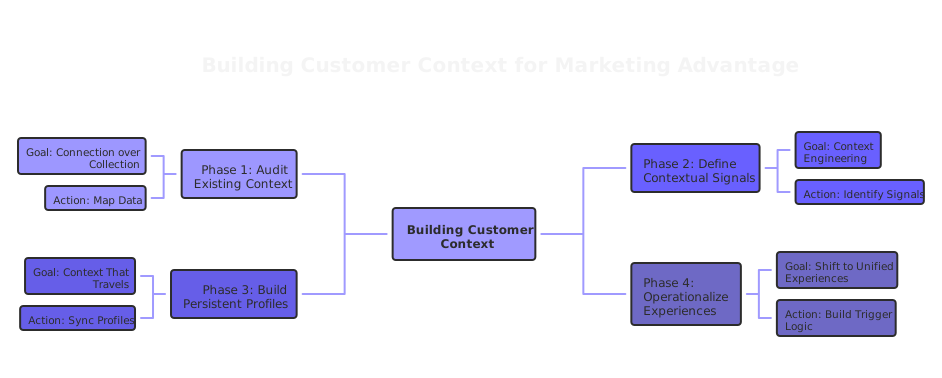
Step 1: Audit What Context You Already Have
Before you buy anything new, map what you already know. What behavioral data do you collect? Where does it live? Is it connected to individual profiles or sitting in aggregate reports?
Most companies are richer in context data than they realize. It is just fragmented. CRM data in one place, web behavior in another, email engagement in a third, support history somewhere else entirely.
The first step is not collection. It is connection.
Step 2: Define the Contextual Signals That Actually Matter for Your Business
Not all context is equal. The signals that predict purchase intent for a B2B SaaS company are different from those for an e-commerce brand.
Define the five to ten signals that most reliably indicate a customer's current state for your business. High intent. At-risk. Loyal but underutilized. Ready to upgrade. Map those states explicitly before you try to automate responses to them.
This is context engineering. It is the deliberate design of how customer signals translate into business-relevant understanding.
Step 3: Build Profiles That Persist and Travel
A customer profile is only useful if it is accessible at every touchpoint. That means your email platform, your website personalization layer, your sales CRM, your support system, and your paid media audiences should all draw from the same profile.
When a customer calls support after abandoning a cart, the support rep should be able to see the abandonment. When a paid ad fires, it should account for the fact that this person already spoke to sales last week.
Context has to travel. If it is siloed in one system, it is not really context. It is just local knowledge.
Step 4: Operationalize Context Into Experiences, Not Just Campaigns
This is the hardest step and the most important one.
Context-led marketing is not a campaign strategy. It is an experience strategy. The goal is not to launch a better segmented email. The goal is to make every interaction feel like it accounts for everything you know about that customer.
That means building trigger logic based on context shifts, not just calendar schedules. It means your next-best-action recommendations are informed by history and current behavior. It means your sales team gets alerts when a customer's context changes in a way that signals opportunity.
This is where House of MarTech's implementation work focuses most. Building the connective tissue between data, context, and activation so that intelligence actually reaches the customer moment.
What Is Customer Context Strategy?
Customer context strategy is the deliberate plan for how you collect, connect, maintain, and use customer understanding across every touchpoint. It answers three questions. What do we know about this customer right now? What does that tell us about what they need? And what is the right response at this moment?
A strong customer context strategy does not require the most expensive stack. It requires clear answers to those three questions, and the operational infrastructure to act on them consistently.
The Moat Is Built Over Time
Here is the part that most vendors will not tell you. Customer context is not a feature you buy. It is an asset you build.
Every interaction that adds to a persistent profile, every signal that refines your understanding, every response that accounts for history rather than ignoring it. These compound. Over months and years, you develop an understanding of your customers that a competitor starting fresh cannot replicate quickly, no matter how good their technology is.
That is a real competitive moat. Not because it is technically complex. Because it takes time and intention to build.
This is why context-led marketing is not about being early to a trend. It is about starting now, before the gap between you and the competition gets harder to close.
The Diagnostic Question to Ask Your Team This Week
Here is a simple test. Pick any customer who has been with you for more than six months. Ask your team: what do we know about this specific person that we are actively using to shape how we communicate with them?
If the answer is their name, their email, and which list they are on, you have a context gap.
If the answer includes their behavioral history, their current engagement pattern, their product usage, their support history, and their likely next action, you are building the moat.
Most teams land somewhere uncomfortable in the middle. That gap is exactly where the work is.
If you want a clear picture of where your customer context stands today and what it would take to operationalize it across your stack, that is the kind of diagnostic work we do at House of MarTech. Not a sales call. A real conversation about what is actually happening in your data and what is possible.
Start there.
Frequently Asked Questions
What is customer context in marketing?
Customer context is the full, real-time picture of a customer. It combines their behavioral history, stated preferences, current engagement signals, and situational cues to give marketers a meaningful, actionable understanding of who that person is and what they need right now.
Why is customer context more important than customer data?
Data is raw. Context is interpreted. You can have millions of data points about a customer and still send them the wrong message at the wrong time. Context connects data into understanding and that understanding is what drives relevant, effective marketing.
How do CDPs support customer context?
A CDP can provide the infrastructure for persistent profiles and data unification. But a CDP alone does not create customer context. You also need a clear strategy for which signals matter, how profiles evolve, and how context is activated into real experiences across every channel.
What is the data activation gap?
The data activation gap is the space between collecting customer data and actually using it to improve experiences. Most organizations have significant data available but lack the processes and integrations to get that data into the moments where it could influence a customer interaction.
Related Articles
Need Help Implementing?
Get expert guidance on your MarTech strategy and implementation.
Get Free Audit