
The "Too Technical" Trap: Why CDP Projects Fail at the Translation Layer
Most CDP projects die between technical depth and business framing. Learn how to bridge the gap and keep stakeholder buy-in through the hardest phase.


Listen to summary
0:00 audio overview
The "Too Technical" Trap: Why CDP Projects Fail at the Translation Layer
Picture this. Your IT team just finished a six-month CDP implementation. The data is flowing. The platform is live. The vendor declared success and left.
Three months later, your marketing team is still pulling audiences from spreadsheets.
Nobody is lying. Nobody is incompetent. But something real broke down. It broke down in the space between what the platform can do and what the organization actually does with it.
That space has a name. Call it the translation layer.
And it is where most CDP projects quietly die.
The Platform Is Not the Problem
The CDP market is growing fast. Analysts project it will expand from roughly $10 billion today to over $37 billion by 2030. More companies are buying CDPs every year.
Yet only 64% of deployed CDPs deliver significant business value. That number is declining.
Think about that. Adoption is rising. Outcomes are falling. That gap does not point to bad technology. It points to something organizational.
The platforms work. Adobe, Salesforce, Segment, Hightouch, and dozens of others are genuinely capable. The problem is not what the CDP can do. The problem is the human and organizational infrastructure required to turn that capability into daily business decisions.
That infrastructure is the translation layer. And most companies never build it.
What the Translation Layer Actually Is
The translation layer is not a feature. You cannot buy it. It is the set of people, decisions, routines, and relationships that sit between your CDP and your actual business outcomes.
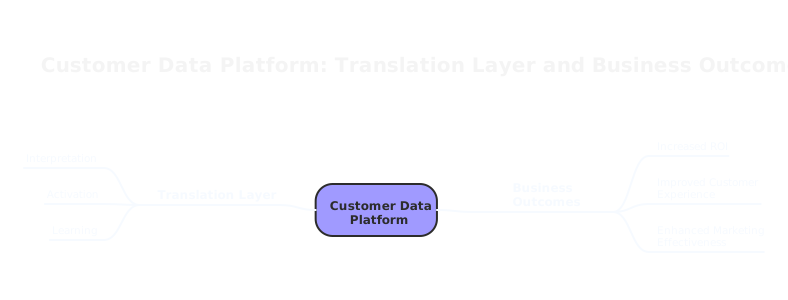
It has three parts.
Interpretation. Someone has to look at a customer segment and decide what it means. Is a high-engagement customer a retention opportunity or a cross-sell candidate? Who decides? What is the process? Without a clear answer, your marketing manager guesses. Or worse, nothing happens at all.
Activation. Once you have an insight, someone has to decide whether it is worth acting on. Is this finding significant enough to invest marketing budget? Who has the authority to say yes? Organizations with a strong translation layer have explicit decision frameworks. Everyone else has arguments between marketing and analytics.
Learning. After a campaign runs, someone has to measure results and decide what to do next. Expand it. Iterate. Stop. This feedback loop sounds obvious. Most companies skip it entirely or run it once a quarter when someone remembers.
These three elements are not technical. They are organizational. And that is exactly why they go unfunded, unplanned, and unbuilt.
The Readiness Problem Nobody Talks About
Here is something the CDP vendor will not tell you during the sales process. Most organizations are not ready for a CDP before they buy one.
That is not an insult. It is a structural problem the industry has mostly ignored.
Ready means something specific. It means someone in your organization is explicitly responsible for defining what a "unique customer" is. It means you have a governance routine, not just a governance document. It means your teams can access data without filing IT tickets. It means your identity matching has defined confidence thresholds and someone reviews edge cases.
Most organizations entering a CDP implementation cannot check those boxes. They have fragmented data systems. They have lean teams already stretched thin. They have unstable customer identity across sources.
The CDP gets implemented into those conditions. Not into a clean slate.
The result is predictable. Rather than solving fragmentation, the CDP becomes another silo. Data gets duplicated. Synchronization becomes a constant headache. Teams distrust the output.
Before selecting a platform, the more important questions are operational. Do you have someone who owns identity? Can your marketing team act on data without IT? Have you defined what governance looks like as a weekly routine, not a one-time setup? Until those questions have clear answers, platform selection is premature.
CDP Stakeholder Communication Is a Skill. Treat It Like One.
Most CDP projects start with a technical team. Engineers, data architects, maybe a CDP implementation partner. They do excellent work. The platform gets built correctly.
Then the handoff happens. The technical team moves on. The marketing team takes ownership of a system they do not fully understand, built to solve problems defined by people who have already left the room.
This is where CDP stakeholder communication breaks down completely.
Effective CDP stakeholder communication strategy does not start at launch. It starts before implementation. Here is what that looks like in practice.
Before implementation. Bring marketing, IT, and leadership into the room together. Not for a feature demo. For a conversation about what business problems you are actually trying to solve. What does success look like in six months? What decisions should the CDP be helping you make? What does your team need to be able to do that it cannot do today?
This conversation forces clarity. It also creates shared ownership before the work begins.
During implementation. Run short, visible wins. Rather than waiting for the full platform to launch before showing value, activate one narrow use case early. Something small enough to measure clearly. Show stakeholders what the CDP produced and what the business result was. This is not a demo. It is proof.
At launch and beyond. Do not hand over documentation. Hand over a working routine. Show people where to go, what to look at, and what to do when they see it. The best CDP stakeholder communication implementation is a live walkthrough of real data connected to a real decision.
The Governance Trap
Governance is the word that kills momentum in CDP projects. It sounds like compliance. It sounds like forms and approval chains and meetings with no decisions.
But governance in a CDP context is actually simple. It is just the set of answers to the questions that come up every week.
Who owns the definition of "active customer"? Who reviews identity merge decisions when the confidence is uncertain? Who decides when a data quality issue is bad enough to pause a campaign?
Organizations that answer these questions clearly and embed them into weekly routines outperform those that treat governance as a one-time setup. The difference is not platform sophistication. It is operational discipline.
The research here is consistent. Organizations that treat data governance as a rhythm achieve sustained results. Those that treat it as a project see gains erode within months.
What does a governance rhythm look like? A weekly check on data quality metrics. A monthly review of which CDP use cases are driving real business value. A quarterly decision about what new capabilities to add and what to stop investing in. These do not require new tools. They require meeting cadences and clear ownership.
The Marketing-IT Divide
One of the most consistent patterns in CDP failure is the disconnect between marketing and IT. They are not adversaries. But they often operate from fundamentally different assumptions.
Marketing approaches CDPs expecting speed. "We defined our use cases. The vendor implemented. When can we start activating?"
IT approaches CDPs expecting thoroughness. "We need stable infrastructure, governance controls, and scalable architecture before we hand this over."
Neither is wrong. But they are not talking about the same thing.
The translation layer failure happens at this intersection. Marketing's need for speed collides with IT's need for stability. The result is either a technically impressive CDP that marketing cannot use, or a rushed launch that creates technical debt and erodes trust in the entire system.
Organizations that solve this build shared accountability around business outcomes, not separate technical and functional goals. Marketing and IT measure success together. How many use cases are actively driving revenue? How much time is saved in audience preparation? How much revenue is attributable to CDP-driven campaigns?
When both teams answer to the same metrics, the conversation changes from "when can we launch" versus "when will it be ready" to "what do we need to get the first use case live this month."
The AI Acceleration Risk
CDP vendors are adding AI fast. Predictive churn scoring. AI-driven audience creation. Real-time decisioning. These capabilities are real. Some of them are genuinely impressive.
But they introduce a specific risk for organizations without a strong translation layer.
AI provides confident outputs. That confidence is dangerous when the underlying data is unstable.
If your identity resolution is producing duplicate customer records, AI churn scoring will make confident predictions about customers who do not exist as distinct individuals. If your data quality is poor, AI personalization will personalize with bad information. The output looks sophisticated. The foundation is broken.
The right sequencing is straightforward. First, stabilize identity and data quality through simple, rule-based approaches. Prove that the foundation is reliable. Then layer AI on top of that proven foundation. Use AI to optimize, not to compensate for organizational readiness problems.
What Actually Works
Organizations achieving real business impact from CDPs share a pattern. It is almost the opposite of the standard implementation playbook.
They start with a single, specific business problem. Not "improve customer experience." Something like "reduce email unsubscribes among customers who purchased in the last 90 days by 8% this quarter." That specificity forces clarity about what data is needed and what success looks like.
They accept imperfection. They launch with known constraints. They know their identity matching has a 15% false positive rate. They know some customer records are incomplete. They activate anyway, with eyes open, and they measure what happens.
They learn from what breaks. When the first use case reveals a data quality problem, they treat it as valuable information, not as failure. The problem becomes the next project.
They expand based on operational reality, not on implementation plans. If Phase 1 reveals that their marketing team lacks SQL skills, they invest in no-code tooling or targeted training before building more complex use cases.
This approach is slower at the start. It is dramatically faster at producing real business value.
The Questions Worth Asking Before Your Next CDP Investment
If you are planning a CDP implementation or trying to revive a struggling one, these questions cut through the noise.
Who owns identity resolution decisions in your organization today? If you cannot name a person, you have a readiness problem that a new platform will not solve.
What does your data governance routine look like weekly, not on paper? If the honest answer is "we don't have one," start there.
Can your marketing team act on data today without filing an IT request? If not, your translation layer is already broken before the CDP is live.
What is the single most valuable customer data use case you could activate in the next 30 days? Start there. Not with a comprehensive platform build.
These questions are not about technology. They are about organizational readiness. And they are the actual determinants of CDP success.
The Work Most Companies Skip
The CDP market will keep growing. The platforms will keep improving. AI capabilities will keep expanding.
But the organizations that extract disproportionate value from CDPs will not be the ones with the most sophisticated technology. They will be the ones that built the translation layer. Clear ownership. Governance as a weekly routine. Shared accountability between marketing and IT. A culture willing to act on data before it is perfect.
That work is not glamorous. It does not appear in vendor demos. It does not come with a launch date.
But it is the work that determines whether your CDP becomes a genuine business asset or an expensive technical exercise that never quite delivers.
If you are wrestling with where your CDP project is losing momentum, the answer is almost always in the translation layer. Not in the platform.
At House of MarTech, we help organizations build the organizational infrastructure that connects CDP investment to business outcomes. That means assessing readiness before platform selection, designing governance routines that actually stick, and structuring marketing-IT collaboration around shared accountability. If your CDP is live but underdelivering, that is exactly the problem we help solve.
Related Topics
Related Articles
Need Help Implementing?
Get expert guidance on your MarTech strategy and implementation.
Get Free Audit