
What CDP Internal Discovery Actually Looks Like: 3 Phases in 4 Weeks
Before vendor demos and RFPs, run an internal discovery. Three phases, four weeks, and the questions that prevent costly CDP implementation mistakes.


Listen to summary
0:00 audio overview
What CDP Internal Discovery Actually Looks Like: 3 Phases in 4 Weeks
Picture this. You select a CDP vendor after a fast RFP. The demos looked great. The contract is signed. Then implementation starts, and things fall apart quickly. The vendor needs data your systems don't reliably produce. Your marketing and IT teams disagree on which customer record is the right one. The use cases you planned in the boardroom don't match what your data can actually support.
This is not a vendor problem. It is a discovery problem.
The CDP internal discovery process is the work you do before you talk to vendors. It is four weeks of structured, focused questions about your data, your team, and your goals. Organizations that skip it spend six to nine extra months untangling problems during implementation, at full consulting rates.
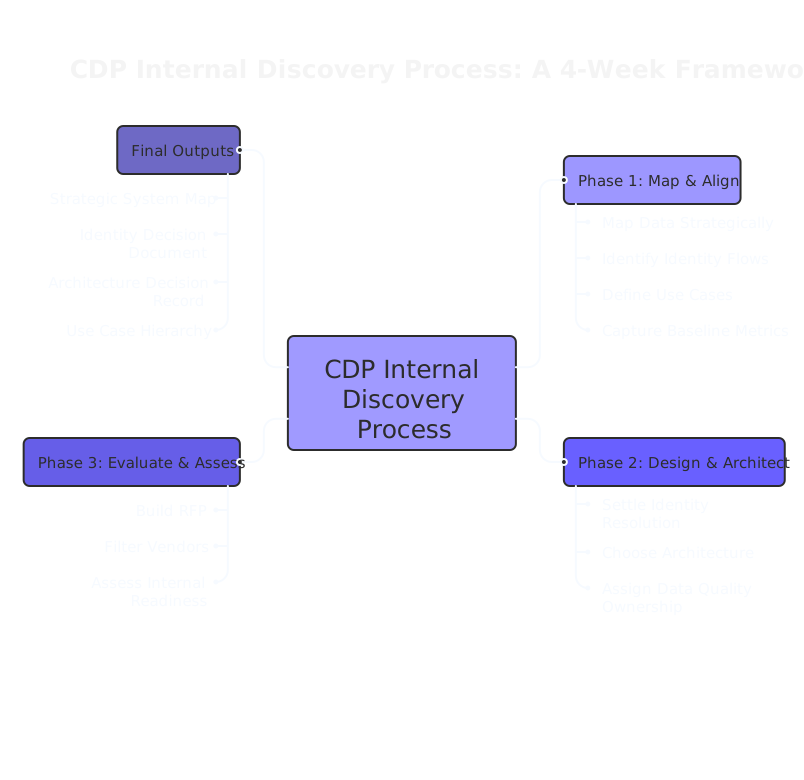
Here is what those four weeks actually look like.
Why Most CDP Projects Fail Before They Start
Most CDP projects underdeliver. The core issue is almost always the same. Organizations treat discovery as something vendors will handle during implementation. They do not.
Vendors will surface some constraints during their process. But by then, your contract is signed. Your timeline is set. Your stakeholders have expectations. Changing course at that point is expensive and politically painful.
The CDP internal discovery process solves this by making the hard decisions early. Architecture choices, identity governance rules, use case sequencing. These decisions shape everything that follows. Make them during discovery, with low stakes, and implementation gets dramatically smoother.
The math is simple. Organizations that run a proper four-week discovery phase reach production deployment in an average of 4.5 months after vendor selection. Organizations that skip structured discovery take 6 to 7 months, even with a shorter upfront timeline. You spend more total time either way. You just choose where you spend it.
The 3-Phase CDP Internal Discovery Process
Phase 1: Map Your Data and Align Your Stakeholders (Weeks 1 to 1.5)
Phase 1 has two jobs. Map what you actually have. And get your key people aligned on what success looks like. Most organizations do these sequentially. That is slower and less accurate. Do them simultaneously.
Start with a strategic data map, not a full audit.
You do not need to catalog every field in every system. That exercise takes months and produces a document nobody uses. Instead, focus on systems that touch your customer at meaningful moments: your CRM, email platform, e-commerce system, web analytics, and customer service tools.
For each system, answer three questions:
- How does this system identify a customer?
- How reliable is that identifier?
- What happens to a customer's data when they interact here?
This gives you a picture of how customer identity flows through your organization. For most mid-market companies, this covers twelve to eighteen systems. You do not need to go deeper than that in week one.
You will likely find three recurring problems. Duplicate customer records that block identity resolution. Inconsistent identifier formats across systems. Missing data that limits segmentation. Document these. You will need them in Phase 2.
Define your use cases and your success metrics before any vendor conversation.
This is the step most organizations rush or skip entirely. They go into vendor conversations with vague goals like "better personalization" or "cross-channel marketing." Vendors love this. It lets them map every capability to your aspirations.
Instead, define two tiers of use cases. Immediate ones, executable within six months. And foundational ones, that unlock future capability but require more groundwork.
A concrete immediate use case: suppress customers who already purchased from your paid media campaigns. Simple. High ROI. Low data complexity. A foundational use case: build unified customer profiles combining online and offline behavior. Valuable. But it depends on solving the data quality gaps you found in your system map.
Then define metrics before implementation. If you want to measure the impact of email suppression on ad spend efficiency, capture your current baseline now. Organizations that skip this step spend twelve to eighteen months trying to prove value. Those that document baselines during discovery show ROI in three to six months.
Phase 2: Design Your Identity Governance and Architecture (Weeks 1.5 to 3)
This is where the real decisions get made. And where most discovery efforts either go too technical or too vague. The goal is to be specific enough to drive real decisions, without writing code.
Settle your identity resolution approach.
Identity resolution is the most consequential technical decision in your entire CDP program. It determines how your platform knows that the person who bought from your e-commerce store last Tuesday is the same person in your email list and the same person your call center spoke to on Monday.
You need to answer three questions explicitly:
- Which systems are your authoritative identity sources?
- What rules decide when two records represent the same customer?
- What happens when a customer's identity changes, like a new email address?
These feel like technical questions. They are actually governance questions. Your CRM team has implicit answers. Your email team has different implicit answers. Your data team has a third set. Discovery forces these into the open so they can be reconciled before implementation, rather than during it when changing course costs money.
Make a one-page decision document. Specify whether you will use deterministic matching (same email, same phone number), probabilistic matching (behavioral signals suggest same person), or a combination. Specify what happens at the edges. This document will prevent weeks of implementation argument.
Choose your architecture model.
There are three broad options. An integrated CDP, where the vendor manages everything in one platform. A warehouse-native approach, where your existing cloud data warehouse (Snowflake, BigQuery, Databricks) is the backbone and you layer tools on top. Or a hybrid of both.
This choice is not about which architecture sounds smartest. It is about what your team can actually operate.
Warehouse-native is elegant and scalable. It is also demanding. You need data engineers who can write SQL, build pipelines, and maintain data models. If you have that team, or are committed to building it, warehouse-native often makes sense. If you do not, an integrated CDP with managed services is a better fit, even if it costs more per record at scale.
Be honest in this phase. The organizations that get into trouble are the ones that choose warehouse-native on architectural merit and discover six months later they do not have the internal capability to run it.
Document your choice and the assumptions behind it. If you choose integrated CDP because you are trading lock-in risk for operational simplicity, write that down. It creates accountability and prevents revisionism later.
Assign data quality ownership.
Data quality always improves during discovery because people are paying attention to it. It almost always decays after implementation because nobody owns ongoing maintenance.
Fix this during Phase 2. Identify the specific data quality issues that block your immediate use cases. Assign a named person or team to own each one. Document a simple improvement timeline.
Do not try to solve every data quality problem before going live. Focus on showstoppers. Duplicate records that prevent identity resolution. Inconsistent formats that break integrations. Missing fields that block segmentation for your first use cases. Everything else goes on a phased roadmap.
Phase 3: Evaluate Vendors and Assess Your Readiness (Weeks 3 to 4)
Phase 3 is where you finally talk to vendors. But not with a generic RFP. You go in with specific scenarios drawn directly from your discovery work.
Build a use-case-driven RFP.
Generic RFPs produce generic responses. They ask vendors to describe their capabilities. Vendors respond enthusiastically. You end up with thirty-page proposals that are nearly impossible to compare.
Instead, present specific scenarios. For example: your e-commerce platform sends a daily purchase feed. A customer buys on a Tuesday. By Wednesday morning, you need that customer suppressed from paid media campaigns across three platforms. How exactly does your platform accomplish that?
That question forces vendors to address your actual integration environment, your actual timing requirement, and your actual activation workflow. The differences in their answers are real and meaningful. You are evaluating implementation reality, not marketing slides.
Filter vendors before the formal process. Use your discovery output to eliminate vendors whose identity approach conflicts with your governance decisions, or whose integration model conflicts with your primary systems. Running a full RFP with twelve vendors wastes everyone's time. Three to four vendors who have been pre-filtered against your actual requirements is more effective.
Assess your own readiness honestly.
This step is uncomfortable. Most organizations skip it entirely. It is also critical.
Evaluate four dimensions before you sign anything.
First, governance maturity. Do you have a data governance function, or will you need to build one during implementation? If you are starting from scratch, your timeline and change management needs are very different.
Second, data engineering capability. Can your team write SQL, manage data pipelines, and troubleshoot integration failures? Or do you need vendor-managed services? Your answer should match your architecture choice from Phase 2.
Third, marketing operations depth. Do you have marketing operations professionals who can execute segmentation logic and campaign activation? Or is that capability concentrated in one person who could leave? CDPs create risk when activation knowledge lives in a single individual.
Fourth, executive sponsorship clarity. Is there a named executive who owns this initiative across functions? CDP programs with diffuse sponsorship face extended timelines because priority disagreements that should have been resolved before implementation get surfaced during it.
Document the gaps you find. Then make explicit decisions about how you will close them. Will you hire? Engage a systems integration partner? Delay certain use cases until capability is in place? These are planning decisions. Make them in week four, not month four.
The Discovery Outputs That Actually Matter
By the end of four weeks, you should have four concrete documents.
A strategic system map showing your primary customer data systems, how they identify customers, and where the major quality gaps are.
An identity governance decision document specifying your matching approach and your rules for managing identity changes.
An architecture decision record naming your chosen CDP architecture model and the assumptions underlying that choice.
A use case hierarchy with baselines listing your immediate use cases, your success metrics, and your current-state measurements.
These are not presentations. They are working documents. They will be referenced throughout implementation. They will prevent arguments. They will keep your vendor accountable to what was actually agreed.
A Note on Discovery Timeline
Four weeks feels fast. It is not the fastest approach. Organizations that rush discovery into one or two weeks push the work into implementation, where it costs more and creates more friction.
Four weeks also feels slower than just calling vendors and starting the process. That instinct is understandable. It is also why so many CDP projects underdeliver.
Extended discovery beyond six weeks shows diminishing returns for most organizations. Each additional week produces less new insight. The goal is focused and strategic, not exhaustive.
If you are not sure where to start or how to facilitate cross-functional alignment during discovery, that is a common challenge. At House of MarTech, we help organizations structure and run this process efficiently, so discovery actually produces decisions rather than documentation.
The four weeks you invest here will determine the trajectory of the next two years. Spend them well.
Related Topics
Related Articles
Need Help Implementing?
Get expert guidance on your MarTech strategy and implementation.
Get Free Audit