
Smart Suppression Lists: The CDP Use Case That Pays for Itself
Stop spending ad money on people who already converted. Smart suppression lists sync daily to every ad platform and recover 5-8% of wasted spend from day one.


Listen to summary
0:00 audio overview
Smart Suppression Lists: The CDP Use Case That Pays for Itself
Picture this. You spend $50,000 a month on paid ads to win new customers. Your agency reports solid click-through rates. Conversions look reasonable. But buried inside that audience? Existing customers. People who already bought from you last month. You're paying Meta and Google to show acquisition ads to people who are already in your CRM.
That's not a targeting problem. That's a suppression problem.
CDP suppression lists fix it. And they typically pay for themselves within the first 30 days.
What Are CDP Suppression Lists?
A suppression list tells your ad platforms, email tools, and SMS systems who not to contact. Your CDP, the system that holds your unified customer data, builds and syncs these lists automatically.
The most common version is simple: take your existing customer list, push it to Google Ads and Meta as an exclusion audience, and stop paying to acquire people you already have.
That's the entry point. But smart suppression goes much further.
Done well, CDP suppression lists don't just cut waste. They actively shape how and when you communicate with every customer, across every channel, based on live data.
Why This Is the Highest-ROI CDP Use Case
Most CDP use cases take months to show results. Personalization requires creative. Journey orchestration requires workflow design. Attribution modeling requires clean historical data.
Suppression requires none of that. It's a configuration change.
Industry benchmarks consistently show that 10 to 20 percent of acquisition budgets are spent on existing customers or recent purchasers who are not going to convert again. For a company spending $500,000 a year on acquisition, that's $50,000 to $100,000 in waste that disappears the moment you sync a proper suppression list.
No new campaigns. No new creative. Just stop showing the wrong ads to the wrong people.
That's why suppression is the place most teams should start when they first deploy a CDP.
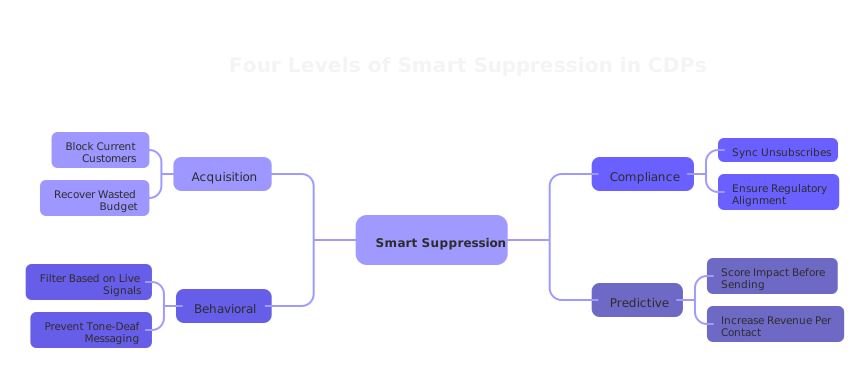
Four Types of Suppression Worth Knowing
CDP suppression lists come in different forms. Each one solves a specific problem.
1. Acquisition Suppression
This is the most common type. You exclude current customers and recent purchasers from your acquisition campaigns on paid channels. They're already converted. Stop trying to convert them again.
2. Compliance Suppression
This covers hard bounces, unsubscribes, spam complaints, and contacts who have opted out under GDPR or CCPA. This isn't optional. It's regulatory. Your CDP should sync these to every channel automatically.
3. Behavioral Suppression
This is where strategy starts to get interesting. You suppress contacts based on live signals, not just status. A customer who just submitted a support ticket gets pulled from your promo email. A customer who engaged yesterday doesn't get a win-back SMS. A recent buyer is pulled from urgency-based ads.
The logic is dynamic. The lists update as behavior changes.
4. Predictive Suppression
The newest approach. Instead of rules, you use a model. The model scores each potential send for predicted impact. If the model says this email is unlikely to change this customer's behavior, you suppress it.
Platforms like Hightouch have built this into their Smart Suppression feature. The result is fewer sends, higher relevance, and measurably better revenue per contact. Pilot data from early adopters has shown campaign revenue increasing 8 to 15 percent alongside a 20 to 25 percent reduction in send volume.
Fewer emails. More money. That's the headline.
How to Implement CDP Suppression Lists
Here's a practical implementation path. Start simple. Build from there.
Step 1: Centralize Your Customer Data
You cannot suppress what you cannot identify. Before anything else, your CDP needs to hold a unified, deduplicated customer record. That means resolving identity across email addresses, phone numbers, device IDs, and CRM entries.
If a customer bought using a Gmail address but browsed using a work address, your suppression list will miss them unless identity resolution is in place. This is the most common reason suppression implementations underperform. Data quality, not logic, is the real bottleneck.
Step 2: Build Your First Suppression Audience
Start with current customers. Export your full customer list from your CRM or CDP. Segment it to include everyone who has purchased in the past 12 months, or whatever window makes sense for your sales cycle.
Push this list to your ad platforms as a custom exclusion audience. In Google Ads, this lives under Audience Manager. In Meta, it's a Custom Audience used as an exclusion in your campaign targeting.
This single step is where most businesses recover the budget they needed to justify their CDP investment.
Step 3: Expand to Behavioral Suppression
Once acquisition suppression is running, introduce behavioral rules.
Common starting points:
- Suppress active support cases from promotional emails
- Suppress contacts who engaged with a campaign in the last 7 days from the next batch send
- Suppress post-purchase buyers from urgency-based ads for 30 to 60 days after purchase
- Suppress high-value customers from discount-led messaging that could train them to wait for deals
Each rule should connect to a real business problem. Don't build suppression for suppression's sake. Build it because you can identify a specific customer experience failure it prevents.
Step 4: Sync Across All Channels
Suppression only works when it's consistent. A customer who opted out of email but still sees ads feels the dissonance. A customer suppressed from SMS but hammered with emails doesn't trust you.
Your CDP should be the single source of truth for suppression decisions. It pushes those decisions to your email platform, your ad channels, your SMS provider, and anywhere else you contact customers. Batch syncs daily are a minimum. Real-time syncs for critical events, like a hard bounce or a purchase, are worth building.
Step 5: Measure What Actually Changed
Suppression ROI is measurable, but you need to look at the right numbers.
For paid media, compare customer acquisition cost before and after suppression went live. Track the change in audience composition, specifically the reduction in existing customer overlap with your acquisition audiences.
For email, track unsubscribe rates, complaint rates, and overall deliverability. Lower volume with higher engagement rates is the target signal.
For predictive suppression, run a holdout group. Send the suppressed messages to a small test group and compare outcomes. If the model is working, the holdout group will underperform relative to the unsuppressed audience.
The Organizational Challenge Nobody Talks About
Suppression reduces send volume. That makes some teams nervous.
If your marketing team is measured on emails sent, impressions delivered, or campaign frequency, suppression will look like a failure by those metrics. It isn't. It's a sign you're shifting from volume thinking to value thinking.
The fix is changing the measurement frame. Revenue per email sent. Return on ad spend per campaign. Customer lifetime value by engagement cohort. These metrics reward efficiency. Volume metrics punish it.
This is a governance conversation, not a technology conversation. Who owns suppression decisions? Who audits the lists? Who approves new suppression rules? Without clear answers, suppression strategy drifts. Marketing builds lists without telling sales. Compliance adds rules marketing doesn't know about. Operations can't keep everything in sync.
Build a simple suppression governance process. Even a monthly review with representatives from marketing, data, and compliance will prevent most of the common failures.
The Most Common Mistake: Suppression as a Silo
The single biggest implementation mistake is treating suppression as an email problem. Or a paid media problem. Or a compliance problem.
Suppression is a customer experience problem. The question is always the same: given what we know about this customer right now, is this the right contact to make?
That question doesn't live in your email platform. It lives in your CDP, where all the customer data is unified. If suppression logic is scattered across five tools, each with its own lists and rules, you will contradict yourself. The customer will feel it.
Centralize suppression in your CDP. Let it cascade out to every channel. That's the architecture that delivers consistent experiences and consistent results.
What Good CDP Suppression Lists Strategy Looks Like at Scale
For teams further along in CDP maturity, suppression evolves into something closer to real-time decisioning.
Instead of asking which lists to apply to a campaign, you're asking a different question for every customer at every potential contact point: what is the right action here?
Sometimes the right action is send. Sometimes it's wait. Sometimes it's suppress entirely and route to a human instead.
This is where predictive models earn their place. Not by replacing human judgment, but by handling the volume of individual decisions that no human team can process at scale. The marketer sets the strategy and the thresholds. The model executes at the contact level.
Organizations operating at this level report suppression becoming a genuine competitive advantage. Their customers feel understood rather than bombarded. Engagement rates improve. Churn falls. Long-term brand health strengthens in ways that take months to appear but are durable once they do.
A Realistic Starting Point for Most Businesses
If you are running paid acquisition on Google or Meta and you have a CRM with customer data, you can implement basic CDP suppression lists this week.
You don't need a sophisticated ML model. You don't need a dedicated data science team. You need your customer list, your ad accounts, and a process to sync them at least daily.
Start there. Measure the CAC reduction. Use that number to justify the next layer of suppression investment. Behavioral suppression. Cross-channel sync. Eventually predictive scoring.
The use case pays for itself. Build it in layers and let the results fund the next phase.
At House of MarTech, we help teams set up this architecture cleanly from the start, so each layer of suppression builds on solid data foundations rather than patched-together workarounds. If you're mid-CDP implementation or evaluating whether your current stack can support this, that's a good conversation to have before you start building suppression rules on top of fragmented data.
The One Idea Worth Taking Away
More contact is not better marketing. Better contact is.
Suppression is the discipline that forces that distinction. It makes you ask, before every send, whether this specific message to this specific person is actually worth making.
The businesses that build that discipline into their systems, not just their intentions, are the ones that earn customer attention over the long run. And they're the ones recovering the most budget from channels that were burning money on the wrong audience.
Start with your existing customers. Stop paying to acquire them twice. Everything else builds from there.
Related Articles
Need Help Implementing?
Get expert guidance on your MarTech strategy and implementation.
Get Free Audit