
Graph-Based Profiling: Next-Gen Techniques for Cross-Device Identity Matching
Discover how graph-based profiling and cross-device identity matching help you build accurate audience profiles, earn customer trust, and deliver personalization that actually works.


TL;DR
Quick Summary
Graph-Based Profiling: Next-Gen Techniques for Cross-Device Identity Matching
Quick Answer
Imagine you run a coffee shop. A regular customer comes in every Monday and orders the same latte. You know her by name. You know her order. You know she always sits by the window.
Now imagine she walks in on a Saturday wearing a hat and sunglasses. You might not recognize her right away. But the moment she starts her usual order, it clicks.
That is exactly what cross-device identity matching tries to do for your marketing. A customer might visit your website on their phone, browse again on a laptop, and finally buy through a tablet. Without the right tools, those three visits look like three different people. With graph-based profiling, you can connect those dots — and serve that customer in a way that actually feels personal.
This guide breaks down how graph-based profiling works, why most current approaches fall short, and what better cross-device audience profile strategies look like in practice.
What Is Graph-Based Profiling?
Graph-based profiling is a way of storing and connecting customer data using a structure called a graph. Instead of putting everything in a big flat table (like a spreadsheet), a graph uses nodes (people, devices, events) and edges (the connections between them).
Think of it like a web of relationships. A customer node connects to a device node, which connects to a session node, which connects to a purchase node. Each relationship carries meaning.
This structure makes it much easier to answer questions like:
- "Is the person who clicked this email the same person who bought last week?"
- "How many devices does this customer use before they convert?"
- "What does this customer's journey actually look like end-to-end?"
Traditional databases struggle with these questions. Graph databases handle them naturally.
Why Cross-Device Audience Profile Building Is So Hard
Here is the core challenge: people do not use just one device. They switch constantly. And most of the time, they are not logged in when they browse.
This creates a fragmented picture. Your analytics show five visitors. But it might really be two people — each using two or three devices.
When your audience profiles are fragmented, everything downstream suffers:
- You show the same ad to someone who already bought
- You send a welcome email to someone who has been a customer for two years
- You score a lead as cold when they have actually been very active
The goal of cross-device audience profile strategy is to stitch those fragments together accurately — so you can treat each person as one person, not as a collection of disconnected signals.
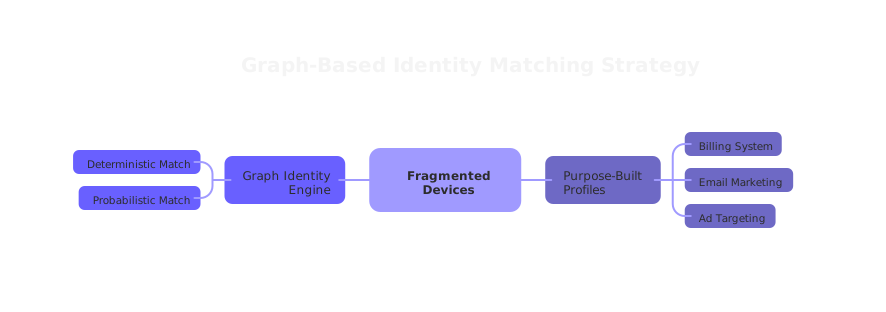
The Two Ways to Match Identity Across Devices
1. Deterministic Matching
This is the gold standard. It happens when a customer gives you a piece of verified information — like logging in with their email address — on multiple devices.
When the same email appears on a phone and a laptop, you know for certain those two sessions belong to the same person. No guessing needed.
Best for: Logged-in users, email campaigns, loyalty programs, subscription products.
Limitation: It only works when people actively identify themselves. Most casual browsing happens without a login.
2. Probabilistic Matching
This approach uses signals — like shared IP addresses, similar device settings, overlapping time patterns, and browser fingerprints — to estimate whether two sessions belong to the same person.
It expands your reach. But it introduces some level of error. Two family members sharing a home WiFi might be matched as one person. A business traveler using hotel WiFi might look like a completely different user every few days.
Best for: Expanding audience reach, upper-funnel targeting, audience building.
Limitation: Accuracy varies. False matches create bad data that flows downstream into your campaigns and reporting.
The smartest cross-device audience profile implementations use both methods together — applying deterministic matching where possible and probabilistic matching where needed, with a clear understanding of how confident each match actually is.
What Most Teams Get Wrong About Identity Matching
Many teams measure success by match rate — the percentage of sessions they can connect to a known profile. Higher match rate feels like progress.
But match rate is a technical number, not a business number.
A 95% match rate filled with guesses is worth less than a 60% match rate built on verified data. When you optimize only for volume, you end up with profiles that look complete but contain incorrect assumptions. Those incorrect assumptions feed bad personalization, which hurts the customer experience and your results.
The better question to ask is: How accurate are the matches we do have? And how are those matches affecting actual business outcomes — like conversion rates, retention, and customer satisfaction?
This is a meaningful shift in how you measure success. Instead of asking "How many profiles did we unify?" ask "How did our unified profiles perform?"
A Better Framework: Build Profiles for a Purpose, Not for Everything
One of the most useful ideas in cross-device audience profile best practices is this: not every use case needs the same type of identity.
Different business functions need different levels of certainty. When you try to build one master profile that serves every team, you end up with compromises that serve no one well.
Here is a practical way to think about it:
| Use Case | Identity Need | Right Approach |
|---|---|---|
| Billing & payments | Very high accuracy | Deterministic only |
| Email personalization | Medium accuracy | Deterministic + verified behavior |
| Ad targeting | Broader reach | Probabilistic with confidence scores |
| Fraud detection | Pattern-based | Graph anomaly detection |
| Privacy & consent | Minimal, auditable | Consent-first records |
When you design your identity infrastructure around specific use cases, each team gets what they actually need. Marketing gets reach. Finance gets precision. Legal gets clean audit trails.
This approach requires letting go of the idea that one unified profile will solve everything. In practice, multiple purpose-built profiles — each optimized for their context — tend to produce better results across the board.
How Graph-Based Profiling Supports This Framework
A graph database is well suited for this kind of flexible, multi-purpose identity work. Here is why:
Relationships are first-class citizens. In a graph, the connection between two data points is as important as the data points themselves. You can store how confident a match is, when it was made, and what signals supported it — all as properties of the edge connecting two nodes.
You can build multiple views of the same data. A graph can support different "lenses" on the same underlying information. Your billing team can query for high-confidence matches only. Your marketing team can pull a broader audience that includes probabilistic matches. The data lives in one place, but different teams get the view that fits their needs.
It handles complex, real-world identity naturally. People share devices. People share households. People have multiple email addresses. A graph can model all of these relationships without forcing artificial simplification.
The Role of Zero-Party Data in Your Cross-Device Audience Profile Strategy
Here is something that often gets overlooked in identity discussions: the most accurate data is the data your customers give you directly.
Zero-party data is information a customer intentionally shares with you. Think preference centers, quiz results, onboarding questions, and survey responses. When a customer tells you they prefer email over SMS, or that they are shopping for a gift rather than themselves, that information is immediately more accurate than anything you could infer from their browsing behavior.
In a graph-based system, this kind of explicit data becomes a powerful anchor. It is not probabilistic. It is not inferred. It is a direct expression of who that person is and what they want.
Even better: when customers feel that you are listening to them — actually asking what they want rather than just tracking what they do — they tend to share more over time. This creates a positive cycle. Better data leads to better personalization, which builds trust, which leads to more data sharing.
Some organizations have found that by focusing more on collecting explicit customer input and less on behavioral inference, they end up with smaller but more reliable profiles — and better business results to show for it.
Privacy and Consent Are Not Add-Ons
A common mistake in cross-device identity matching is treating privacy compliance as something you layer on top of your existing system.
When privacy is an afterthought, you end up with systems that are hard to maintain, hard to audit, and risky to operate under regulations like GDPR, CCPA, and similar laws. Deleting a customer's data becomes a complicated project instead of a clean operation. Consent records are scattered or incomplete.
The cleaner approach is to build consent into the foundation of your identity graph. Every data connection should have a consent record attached to it. If a customer withdraws consent, the graph knows exactly which connections to remove — and can do so cleanly, without breaking everything else.
This is not just a compliance benefit. Organizations that build privacy-first identity systems tend to earn more customer trust. And more trust tends to translate into more willingness to share data — which feeds back into better profiles.
Practical Steps for Cross-Device Audience Profile Implementation
If you are ready to improve how your organization handles cross-device identity, here is a straightforward path to follow:
Step 1: Audit What You Actually Need
Before changing any technology, get clear on what your different teams actually need from customer identity. Map out each use case and the accuracy requirements for each. You may find you are collecting far more data than you actually use.
Step 2: Choose Your Matching Approach Intentionally
Decide where you will use deterministic matching, where you will use probabilistic matching, and what your confidence thresholds will be for each context. Document these decisions so your team knows what the data means.
Step 3: Add Zero-Party Data Collection
Build at least one direct channel for collecting explicit customer preferences. A simple preference center, an onboarding survey, or a product quiz are all good starting points. Feed this data into your identity graph as high-confidence, first-party nodes.
Step 4: Build Consent Into Your Data Model
Ensure every identity connection in your system has an associated consent record. Test your ability to fulfill a data deletion request end to end. If it is complicated, that is a signal that consent is not yet properly embedded.
Step 5: Measure Business Outcomes, Not Just Match Rates
Set up reporting that connects your identity data quality to downstream business results. Track whether better-matched profiles lead to higher conversion rates, better email performance, or stronger retention. Let business outcomes guide your tuning decisions.
What Good Graph-Based Profiling Looks Like in Practice
A well-implemented graph-based cross-device audience profile system has a few recognizable qualities:
- It is transparent. Your team can explain, for any given customer match, what signals supported that decision and how confident the system is.
- It is purposeful. Different teams use identity data in ways that match their actual needs — not a one-size approach.
- It respects customer agency. Customers can update their preferences, opt out, or request their data — and the system responds cleanly.
- It gets better over time. As you collect more zero-party data and refine your matching logic, profiles improve without needing to expand your data collection footprint.
The Bigger Picture: Identity as a Relationship Tool
Graph-based profiling and cross-device identity matching are ultimately not just technical capabilities. They are the foundation of how you understand and relate to your customers.
When your identity infrastructure is accurate, your personalization improves. When your personalization improves, customer experience gets better. When the experience gets better, trust increases. And when trust increases, customers are more willing to share information — which makes your profiles even more useful.
This positive cycle is available to any organization willing to focus on quality over quantity, and on genuine customer understanding over broad data collection.
The goal is not to know everything about everyone. The goal is to know the right things — and to use them in ways your customers actually appreciate.
How House of MarTech Can Help
At House of MarTech, we help organizations design identity and data strategies that are practical, privacy-respecting, and built around what your business actually needs.
Whether you are just starting to think about cross-device audience profile strategy or you are ready to re-architect an existing system, we can help you find the right path — without unnecessary complexity or vendor lock-in.
We work with your existing tools, your specific use cases, and your team's real capabilities to build something that works in practice, not just on paper.
Reach out to start a conversation — we would be glad to help you figure out where to begin.
Frequently Asked Questions
Get answers to common questions about this topic
Have more questions? We're here to help you succeed with your MarTech strategy. Get in touch
Related Articles
Need Help Implementing?
Get expert guidance on your MarTech strategy and implementation.
Get Free Audit