
Lead Qualification Scoring Models: Combining Behavioral, Firmographic, and Intent Data for B2B Prioritization
Master lead qualification with combined behavioral, firmographic, and intent scoring. Step-by-step B2B framework with real implementation examples.


TL;DR
Quick Summary
Listen to summary
0:00 audio overview
Lead Qualification Scoring Models: Combining Behavioral, Firmographic, and Intent Data for B2B Prioritization
Quick Answer
Picture your sales team spending three weeks chasing a VP who downloaded every piece of content you published. They were engaged. They were enthusiastic. They were never going to buy. Their company was too small, their budget nonexistent, and their interest purely academic.
Meanwhile, a director at a perfect-fit account visited your pricing page four times in one week. Nobody called her.
That gap, between who looks active and who is actually ready to buy, is the problem lead qualification models are built to solve. Most of them fail because they only look at one piece of the picture.
This guide covers how to build lead qualification models that combine three data types: behavioral signals, firmographic fit, and intent data. Together, they give you a far more accurate picture of who deserves your team's attention right now.
Why Single-Source Scoring Breaks Down
Most organizations start with one data source. They score on engagement (email opens, page views) or on company profile (industry, company size) but rarely both. Neither approach works well on its own.
Engagement-only scoring rewards curiosity, not buying intent. A researcher writing a blog post about your category will rack up points. So will a competitor monitoring your content.
Firmographic-only scoring assumes fit equals readiness. A Fortune 500 company might be a perfect profile match but two years away from budget approval. A 200-person SaaS company might be ready to sign next week.
The strongest lead qualification models layer all three signals: who the prospect is, what they're doing on your properties, and what they're researching outside them.
Layer 1: Firmographic Fit Scoring
Firmographic fit answers the first question you need to ask: is this even the right type of company?
Before any behavioral signal matters, the account needs to match your Ideal Customer Profile. If it doesn't, high engagement scores just mean you're wasting more time on the wrong prospect faster.
Define Your ICP With Data, Not Opinion
Your ICP should come from closed-won deals in the last 12 to 18 months, not from who you wish would buy from you. Look for patterns across:
- Industry and sub-industry
- Company size by headcount and revenue
- Geographic region
- Funding stage or ownership type
- Technology stack already in use
Technographic data is the most underused dimension here. If a prospect already uses a competing solution, they have budget allocated to the problem. If they use complementary tools that integrate with yours, they'll see value faster. Both signals matter.
Build a Fit Score on a 30-Point Scale
A clean firmographic scoring structure might look like this:
Industry match: 0 to 10 points. Primary target industries score full points. Adjacent industries score partial. Poor fits score zero.
Company size: 0 to 10 points. Your sweet spot gets full points. Companies at the edge of your range get partial credit. Companies well outside it get zero, or a negative score.
Technology fit: 0 to 10 points. Compatible stack scores high. Neutral stack scores moderate. Competitive or incompatible stack scores low or negative.
The point of firmographic scoring is to create a hard filter. Prospects below a fit threshold don't move forward regardless of engagement. This is where negative scoring earns its place. A personal email domain, a company with five employees, or an industry you've never successfully served should subtract points, not just fail to add them.
Discipline here saves enormous time downstream.
Layer 2: Behavioral Engagement Scoring
Once a prospect passes fit screening, behavioral data tells you where they are in their thinking.
The key mistake most teams make is treating all engagement equally. A blog view is not the same as a pricing page visit. An email open is not the same as a demo request. Your scoring should reflect actual conversion correlation, not just activity volume.
Weight Actions by Buying Intent
Here is a straightforward framework for behavioral weighting:
High-intent actions (15 to 25 points each):
- Demo request or free trial signup
- Pricing page visit, especially repeated visits
- Direct sales inquiry
- Attending a live product demo
Mid-intent actions (5 to 10 points each):
- Case study or ROI calculator download
- Visiting product feature pages
- Watching a product walkthrough video
- Returning to your site multiple times in one week
Low-intent actions (1 to 3 points each):
- Blog post view
- Email open
- Webinar registration (not attendance)
- Social media click
This isn't guesswork. Pull your last 100 closed deals and trace back which actions most commonly appeared in the 30 days before a demo was requested. Let your own data tell you what matters.
Build Score Decay Into the Model
A pricing page visit from six months ago is a cold signal. A pricing page visit yesterday is a hot one.
Score decay ensures that leads don't sit near the top of your queue because of old activity. A common approach: reduce behavioral scores by 50% after 30 days of inactivity, and by another 50% after 60 days. Leads that re-engage move back up the ranking automatically.
This keeps your scoring model honest. It reflects current interest, not historical curiosity.
Layer 3: Intent Data
Behavioral data captures what prospects do on your properties. Intent data captures what they're researching everywhere else.
Third-party intent providers like Bombora, 6sense, and Demandbase track content consumption across thousands of B2B websites. When a company's employees start consuming content about a problem your solution solves, that creates a topic surge. It's a signal that the problem is active in that organization's thinking.
This matters because most of the B2B buying journey happens before a prospect ever touches your website. They're reading analyst reports, comparing vendors on review sites, asking questions in private communities. Your behavioral data misses all of it.
Use Intent Data to Validate, Not to Lead
Here's the critical nuance most teams miss: intent signals are noisy when used alone.
A company researching data integration topics might be evaluating vendors. Or they might be educating their team after reading an analyst report. Or they might be monitoring competitive activity. The signal alone doesn't tell you which.
Intent data becomes powerful when it corroborates other signals. An account that matches your ICP, has an engaged contact visiting your pricing page, and is showing an external intent surge in your category. That's a buying signal. Any one of those three factors in isolation is much weaker.
The practical approach: use intent data to prioritize within your qualified pipeline, not to identify your pipeline from scratch. If two accounts both have behavioral scores of 65, the one showing external intent signals should get the call first.
Layer Intent Into Your Score
A straightforward intent scoring addition:
- Company surge on primary topic category: 10 to 20 points
- Surge on secondary or adjacent categories: 5 to 10 points
- Competitive research detected: 5 to 15 points (they're evaluating the market)
- Review site visits for your category: 5 to 10 points
These points supplement your behavioral and firmographic scores. They don't replace them.
Putting It Together: The Three-Layer Model
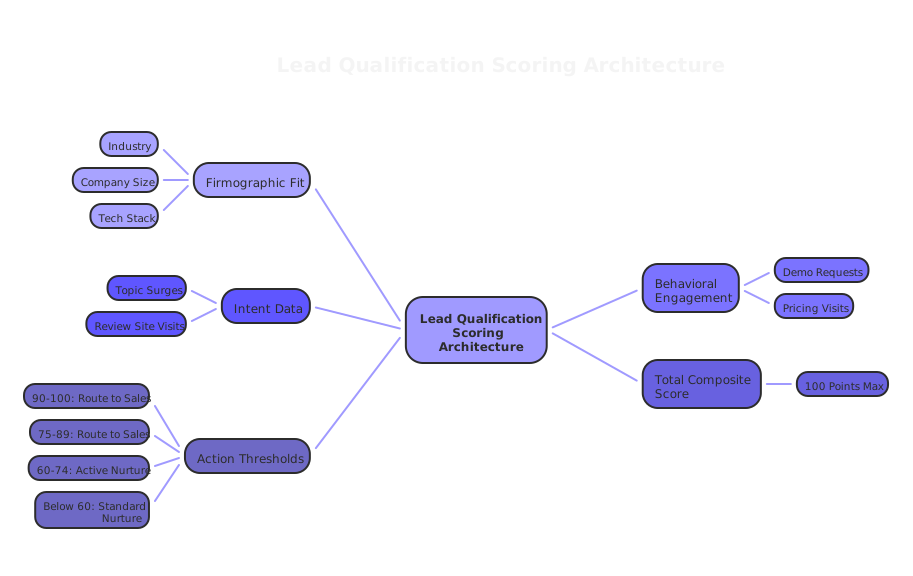
A complete lead qualification scoring model combines all three layers into a single composite score, typically on a 100-point scale.
Here is a simple structure:
| Layer | Max Points | Purpose |
|---|---|---|
| Firmographic Fit | 30 | Is this the right type of company? |
| Behavioral Engagement | 50 | Are they showing buying interest? |
| Intent Data | 20 | Are they actively researching? |
Score thresholds that work in practice:
- 90 to 100: Route to sales immediately. These accounts pass all three filters. Require contact within 24 hours.
- 75 to 89: Route to sales with standard priority. 48-hour response SLA.
- 60 to 74: Enter active nurture. Trigger relevant sequences. Monitor for score increases.
- Below 60: Standard nurture or suppress if fit score is also low.
These thresholds should be calibrated to your own conversion data. Start here and adjust based on what your actual MQL-to-SQL rates tell you over 60 to 90 days.
The Piece Most Teams Skip: Buying Group Scoring
Individual lead scoring has a structural problem in modern B2B. Most purchases involve 6 to 10 decision-makers. Scoring one contact while three others are quietly evaluating competitors misses the real picture.
The next evolution of lead qualification models is account-level scoring that tracks buying group completeness.
Ask: are multiple stakeholders from this account engaging? Are you reaching financial decision-makers in addition to technical evaluators? Is there a champion with internal influence?
You don't need sophisticated software to start. Look at your CRM for accounts where multiple contacts have behavioral scores above 40. That pattern, multiple stakeholders showing interest simultaneously, is one of the strongest buying signals you can find.
When you see it, treat the account as high-priority regardless of any individual's score.
The Governance Rules That Make Scoring Work
A scoring model without operational discipline is a dashboard nobody acts on.
Define your terms in writing. What is an MQL? What is an SQL? What does it mean for a lead to be sales-accepted? If marketing and sales answer these questions differently, your scoring model will generate conflict, not pipeline.
Set SLAs by score band. A 90+ score that gets called three days later might as well not have been scored. Speed to lead matters as much as score accuracy.
Review outcomes weekly. Pull the last 30 days of routed leads. What converted? What didn't? What patterns do you see? Your model should improve every month based on this feedback.
Run quarterly calibrations. Score thresholds that worked in Q1 may not work in Q3. Market conditions shift. Buying behavior evolves. Schedule regular calibration reviews to keep the model accurate.
At House of MarTech, we work with teams to build these governance structures from the start. Getting the SLAs and definitions right often produces faster results than refining the scoring algorithm itself.
Common Mistakes in Lead Qualification Models
Rewarding engagement over fit. A highly engaged wrong-fit lead wastes sales time and distorts your conversion data. Fit scores should act as a gate. No amount of behavioral engagement should override a poor ICP match.
Ignoring score decay. Without decay, your pipeline fills up with stale leads that looked hot months ago. Your sales team loses confidence in the model when calls go cold.
Using intent data as a primary signal. Topic surges without corroboration generate false positives. Use them to validate and prioritize, not to originate outreach.
Skipping negative scoring. If you're not actively removing points for bad signals (competitor employees, personal email domains, company sizes below your minimum), you're letting noise into your pipeline.
Building a model nobody agreed on. If marketing built the model without sales input, sales will find reasons to ignore it. Build it together, define the outcomes together, and review performance together.
Lead Qualification Models Best Practices: A Quick Reference
For teams that want a practical checklist, these are the lead qualification models best practices that consistently drive results:
- Start with ICP clarity before configuring any scoring system
- Weight behavioral actions by conversion correlation, not intuition
- Build in score decay for behavioral signals after 30 days
- Use intent data to validate qualified accounts, not to source them
- Implement negative scoring rules for clear disqualifiers
- Define score-band SLAs and hold both teams accountable
- Track MQL-to-SQL conversion by score band monthly
- Calibrate thresholds quarterly based on outcome data
- Watch for multi-stakeholder engagement at the account level
- Treat governance as part of the model, not separate from it
Where to Start if You're Building From Scratch
If you have under 500 leads per month or less than 1,000 historical conversions in your CRM, start with a rule-based model. It's transparent, explainable to sales, and faster to implement than machine learning approaches.
Get your ICP defined from closed-won data. Set up firmographic scoring in your CRM. Add behavioral weighting based on your highest-converting actions. Layer in intent data from a provider when you're ready. Establish SLAs. Review outcomes monthly.
Simple and disciplined will outperform sophisticated and ignored every time.
When you have the data volume and governance in place, a hybrid approach works well: rule-based fit scoring as a gate, machine learning ranking for prioritization within qualified accounts. That combination gives you transparency where sales needs it and pattern recognition where your data supports it.
Lead qualification models aren't a technology problem. They're an alignment problem with technology to help. Build the model your team will actually use, govern it rigorously, and let the data tell you how to improve it over time.
If you want help designing a scoring architecture that fits your pipeline size and stack, the team at House of MarTech can walk you through it.
Frequently Asked Questions
Get answers to common questions about this topic
Have more questions? We're here to help you succeed with your MarTech strategy. Get in touch
Related Articles
Behavioral Lead Scoring: Why Treating Every Lead the Same Costs You Deals
AI-Powered Lead Qualification Frameworks: Scoring Beyond Demographics and Firmographics
Agentic AI Marketing Workflows: Building Autonomous Systems That Execute Campaigns Without Human Intervention
Need Help Implementing?
Get expert guidance on your MarTech strategy and implementation.
Get Free Audit