
The Art of Signal Intelligence: Advanced Analytics for Predictive CDP
Learn how to turn customer behavior signals into smarter predictions, better decisions, and stronger marketing results with your CDP.


TL;DR
Quick Summary
Listen to summary
0:00 audio overview
The Art of Signal Intelligence: Advanced Analytics for Predictive CDP
Quick Answer
Imagine you run a busy coffee shop. A regular customer walks in, but instead of heading straight to the counter, she pauses near the door, checks her phone twice, then leaves without ordering.
You noticed the signal. But did you act on it?
In marketing, your customers send signals like this every single day. They click, they pause, they leave pages, they stop opening emails. Each one of these actions is telling you something important.
A Customer Data Platform (CDP) collects all of this. But collecting data is just the start. The real power comes from reading those signals correctly and using them to make smarter decisions before the customer walks out the door.
That is what signal intelligence is all about. And when you combine it with predictive analytics and intent signals, your CDP stops being just a storage tool. It becomes a system that helps you act at exactly the right moment.
Let us walk through how this works and how you can apply it to your business.
What Are Customer Signals, Really?
A signal is any action a customer takes that tells you something about where they are in their journey.
Some signals are obvious:
- A customer adds a product to their cart but does not buy
- Someone opens your email three times in one day
- A long-time buyer suddenly goes quiet for 60 days
Other signals are subtle:
- A customer who used to browse five pages now only visits one
- Someone who calls support more often than usual
- A visitor who reads your pricing page but never requests a demo
When you look at one signal alone, it does not tell you much. But when you combine several signals together and look at them over time, patterns start to emerge. Those patterns are where predictive power lives.
The goal of predictive analytics and intent signals strategy is to recognize these patterns early enough to do something useful with them.
Why Most CDPs Are Not Reaching Their Full Potential
Here is something worth thinking about. Many companies invest in a CDP and expect the results to follow automatically. But the platform itself does not create results. What creates results is how you interpret and act on the data inside it.
The most common gap we see is this: teams collect a lot of data, but they are not clear on which signals actually matter for specific business decisions.
For example:
- Which signals predict that a customer is about to stop buying?
- Which signals suggest someone is ready to upgrade?
- Which patterns show that a customer is frustrated, not just inactive?
Without clear answers to these questions, even the best CDP becomes a very expensive filing cabinet.
The fix is not more data. It is better signal interpretation.
When you build your customer data platform strategy around 2 to 3 specific outcomes you care about most, everything becomes clearer. Your data collection becomes focused. Your team knows what to look for. Your actions become timely and relevant.
The Core Idea Behind Predictive Analytics and Intent Signals
Predictive analytics is not magic. At its core, it answers one question: Based on what this customer has done in the past, what are they likely to do next?
Intent signals are the inputs that feed that prediction. They are the breadcrumbs a customer leaves behind as they move through your channels.
Here is a simple way to think about it:
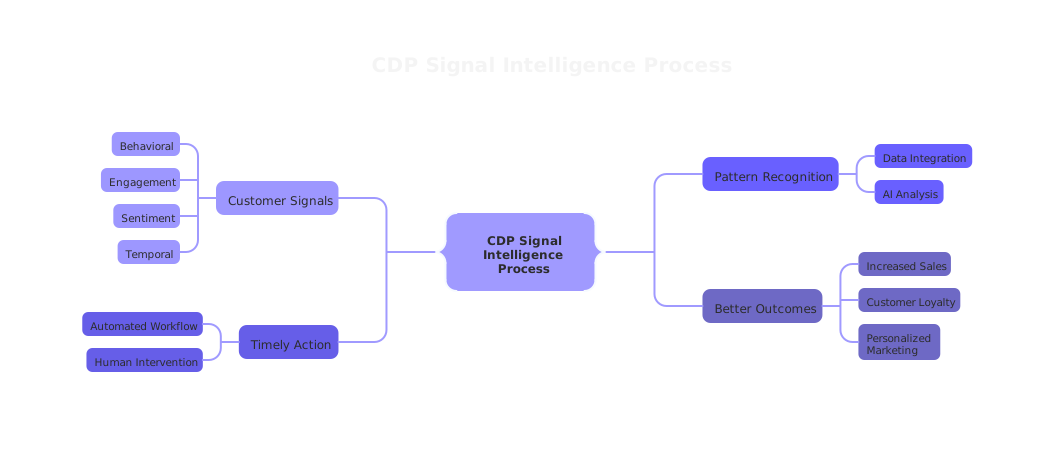
Intent signal + pattern recognition + timely action = better outcomes
Let us say a customer has:
- Visited your pricing page three times in the last week
- Opened your last two emails but did not click
- Had one support conversation four weeks ago
Each of those actions is a signal. Together, they suggest this person is interested but hesitant. That is an intent signal worth acting on. Maybe they need a clearer answer to a question. Maybe a short, personal outreach from your sales team would close the loop.
Without signal intelligence, this customer might just receive your next scheduled email blast. With it, they get a timely, relevant touchpoint that feels helpful rather than random.
That is the difference predictive analytics and intent signals implementation makes in practice.
Four Signal Types Your CDP Should Be Tracking
To build strong signal intelligence, you need to think beyond just purchase history. Here are four signal types that give you a much fuller picture of customer intent.
1. Behavioral Signals
These come from how customers interact with your digital properties.
- Pages visited and time spent on each
- Content downloaded or watched
- Features used (or ignored) in your product
- Cart activity, checkout steps, and drop-off points
Behavioral signals are often the first to shift before a customer makes a major decision, like leaving or upgrading.
2. Engagement Signals
These come from how customers respond to your communications.
- Email open rates and click-through patterns over time
- Response rates to surveys or feedback requests
- Participation in loyalty programs or events
A sudden drop in engagement is often a leading indicator of churn. Catching it early gives you time to respond.
3. Sentiment Signals
These come from the tone and content of customer conversations.
- Support tickets and chat transcripts
- Reviews and social comments
- Net Promoter Score responses
When a customer's support interactions become more frustrated in tone, that is a signal. When positive reviews suddenly stop, that is a signal too. Sentiment signals help you understand the emotional context behind the behavior you are seeing.
4. Temporal Signals
These come from when and how often customers do things.
- How frequently they purchase compared to their historical average
- How long since their last login or visit
- Whether their engagement is growing or slowing over time
A customer who used to buy monthly and has now gone 90 days without a purchase is showing a temporal signal that deserves attention.
When your CDP is set up to track all four of these signal types, your predictive analytics and intent signals work becomes much more accurate and much more useful.
How to Build a Signal Intelligence System That Actually Works
You do not need to overhaul your entire marketing stack to get started. Here is a practical path forward.
Step 1: Define the Decisions You Want to Make Better
Start with your business outcomes. Pick two or three specific decisions where better data would clearly help.
Examples:
- "We want to identify customers likely to churn 30 days before they leave."
- "We want to know which leads are most likely to convert this week."
- "We want to find customers who are ready for an upsell before we push a campaign."
Once you know the decisions, you can work backward to figure out which signals are most predictive of each one.
Step 2: Map the Signals to Each Decision
For each decision, list the behavioral, engagement, sentiment, and temporal signals that would logically relate to it.
For churn prediction, your signal map might look like:
- 60-day drop in purchase frequency (temporal)
- Decline in email engagement over last 4 weeks (engagement)
- Increase in support ticket volume (sentiment)
- Fewer pages visited per session (behavioral)
This is your starting signal set. You will refine it over time as you learn which combinations are truly predictive in your specific business.
Step 3: Set Up Real-Time or Near-Real-Time Activation
The value of a signal drops fast. A customer who shows strong purchase intent right now may not feel the same way tomorrow.
Work with your CDP and activation tools to reduce the time between signal detection and response. For high-value moments, you want your system to respond in minutes, not hours.
This does not mean fully automating every response. It means making sure your team gets the right signal at the right time so they can act quickly and appropriately.
Step 4: Keep Humans in the Loop for Complex Signals
Not every signal should trigger an automated response. When signals suggest a customer is frustrated, confused, or at a critical decision point, a real human conversation is often more effective than an automated email.
Build your workflows so that high-stakes signals surface to the right person on your team with enough context to act meaningfully. Give them the signal, the pattern, and a suggested response. Then let them own the decision.
This combination of smart automation and human judgment is where predictive analytics and intent signals best practices are moving in 2026.
The Trust Factor: Why Privacy and Transparency Make Your Signals Better
Here is something that surprises many teams: being more transparent with customers about your data practices often improves the quality of your signal intelligence.
When customers understand what data you collect and why, and when they can see that it benefits them, they are more likely to opt in. And customers who genuinely opt in give you cleaner, more reliable signals.
Think about it this way. A customer who knowingly shares their preferences with you is sending an intentional signal. That signal is much more valuable than one inferred from probabilistic matching across anonymous data points.
Consent is not just a legal requirement. It is a data quality strategy.
Collect only the signals you actually need for your specific use cases. Be clear with customers about what you are tracking and why. Make it easy for them to update their preferences. This approach builds trust, reduces noise in your data, and often produces better predictions than trying to collect everything you can.
A Note on Scope: Doing Less, Better
One of the most important lessons from organizations seeing strong results with signal intelligence is this: narrower focus usually wins.
The temptation is to build a system that predicts everything. Churn risk, purchase intent, upsell readiness, lifetime value, next best action, all at once. But systems trying to do everything often do nothing particularly well.
The organizations seeing the clearest results pick one or two predictions to get really good at first. They gather clean data for those specific use cases. They build simple, explainable models. They measure outcomes carefully and adjust.
Once those predictions are working well and your team trusts the signals, you expand.
This is sound customer data platform strategy that applies whether you are just getting started or are years into your CDP journey.
What Good Signal Intelligence Looks Like in Practice
Let us bring this to life with a simple example.
A software company notices that customers who cancel usually show three signals in the 45 days before they leave:
- Their weekly active usage drops by more than 40 percent
- They open fewer than 20 percent of product emails in a given month
- They submit at least one support ticket that is not resolved within 48 hours
The team builds a simple alert inside their CDP. When a customer hits two out of three of these signals, a customer success team member gets notified with that customer's full context.
The team member reaches out personally. Not with a discount. Not with a generic check-in email. With a real conversation about what is going on.
Result: the company reduces churn by a meaningful percentage in the first quarter after launch. Not because their technology was impressive. Because they were paying attention to the right signals and responding like humans.
That is signal intelligence working as it should.
Getting Started: Your Next Steps
If you want to build stronger signal intelligence into your CDP strategy, here is where to begin.
This week:
- List the top two or three business decisions where better timing or information would make a real difference
- Identify which customer signals your current CDP is already capturing for those decisions
This month:
- Map out which signal combinations are most predictive for your priority outcomes
- Review your current activation timing and identify where latency is costing you opportunities
This quarter:
- Pilot a focused signal-to-action workflow for one high-value use case
- Measure outcomes carefully and use what you learn to improve the model
The goal is not a perfect system on day one. The goal is a clear, focused system that gets better over time because you are paying attention and learning.
Final Thought
Your customers are always communicating with you. Every click, every pause, every moment of silence is a signal. The question is whether your systems and your team are set up to hear those signals clearly and respond in a way that feels helpful, not intrusive.
Predictive analytics and intent signals are not about knowing everything about your customers. They are about knowing the right things at the right time, so you can be genuinely useful to them.
That is what turns a CDP from a data warehouse into a competitive advantage.
If you are ready to explore how to build or improve your signal intelligence strategy, the team at House of MarTech is here to help. We work with businesses at every stage to turn their customer data into clear, actionable intelligence that drives real results.
Frequently Asked Questions
Get answers to common questions about this topic
Have more questions? We're here to help you succeed with your MarTech strategy. Get in touch
Related Articles
Need Help Implementing?
Get expert guidance on your MarTech strategy and implementation.
Get Free Audit