
The Evolution of Contextual Advertising
Contextual advertising has moved from a backup plan to a powerful, AI-driven strategy for the privacy-first era. Learn how business leaders are reaching the right audiences without relying on third-party cookies — and how to build a system that scales.


TL;DR
Quick Summary
Listen to summary
0:00 audio overview
Quick Answer
There is a moment every experienced marketer remembers. You are running a campaign, the numbers look decent, and then someone asks: "But do we actually know who we are reaching?"
For years, the honest answer was complicated. Digital advertising leaned heavily on third-party cookies — small data files that tracked people across websites and built detailed profiles of their behavior. It worked. But it also created a system that many people, regulators, and even browsers started pushing back against.
Now that system is changing. And the shift is not a crisis. It is actually an opportunity — one that takes us back to a smarter, more respectful way of connecting with people.
This is the story of the evolution of contextual advertising: how it started, where it went, what killed its momentum temporarily, and why it is now becoming one of the most powerful tools in a modern marketer's playbook.
What Is Contextual Advertising, Really?
Before we trace its journey, let us make sure we are all speaking the same language.
Contextual advertising means placing your ad next to content that is directly related to what you are selling. A running shoe brand advertising on an article about marathon training. A financial planning tool showing up inside a piece about saving for retirement. The connection is the content itself — not a profile built from someone's browsing history.
This is different from behavioral advertising, which tracks what people do across different websites over time and uses that history to decide which ads to show them.
Think of it this way: contextual advertising asks "What is this person reading right now?" Behavioral advertising asks "What has this person been doing for the past three months?"
Both approaches have value. But they carry very different implications for privacy, trust, and long-term scalability.
Where Contextual Advertising Began
In the early days of the internet, contextual advertising was simply how digital ads worked. Google's AdSense, launched in 2003, is one of the most well-known examples. It scanned the words on a webpage and matched ads to that content. A cooking blog showed food ads. A travel site showed flight deals. Simple. Logical. Clean.
This approach did not require knowing anything personal about the visitor. It relied entirely on the content of the page.
For a while, this was enough. But as the internet grew and advertisers wanted more precision, the industry started building more sophisticated tracking tools. Third-party cookies became the foundation of a new targeting approach — one that could follow users across websites, track their interests, and build detailed audience profiles.
This felt like a major upgrade. Advertisers could now target a specific type of person — say, someone who had visited five car dealership websites in the past two weeks — no matter where that person was browsing. Reach and precision, at the same time.
Contextual advertising took a back seat. It became the option you used when you had nothing better. A fallback. A lesser choice.
That perception turned out to be very wrong.
The Turn: Why the Industry Is Returning to Context
Three things changed the equation.
First, privacy laws caught up with behavior. Regulations like GDPR in Europe and CCPA in California put new responsibilities on businesses around how they collect and use personal data. Advertisers suddenly needed to think much more carefully about consent and data handling.
Second, browsers started blocking third-party cookies. Firefox and Safari did it first. Then Google announced plans to phase them out in Chrome — the world's most widely used browser. While Google's timeline has shifted, the direction is clear: the era of widespread third-party cookie tracking is ending.
Third, and perhaps most importantly, people started noticing. When someone searches for a product and then sees that exact product following them around the internet for weeks, it feels less like helpful marketing and more like being watched. Consumer trust in data-heavy advertising dropped. And trust, once lost, is hard to earn back.
Together, these shifts created the conditions for contextual advertising to step back into the spotlight — not as a fallback, but as a serious, forward-looking strategy.
What Makes Modern Contextual Advertising Different
Here is where the story gets genuinely interesting.
The contextual advertising of 2025 is not the same as the keyword-matching of 2003. Artificial intelligence has completely changed what is possible.
Early contextual targeting read the words on a page. If the article mentioned "running," a shoe ad might appear. Simple, but blunt. An article about avoiding running injuries could still trigger a running shoe ad — not exactly a perfect match.
Modern contextual targeting uses AI to understand the full meaning of a page. It analyzes:
- The overall theme and emotional tone of the content
- Images, video, and audio within the page
- The sentiment — is this content positive, negative, cautionary, or celebratory?
- How content connects to other topics and signals
This is sometimes called semantic analysis — understanding meaning, not just matching keywords. An AI-powered contextual system can tell the difference between an article celebrating a marathon finish and an article warning about knee injuries from overtraining. That distinction matters enormously for where your ad should appear.
Some platforms are now applying computer vision — technology that reads and interprets images and video frames — to extend contextual targeting into visual content. This opens up contextual advertising in streaming, podcasts, and social video in ways that were not previously possible.
What This Means for Your Advertising Strategy
Let us get practical. If you are a business leader thinking about where to put your advertising dollars, here is a clear way to think about the evolution of contextual advertising and what it means for you.
Understanding Your Options
| Approach | What It Uses | Privacy Risk | Cookie Dependency |
|---|---|---|---|
| Behavioral targeting | User browsing history | Higher | High |
| Contextual targeting | Page/content analysis | Lower | None |
| First-party data targeting | Your own customer data | Lower (with consent) | Low |
| Combined approach | All of the above | Varies | Low to Medium |
The smartest advertisers today are not choosing one approach. They are building a layered system that combines contextual signals with first-party data — the information they have collected directly from their own customers with proper consent.
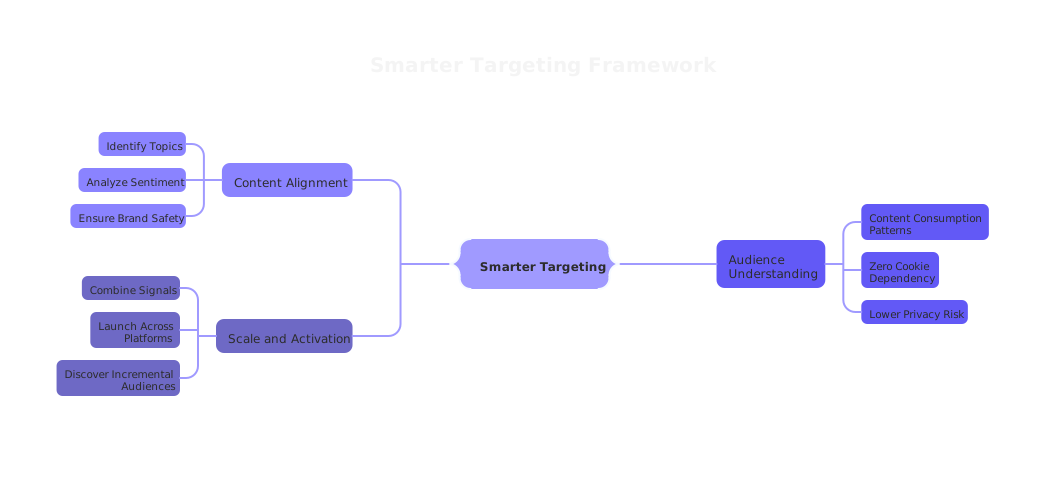
The Practical Framework: Three Layers of Smarter Targeting
Here is a simple framework for thinking about contextual advertising implementation in your own strategy:
Layer 1: Content Alignment
Start by identifying the types of content where your ideal customer is most likely to be engaged. This is not just about topic matching. Think about emotional state. Someone reading a "how to prepare for your first home purchase" guide is in a very different mindset than someone reading "how to fix a bad credit score." Both might be relevant for a financial services brand — but they call for very different messages.
Layer 2: Audience Understanding Without Tracking
Modern contextual platforms can help you understand who is consuming certain types of content without relying on individual tracking. You learn about audiences through content patterns rather than personal data trails. This insight can reshape your entire content and media strategy — not just your paid ads.
Layer 3: Scale and Activation
One of the strongest advantages of contextual advertising today is how easy it has become to activate across multiple platforms. You can take a contextual strategy and launch it across different demand-side platforms (DSPs) — the technology tools that let advertisers buy digital ad space — without heavy technical setup. This makes scaling a well-defined contextual strategy significantly more straightforward than managing complex audience segments.
How Contextual Advertising Connects to Brand Safety
There is another dimension of this evolution that does not get talked about enough: brand safety and suitability.
Brand safety means your ad does not appear next to content that could harm your brand's reputation — think news articles about disasters, crime, or controversy. That has been a concern in digital advertising for years.
But brand suitability goes one step further. It asks: not just "is this content harmful?" but "is this content the right fit for our brand?"
A luxury travel brand might be perfectly safe appearing next to a generic travel article, but the right fit would be an aspirational piece about bucket-list destinations in a premium travel publication. Contextual advertising, done well, addresses both brand safety and brand suitability simultaneously — because you are choosing based on content meaning, not just keyword exclusion lists.
This is one reason major brands have been increasing their investment in contextual strategies. The control and clarity it provides is genuinely valuable, beyond just the privacy compliance benefits.
The Bigger Picture: Where Contextual Advertising Is Heading
The numbers tell a compelling story about where the industry is going. Research from multiple sources suggests the global contextual advertising market is on a strong growth trajectory through the late 2020s and into the 2030s, driven by AI advancement and privacy regulation.
But the more important signal is not the market size. It is the behavior shift happening among sophisticated advertising teams.
The most thoughtful marketing leaders are no longer asking "should we use contextual advertising?" They are asking "how do we build a systematic contextual strategy that connects to our first-party data, aligns with our brand values, and scales efficiently?"
That is a very different — and much more productive — question.
At House of MarTech, we work with businesses to answer exactly these kinds of questions. Not by selling a single tool or pushing one approach, but by helping teams understand the full landscape of their options and build systems that make sense for their specific goals. Our MarTech Growth Systems approach is built around this kind of strategic clarity — connecting the right technology to the right business outcomes.
Building Your Contextual Advertising Foundation
If you are ready to think more seriously about contextual advertising as part of your overall strategy, here are the practical starting points:
Audit where you are today. Understand what percentage of your current digital advertising relies on third-party cookies or behavioral data. This tells you your exposure to the ongoing changes in the industry.
Map your content context. Think about the kinds of content your ideal customers consume. Not just topics — but tone, format, platform, and emotional context.
Evaluate your first-party data. What do you already know about your customers from your own channels? This is the asset that makes contextual advertising even more powerful when the two are combined.
Start testing, not replacing. You do not have to overhaul your entire media strategy at once. Running contextual campaigns alongside your existing approach lets you build confidence in the results before making larger shifts.
Choose platforms that offer transparency. The best contextual advertising tools show you exactly where your ads are running and why. That transparency is not just good for compliance — it is genuinely useful for refining your strategy.
The Pattern That Matters Most
The evolution of contextual advertising is really a story about the industry finding its way back to something that was always true: the best advertising feels relevant, not intrusive.
When your ad appears in a moment that genuinely connects to what someone is thinking about or working through, it earns attention rather than demanding it. That is not a new idea. It is one of the oldest principles in marketing. What has changed is the sophistication of the tools we now have to execute it — and the urgency created by a privacy landscape that is reshaping the entire digital advertising ecosystem.
The businesses that will navigate this transition most effectively are the ones building systems now — not waiting for the next disruption to force their hand.
If you are thinking through what this means for your specific situation, House of MarTech is here to help you build the clarity and the systems to move forward with confidence. Explore how we approach MarTech strategy and growth systems — or reach out directly to start a conversation about where your advertising strategy stands today.
The landscape is changing. The businesses that understand the shift — and build for it — are the ones that will come out ahead.
Frequently Asked Questions
Get answers to common questions about this topic
Have more questions? We're here to help you succeed with your MarTech strategy. Get in touch
Related Articles
Need Help Implementing?
Get expert guidance on your MarTech strategy and implementation.
Get Free Audit