
The Psychology of B2B Buying Decisions: What Marketing Technology Can't Tell You
Explore the psychology behind B2B buying decisions. Understand emotional triggers, cognitive biases, and human factors that MarTech data misses.


Listen to summary
0:00 audio overview
The Psychology of B2B Buying Decisions: What Marketing Technology Can't Tell You
Picture this. A software vendor runs a flawless campaign. Strong open rates. High engagement scores. Plenty of demo requests. Their CRM shows green across every metric. Then the deal stalls. No decision. The buyer goes quiet.
The data said everything was working. The psychology said otherwise.
That gap, between what your MarTech stack can measure and what actually drives a purchase, is costing B2B organizations real money. Understanding B2B buying psychology is not a soft skill. It is a competitive edge.
Your Data Sees Behavior. It Cannot See Motivation.
Marketing technology is genuinely powerful. It tracks clicks, content views, email opens, and proposal downloads with precision. But behavior and motivation are not the same thing.
A buyer can read your pricing page four times, attend two webinars, and download your ROI calculator, while privately doubting whether the decision is safe to make. Your platform scores that as a hot lead. The buyer sees it as research without resolution.
Emotions drive roughly half of all B2B purchasing decisions. That finding holds across multiple independent studies on B2B buying psychology. Yet virtually every MarTech platform is built on the opposite assumption: that B2B buyers are rational, process-driven, and persuadable through information.
They are not. They are people making high-stakes decisions with their careers on the line.
The Career Risk Nobody Talks About
This is the part that most marketing strategy skips entirely. B2B buyers are not just solving an organizational problem. They are protecting their professional reputation at the same time.
Research surveying nearly 1,000 managers found that around 80% had made at least one major decision in the past year that was defensive in nature. Designed to protect themselves, not to advance the business.
That changes everything about how a buying decision actually gets made.
When a buyer evaluates your solution, they are asking two parallel questions. The first is obvious: "Does this solve our problem?" The second is invisible: "Can I defend this choice if it goes wrong?"
An established vendor is easy to defend. "Everyone uses them. It was the safe call." A newer or more innovative vendor, even a genuinely better one, introduces personal risk. If implementation struggles, someone gets blamed.
Your demand generation campaign cannot address that fear. Your intent data cannot see it. But it shapes the outcome anyway.
What You Can Do About It
Build what some practitioners call a defensibility narrative. Help buyers understand that choosing your solution is the safe, well-reasoned choice. Use case studies from similar companies. Provide language buyers can use to explain the decision internally. Give them risk-reducing commitments such as strong onboarding support or a clear success roadmap.
You are not just selling a product. You are giving someone the confidence to stand behind a decision.
The Invisible Network Making the Real Calls
Traditional stakeholder mapping looks at titles and org charts. That gives you a fraction of the picture.
Modern B2B purchasing involves around ten decision-makers on average. But the real influence network is larger and messier. It includes people who never attend a single vendor call.
Buyers consult peer review sites more than any other single information source during software purchases. Over half consult with people already using similar products before shortlisting vendors. Nearly three-quarters of enterprise buying teams bring in external consultants or analysts.
By the time a formal vendor evaluation begins, your reputation has already been shaped by conversations you were not part of.
This is a core insight of B2B buying psychology strategy: influence does not flow only through your campaigns. It flows through communities, review platforms, analyst commentary, and Slack channels inside your prospects' organizations.
Practical Implication
Stop treating third-party visibility as a nice-to-have. Encourage real customers to share honest feedback on review platforms. Invest in analyst relationships. Show up in the communities where your buyers talk to each other. Your first-party marketing is less persuasive than a peer recommendation, and your buyers already know that.
Buying Committees Are Social Groups, Not Process Machines
Most vendor playbooks treat the buying committee as a logical structure. Identify the champion, map the stakeholders, send role-specific content, drive consensus.
The problem is that committees behave like social groups, not organizational flowcharts.
Group dynamics create their own pressure. Stakeholders may privately doubt a decision but stay quiet to avoid conflict. Others may dig in on positions not because the evidence supports them, but because they feel their concerns are not being heard. Sometimes a group agrees on a choice that no individual member would have made alone.
Internal misalignment is the leading reason B2B deals stall. One estimate puts the percentage of B2B purchases that stall at some point during the buying process at 86%. That stall is usually not about your product. It is about the committee failing to reach internal alignment.
You cannot sell your way through that stall. But you can help buyers navigate it.
How to Help Buyers Find Internal Alignment
The vendors who consistently close complex deals do something different. They stop trying to overcome buyer objections and start helping buying committees resolve their own disagreements.
That means providing tools and frameworks that surface trade-offs honestly. It means creating content that validates competing stakeholder concerns rather than flattening them. It means positioning yourself as a partner in the decision, not a vendor competing to win it.
When a buying committee experiences you as someone who helps them think clearly, rather than someone pushing an agenda, trust builds fast.
Information Abundance Is Creating a Confidence Problem
Here is something counterintuitive. Buyers today have access to more information than ever. AI tools let them research faster. Comparison sites give them peer data instantly. Yet buyer satisfaction with their vendor selections is getting worse, not better.
A large body of recent research finds that more than 80% of B2B buyers report dissatisfaction with the vendor they selected after purchase. Sales cycles are shortening, but outcomes are not improving.
More data is not producing better decisions. It is producing faster decisions with the same underlying confidence gaps.
When buyers research independently, they form conclusions without the psychological anchoring that comes from working through a decision with a trusted advisor. They arrive at vendor conversations with pre-formed opinions. Those opinions feel solid. But the emotional confidence to commit? That has not been built.
Confidence does not come from information volume. It comes from feeling understood, from trusting the process, and from believing that the decision is sound, not just defensible.
B2B Buying Psychology Implementation: Building Buyer Confidence
If you want to implement B2B buying psychology best practices, start here. Focus less on delivering more information and more on creating understanding.
Ask better questions. Reflect back what you hear. Show buyers you understand their specific constraints, not just their industry category. Let them feel that your recommendation is built for their situation, not copy-pasted from a segment profile.
That feeling, of being genuinely understood, is what converts a well-qualified lead into a committed buyer.
Authenticity Has Become a Competitive Advantage
When every vendor uses AI to generate thought leadership at scale, original thinking becomes rare. When engagement pods and automation inflate platform metrics to the point where social channels have had to rebuild their algorithms, genuine expertise stands out.
This is not a moral argument. It is a market reality.
Sophisticated buyers are getting better at detecting generic content. They scroll past it. They dismiss it. What they stop for is specificity, honest perspective, and evidence of real experience.
Organizations that have moved away from high-volume content production toward smaller quantities of genuinely insightful material consistently report better conversion rates and higher customer lifetime value. Not because buyers reward authenticity as a virtue, but because authenticity signals competence. It tells buyers that the person on the other end of this content actually knows what they are talking about.
That signal matters enormously when a buyer is deciding who to trust with an important decision.
The Real Competitor Is the Status Quo
Most sales and marketing organizations are built to compete against named competitors. But between 40% and 60% of qualified B2B deals end with no decision at all.
The buyer did not choose a competitor. They chose to do nothing.
That is status quo bias in action. Change means risk. The current situation, even if imperfect, is known. In a buying committee where multiple careers are connected to the outcome, doing nothing is often the rational choice from a personal risk standpoint. No one gets blamed for maintaining the status quo.
If you are not explicitly competing against inaction, you are fighting the wrong battle.
Competing Against No Decision
Make the cost of inaction visible. Help buyers quantify what staying put actually costs them, in time, efficiency, revenue, or competitive position. Position your solution not as a risky new thing to adopt, but as the lower-risk path compared to the accumulating cost of the current situation.
Then reduce switching friction. Strong implementation support, clear onboarding plans, and ongoing customer success engagement make the act of changing feel manageable. You are not just selling the outcome. You are making the transition feel safe.
What Good Looks Like: A Three-Layer Check
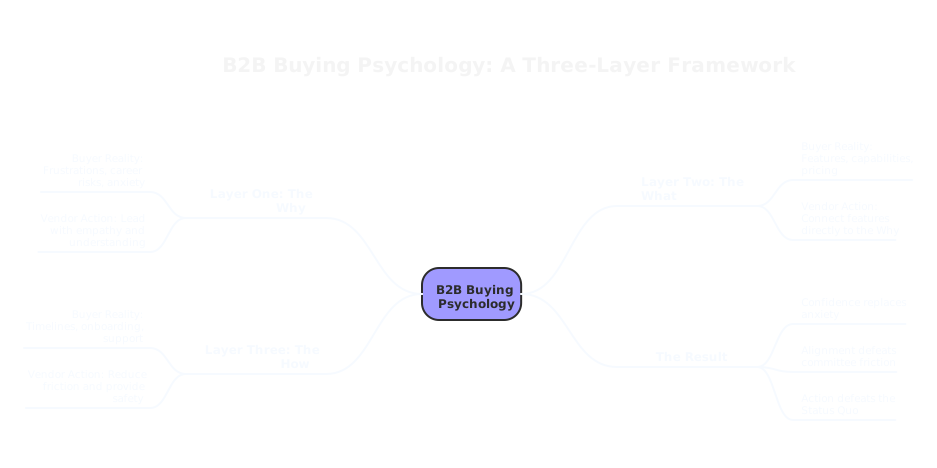
A useful B2B buying psychology framework separates purchasing motivation into three layers.
The first layer is the Why. This is the emotional and commercial driver. A team frustrated by inefficiency. A leader anxious about falling behind. Someone who needs to show their board a clear win. The Why is almost always present and almost always ignored by marketing content.
The second layer is the What. This is the solution requirement. Features, capabilities, integrations, pricing. Most marketing lives here.
The third layer is the How. Implementation, support, timelines, and processes. Sales often lives here.
The problem is leading with What and How while skipping Why entirely. Buyers who do not feel understood at the Why level do not develop the emotional commitment to move forward. They keep researching. They stall. They go with the status quo.
Start with Why. Lead with a genuine understanding of the pressures, fears, and ambitions driving the decision. Then connect your solution to those motivations specifically. The What and How follow naturally once a buyer feels you actually understand what they are trying to accomplish.
What MarTech Is Good For, and Where It Stops
None of this is an argument against marketing technology. A well-configured stack helps you find the right accounts, understand behavioral patterns, and reach buyers efficiently. At House of MarTech, we help organizations build and optimize exactly those systems.
But a MarTech platform cannot build trust. It cannot ease a buyer's career anxiety. It cannot help a fractured buying committee find internal alignment. It cannot replace the moment when a buyer thinks, "This person actually gets what we're dealing with."
Those outcomes require human judgment, genuine expertise, and the kind of relational intelligence that no software automates.
The best B2B marketing organizations use technology to identify where to invest human attention, then invest it well. They treat their stack as a map, not the territory.
Where to Go From Here
If your campaigns are generating strong metrics but weak revenue results, the gap is likely psychological, not technical.
Start by asking what your buyers are actually afraid of. Not what they say in discovery calls, but what keeps them from committing. Map the emotional stakes alongside the functional requirements. Look at where your buying committee conversations stall and ask what alignment or confidence is missing.
Then look at your content and ask honestly: does it address why buyers should care, or only what your product does?
The organizations pulling ahead in complex B2B markets are not the ones with the most sophisticated MarTech stacks. They are the ones who understand that purchasing decisions are made by people, not personas. Emotional, risk-aware, politically navigating people trying to make a choice they can feel good about.
That understanding is the actual competitive advantage. And no platform sells it.
Related Articles
Need Help Implementing?
Get expert guidance on your MarTech strategy and implementation.
Get Free Audit