
Why Most Customer Segmentation Strategies Fail (And What Actually Works)
Most businesses slice their customers into groups and call it strategy. But segmentation without a clear purpose is just organized guessing. Here is what separates customer segmentation that drives real growth from segmentation that just looks good in a deck.


TL;DR
Quick Summary
Listen to summary
0:00 audio overview
Quick Answer
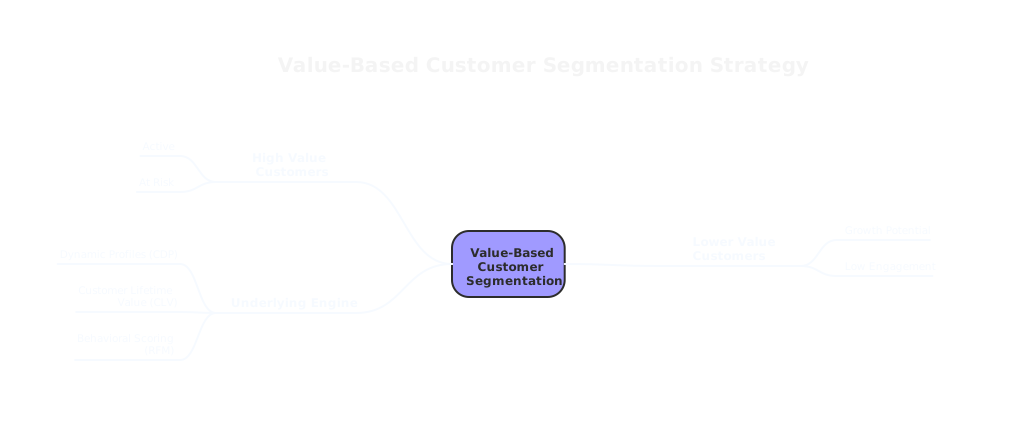
The Honest Truth About Customer Segmentation
Picture this: your marketing team spends three months building a beautiful segmentation model. You have eight customer groups, each with a clever name and a color on a slide. The project gets presented. Everyone claps. And then... nothing really changes.
Six months later, you are still sending the same email to almost everyone. Conversions are flat. Your best customers feel like they are being treated the same as someone who bought from you once during a sale.
This is not a rare story. It is the most common one.
The problem is not the segmentation itself. The problem is that most businesses treat segmentation as an exercise in organization rather than a tool for action. They group customers by who they are instead of what those customers are likely to do next — and what it will cost or earn the business when they do it.
This post is about changing that. We will walk through what segmentation actually means when it works, which frameworks are worth your time, and how the right marketing technology brings it all together so your strategy does not just live in a slide deck.
What Is Customer Segmentation, Really?
Customer segmentation is the practice of dividing your customers into groups based on shared behaviors, needs, or value — so you can treat each group differently in ways that benefit both them and your business.
The keyword there is "differently." If your segmentation does not change how you communicate, what you offer, or how you prioritize your resources, then you have not really segmented anything. You have just labeled people.
True segmentation answers a very simple question: Who deserves more of our attention, and what kind of attention do they deserve?
That question immediately shifts segmentation from a marketing exercise into a business strategy decision.
Why Most Segmentation Efforts Fall Short
There are a few patterns that show up again and again when segmentation does not deliver results.
1. Segments Are Built on Demographics Alone
Age, location, and job title are easy to collect. But they rarely tell you what someone will do next. Two customers can be the same age, live in the same city, and buy completely different things for completely different reasons.
Demographics describe people. Behavior predicts people.
2. Every Segment Gets the Same Resources
If you have eight segments but your team treats six of them almost identically, the segmentation is doing very little work. Real segmentation means real trade-offs: some customers get more personalized experiences, more offers, more service. Others get less, because they are less likely to grow with you.
This feels uncomfortable. But it is the honest math of sustainable growth.
3. The Data Lives in Too Many Places
Your email platform knows what people clicked. Your e-commerce system knows what they bought. Your support tool knows how many times they complained. But if those systems do not talk to each other, no one has a complete picture of any customer.
This is where marketing technology plays a critical role — not as a set of tools that do things for you, but as an infrastructure that connects your data so your decisions can be smarter.
4. Segmentation Is Static
Customers change. Someone who bought from you twice last year might be pulling away. Someone who barely engaged six months ago might be ready to become one of your best customers. If your segments only get updated once a quarter, you are always working with a picture of the past.
The Framework That Actually Works: Segment by Value, Then by Behavior
There is a way to think about segmentation that cuts through the noise. It starts with one question: how much is this customer worth to my business over time?
This is called Customer Lifetime Value (CLV) — the total revenue a customer is expected to bring during their relationship with you. It is not just about what they spent last month. It is about what they are likely to spend, how often they will return, and whether they will tell others about you.
Once you understand CLV, you can layer in behavior signals using a method called RFM analysis.
What Is RFM Analysis?
RFM stands for:
- Recency — How recently did this customer buy?
- Frequency — How often do they buy?
- Monetary Value — How much do they spend?
Each customer gets a score in all three areas. When you combine those scores, you can quickly see who your highest-value customers are, who used to be active but has gone quiet, who buys often but spends very little, and who showed up once during a promotion and never returned.
This is not complicated math. It is a practical lens that helps you stop treating a loyal customer of three years the same way you treat someone who grabbed a discount last Tuesday.
A Real Example Worth Looking At
A retail brand that had been running loyalty programs for years discovered something surprising when they dug into their data. Their most frequent buyers — the ones who came back every single month — were actually among their least profitable customers. Why? Because they almost exclusively bought during sales, they returned items at a high rate, and they required more customer service time than average.
Meanwhile, a smaller group of customers who bought less often spent significantly more per purchase, returned very little, and referred friends consistently.
The brand had been spending its loyalty budget on the wrong group. Not because those frequent buyers were bad customers — but because the business had never looked at the full picture of what each customer relationship actually cost and returned.
When they restructured their loyalty program around value rather than frequency alone, retention among their highest-value customers improved, and the cost of running their program went down at the same time.
This is what happens when segmentation connects to real business outcomes instead of just marketing metrics.
How Marketing Technology Makes This Possible at Scale
Here is the honest challenge: doing this manually, or with disconnected tools, is extremely difficult.
To segment by CLV and behavior in real time, you need:
- A single place where all customer data comes together (purchase history, web behavior, email engagement, support interactions)
- The ability to update segments automatically as customer behavior changes
- A way to activate those segments across every channel — email, ads, SMS, your website — without rebuilding them from scratch each time
This is the core use case for a Customer Data Platform (CDP). A CDP collects data from all your different systems, builds a complete profile for each customer, and makes those profiles available to every tool in your marketing stack.
But a CDP is not magic on its own. It needs to be connected to the right tools, mapped to your actual business goals, and maintained as your strategy evolves.
This is where many businesses get stuck. They invest in the technology but not in the strategy that makes the technology useful. The platform sits there, full of data, not doing much.
At House of MarTech, this is exactly the kind of challenge we help businesses work through — not just picking the right tools, but making sure those tools are connected to a clear segmentation strategy that drives decisions, not just reports.
Building a Segmentation Strategy That Holds Up
Here is a practical starting point if you want to move from theoretical segments to ones that actually change how you operate.
Step 1: Define What "Value" Means for Your Business
Before you build any segments, be specific about what a high-value customer looks like for you. Is it total spend? Repeat purchase rate? Referrals? Low return rates? The answer depends on your business model, and getting clear on it before you start will shape everything that follows.
Step 2: Start With Three to Four Segments, Not Eight
More segments sound impressive but are harder to act on. Start with a simple breakdown:
- High Value, Active — Your best customers right now. Protect them. Reward them. Listen to them.
- High Value, At Risk — Customers who used to be engaged but have gone quiet. These are worth a targeted win-back effort.
- Growth Potential — Customers who show signs of increasing value but have not gotten there yet. Small nudges can make a big difference here.
- Low Value, Low Engagement — This group gets a lighter touch. Do not ignore them, but do not over-invest either.
This is not the final word. But it is a starting point that most marketing teams can actually act on.
Step 3: Match Your Message to Each Segment
The whole point of segmentation is that different groups hear different things. Your high-value active customers should feel recognized and appreciated, not just marketed to. Your at-risk customers need a reason to come back, not another generic newsletter. Your growth-potential customers need to understand more of what you offer.
This does not require building entirely different campaigns for each group. It often means small, specific adjustments in timing, messaging, and offer type that take your existing campaigns from average to genuinely relevant.
Step 4: Set Up the Right Technology to Keep It Running
A segmentation strategy you update once a year is a strategy that stops being true almost immediately. The goal is a system where:
- Customer data flows into one place automatically
- Segments update based on actual behavior, not a calendar schedule
- Your marketing tools can access the right segment data without manual exports
This is where the right marketing technology stack becomes less of a nice-to-have and more of a business requirement.
Common Questions About Customer Segmentation
How many segments should a business have?
Start with fewer than you think you need. Three to five clear, actionable segments almost always outperform ten segments that your team cannot realistically treat differently. Add complexity only when your team has the capacity and tools to act on it.
What is the difference between segmentation and personalization?
Segmentation is about grouping. Personalization is about what you do with those groups. Good segmentation makes personalization possible at scale — you cannot personalize for every individual, but you can personalize for well-defined groups in ways that feel individual.
Do I need a CDP to do customer segmentation?
Not to start. You can do meaningful segmentation with your existing CRM and analytics tools. But as your customer base grows and your data becomes more complex, a CDP becomes the infrastructure that makes segmentation sustainable and real-time rather than a periodic manual project.
How do I know if my segmentation is working?
Look at whether behavior differs across your segments in the way you expected. Are your high-value segments responding better to the experiences you designed for them? Are your at-risk customers coming back at a higher rate after targeted outreach? Segmentation should show up in your numbers, not just in your reports.
The Bigger Picture: Segmentation as a Business Philosophy
The businesses that win with segmentation are not necessarily the ones with the most sophisticated technology or the largest data teams. They are the ones that have made a clear decision about who their best customers are — and then built their entire marketing operation around serving those customers exceptionally well.
That sounds simple. It is not always easy. It requires saying no to some audiences, investing more in fewer relationships, and building the systems that make consistent, relevant communication possible over time.
But the payoff is real. When customers feel understood — when they receive messages that match where they actually are in their relationship with your brand — they stay longer, spend more, and bring others with them.
Segmentation done well is not about being clever with data. It is about being genuinely useful to the right people at the right time.
Where to Go From Here
If you are looking at your current approach to customer segmentation and recognizing some of the gaps described here, the good news is that you do not need to rebuild everything at once.
Start by getting clear on what your highest-value customers look like today. Pull whatever data you have — purchase history, engagement data, support tickets — and look for the patterns. You will likely find that the picture is more interesting than your current segmentation suggests.
From there, think about what technology is limiting your ability to act on what you see. If your tools do not let you update segments in real time, or if your data lives in too many disconnected places, that is the constraint worth solving next.
At House of MarTech, we work with businesses at exactly this stage — when you know your segmentation should be doing more, but you are not sure whether the gap is in your strategy, your technology, or both. We help you figure that out, and then build the infrastructure to close it.
If that conversation sounds useful, we are here for it.
Customer segmentation is not a one-time project. It is a capability you build over time — one that gets sharper as your data improves, your tools connect, and your team learns what your best customers actually respond to. The businesses that treat it that way are the ones that compound value year over year.
Frequently Asked Questions
Get answers to common questions about this topic
Have more questions? We're here to help you succeed with your MarTech strategy. Get in touch
Related Articles
Need Help Implementing?
Get expert guidance on your MarTech strategy and implementation.
Get Free Audit