
AI-Powered Lead Qualification Frameworks: Combining Behavioral Scoring, Firmographic Data, and Intent Signals
Implement AI-powered lead qualification that combines behavioral signals, firmographic enrichment, and intent data for higher conversion rates.


Listen to summary
0:00 audio overview
AI-Powered Lead Qualification Frameworks: Combining Behavioral Scoring, Firmographic Data, and Intent Signals
Picture your sales team at 9 AM on a Monday. They have 200 new leads from last week. No scores. No ranking. Just names, job titles, and company names.
Who do they call first?
Most teams guess. They sort by job title, or by company size, or by whoever submitted the form most recently. A lot of revenue walks out the door before lunch.
AI lead qualification fixes this. It gives your team a clear, ranked list. It tells them who is ready to buy, who needs more nurturing, and who is wasting their time. The result is fewer wasted calls, shorter sales cycles, and more closed deals.
Here is how to build a framework that actually works.
What AI Lead Qualification Actually Does
AI lead qualification is not magic. It is pattern matching at scale.
The system looks at every lead in your database. It compares each lead against the profile of customers who actually bought from you. It scores each lead based on how closely they match that profile, then ranks your entire pipeline by conversion likelihood.
The key difference from old-school scoring is the learning loop. Traditional scoring uses rules you set manually. AI scoring updates its own weights as new deals close. It gets smarter every month without you having to touch it.
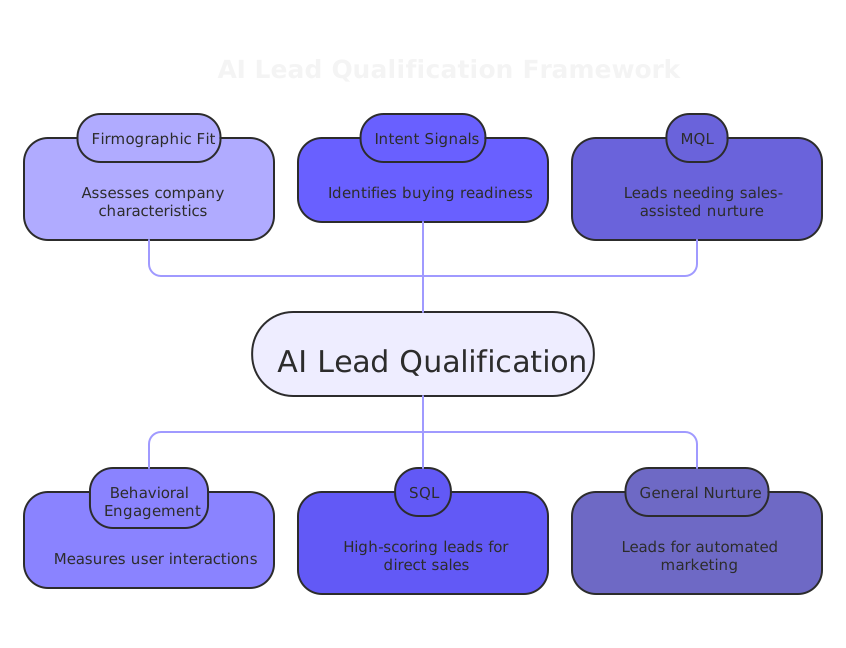
A well-built AI qualification system combines three types of data.
- Behavioral signals: What a lead does on your website, in your emails, and with your content.
- Firmographic data: What kind of company the lead works for. Size, industry, revenue, growth stage.
- Intent signals: Evidence that the lead is actively researching a solution like yours right now.
None of these three works well alone. Together, they give you a complete picture.
The Three-Signal Framework: How to Weight Your Score
A practical starting point is a 100-point composite score. Here is a weighting that works for most B2B organizations.
Firmographic fit: 30 points
This tells you whether a prospect could ever be a customer. Think of it as the filter before the filter. If a lead comes from a 10-person startup and your minimum viable customer has 200 employees, no amount of engagement changes that math.
Score on: company size, industry vertical, annual revenue, geographic location, technology stack, and growth indicators like recent funding or new hires.
Behavioral engagement: 50 points
This tells you whether a prospect is interested right now. It carries the most weight because behavior predicts intent better than demographics alone.
Score on: website visits and page depth, time spent on pricing and product pages, email opens and clicks, content downloads, webinar attendance, and demo requests. Add recency weighting. A prospect who visited your pricing page yesterday is worth more than one who did the same thing eight months ago and went quiet.
A practical recency rule: cut the point value of any engagement older than 90 days by 50%. Drop anything older than 180 days to near zero.
Intent signals: 20 points
This tells you whether a prospect is in active buying mode. First-party intent (your own site data) is the most reliable. Third-party intent (research activity tracked across the web) adds context but is noisier.
Score on: repeated pricing page visits, G2 or Capterra profile views, competitor comparison searches, and job postings that suggest a buying initiative (like hiring a role that would use your product).
Why Most Lead Scoring Breaks Down
Before you build your framework, understand the two most common failure modes.
Bad data kills good algorithms. Companies lose an average of $12.9 million per year to bad data. If your CRM has duplicate records, missing company fields, and outdated contacts, no AI system will save you. The algorithm can only work with what it has. Run a data audit before you configure anything. Clean first, score second.
Speed matters more than accuracy. Here is a number that should stop you cold: responding to a lead within one minute of submission boosts conversion by 391%. The average B2B response time is 42 hours. If your team is spending weeks perfecting a scoring model while leads sit for two days, you are optimizing the wrong variable. A decent score delivered fast beats a perfect score delivered slow.
Building the Scoring Model Step by Step
Step 1: Analyze Your Closed-Won Deals
Pull the last 12 to 24 months of won deals from your CRM. Look for patterns. What industries close most often? What company sizes buy most consistently? What engagement actions showed up in the 30 days before a demo request?
This is your training data. Your scoring model should reflect what actually happened, not what seems logical.
Step 2: Define Your Ideal Customer Profile
Write it down before you configure anything. Get sales and marketing leadership in the same room. Agree on the company attributes that define a realistic, valuable customer. If you skip this step, you will spend months arguing about lead quality after the system is live.
Step 3: Map Your Engagement Signals to Buying Intent
Not all actions are equal. A lead who downloads a top-of-funnel blog post is curious. A lead who visits your pricing page three times in a week is buying.
Build a tiered signal map.
- High-intent actions (10+ points): Pricing page visit, demo request, contact form submission, free trial signup.
- Mid-intent actions (5-9 points): Case study download, webinar attendance, product page visit, email click to feature content.
- Low-intent actions (1-4 points): Blog post view, newsletter open, social media click.
Add negative scoring. Unsubscribes, competitor employee domains, and industry segments you do not serve should subtract points. This is as important as positive scoring.
Step 4: Set Your Threshold Tiers
Define what a score actually means for your team.
A common three-tier structure looks like this.
- Sales Qualified Lead (SQL): 70-100 points. Route directly to an account executive for immediate outreach.
- Marketing Qualified Lead (MQL): 40-69 points. Enter a nurture sequence with check-in touchpoints from sales.
- Nurture: Under 40 points. Stay in automated marketing until signals improve.
These thresholds are a starting point, not a permanent setting. Run A/B tests on your thresholds quarterly. Monitor what percentage of 70+ leads actually convert. Adjust accordingly.
Step 5: Build the Feedback Loop
This step separates a good framework from a great one.
After every closed deal, win or loss, capture why. Feed that back into your model. If leads scoring 65-70 are converting at the same rate as 80+ leads, your threshold is too high and you are wasting time on manual outreach that should be automated. If 70+ leads are bouncing, your firmographic weights need adjustment.
Build a quarterly review into your calendar. Bring sales and marketing together. Look at the data. Adjust the weights. The system should get smarter every 90 days.
Moving Beyond Individual Leads: Account-Level Qualification
Here is where most teams leave serious money behind.
B2B purchases now involve an average of 13 stakeholders. Scoring one person from an account and calling it qualified ignores reality. The decision is never one person's alone.
Account-level qualification aggregates signals across every contact at a target company. It measures three things.
Coverage: How many of the key buying roles have engaged with your brand? Target at least three distinct roles per account before routing to sales.
Depth: How many meaningful touches has each contact had? One pricing page visit from the VP of Operations is interesting. Three visits plus a case study download plus email clicks is a signal.
Balance: Is engagement distributed across roles or concentrated in one person? A champion inside the account is valuable. A champion with no lateral influence is risky.
Deals with an identified economic buyer and at least one technical evaluator engaged close 30% faster than deals with only one active contact. Build your account scoring to reflect this reality.
Intent Data: First-Party vs. Third-Party
Not all intent data is created equal.
First-party intent is what you own. Your website analytics, your email platform, your CRM activity. This data is accurate because you collected it directly. It should carry the most weight in your scoring model.
Second-party intent comes from review platforms and software evaluation sites. A prospect actively comparing vendors on G2 is a strong signal. This data is reliable and worth including.
Third-party intent comes from data aggregators tracking research behavior across the web. It is useful for identifying accounts in early research mode, but it is noisy. A company researching your category is not the same as a company ready to buy from you. Weight third-party intent conservatively.
The practical rule: if you are on a limited budget, invest in first-party intent infrastructure (strong website tracking, clear conversion paths, email engagement tracking) before buying third-party intent data. First-party signals convert better and cost less.
Where Human Judgment Still Wins
AI qualification is excellent at pattern matching. It is poor at understanding context.
Your algorithm cannot know that the champion at a target account just quit. It cannot detect that the budget was frozen two weeks ago. It cannot read between the lines of a 15-minute discovery call to understand that the stated need does not match the actual problem.
Use AI to identify which accounts deserve human attention. Use humans to understand what is actually happening inside those accounts.
The most effective qualification frameworks do not eliminate sales discovery. They automate the volume work so salespeople can spend more time on conversations that matter. A rep who used to spend 60% of their week sorting leads can spend that time on genuine discovery calls with high-scoring accounts. That shift in time allocation often delivers more revenue than the scoring improvement itself.
What Good Implementation Actually Looks Like
Be realistic about the timeline. You will not have a functional AI qualification system in two weeks. A solid implementation takes three to six months.
Month one is for data work. Audit your CRM. Remove duplicates. Enrich missing firmographic fields. Standardize your lead source tracking.
Month two is for alignment. Agree on ICP criteria. Define signal maps. Set initial score thresholds. Get sales leadership to sign off before you build anything.
Month three is for configuration and testing. Build the model. Run it against historical data. Check whether your scoring would have correctly ranked your best customers. Adjust weights before going live.
Months four through six are for iteration. Go live with a pilot segment. Track lead-to-opportunity rates at each score tier. Collect sales feedback weekly. Begin your first quarterly review cycle.
If you want help structuring this implementation or auditing your current qualification setup, the team at House of MarTech works with B2B companies on exactly this. We help you avoid the common traps and build something your sales team will actually use.
The One Mistake That Derails Most Implementations
Over-complicating the model before you have clean data and organizational alignment.
It is tempting to add 40 scoring variables, import three intent data providers, and build elaborate decay functions on day one. Resist that. Start with 10 to 15 well-chosen signals. Get your sales team trusting the output. Then add complexity once the foundation is solid.
A simple model your team uses every day beats a sophisticated model they ignore.
Your Next Steps
AI lead qualification is not about buying smarter software. It is about making a deliberate decision: you are going to let data rank your pipeline instead of gut instinct.
That decision pays off. Companies with functional lead scoring see 30% higher conversion rates on average and 138% higher ROI from lead generation compared to those without it.
The starting point is simpler than you think. Pull your last 24 months of closed-won deals. Find the patterns. Build a profile of your real best customer. Map that profile to the signals you can actually track. Start scoring.
Do that, and your sales team on Monday morning will know exactly who to call first.
Related Articles
Need Help Implementing?
Get expert guidance on your MarTech strategy and implementation.
Get Free Audit