
ROAS vs Growth Trade-Offs
Chasing high ROAS can quietly shrink your pipeline and your future. Here is a systematic way to balance efficiency, reach, LTV, and funnel expansion so you stop trading growth for short-term wins.


Your ROAS looks great. Your pipeline is shrinking.
That is not a contradiction. It is one of the most common traps in performance marketing. You tighten your targeting, cut the "underperforming" upper-funnel spend, and watch your return on ad spend climb. The dashboard looks healthy. But six months later, you are wondering why revenue growth has stalled.
High ROAS and strong growth are not the same thing. Sometimes they point in opposite directions. Understanding that gap is where smarter marketing decisions begin.
Why High ROAS Can Be a Warning Sign
ROAS measures revenue generated per dollar spent on ads. It is a useful number. But it rewards you for reaching people who were already going to buy.
When you optimize hard for ROAS, your algorithms do exactly what they are told. They find the people most likely to convert right now. That usually means existing customers, brand searchers, and bottom-of-funnel audiences. Your conversion rate goes up. Your ROAS goes up. And your reach quietly shrinks.
The problem: you are harvesting demand, not building it.
A business running 8x ROAS on a narrow, retargeting-heavy campaign may be outperformed long-term by a competitor running 3x ROAS on a full-funnel strategy that is consistently bringing new buyers into the market. The second business is building a pipeline. The first is burning one down.
This is the core ROAS vs growth tension. It is not about which metric is better. It is about knowing which one to prioritize, when, and why.
What Gets Missed When ROAS Dominates
When ROAS becomes the primary success metric across all channels and all campaign types, three things typically happen.
Upper-funnel investment disappears. Awareness and consideration campaigns rarely show strong direct ROAS. They get cut. But they are what fills the pipeline with future buyers. No new buyers entering the funnel means no growth, regardless of how efficiently you convert the ones already in it.
Customer acquisition slows. High ROAS campaigns often convert existing customers or high-intent visitors who would have converted anyway. New customer acquisition, which is the real engine of revenue growth, gets harder to see and easier to defund.
LTV gets ignored. A customer who buys once at a high ROAS margin may be worth far less than a customer acquired at lower short-term efficiency but with strong retention and repeat purchase behavior. ROAS does not tell you that story. Lifetime value does.
The fix is not to abandon ROAS. It is to stop using it as the only lens.
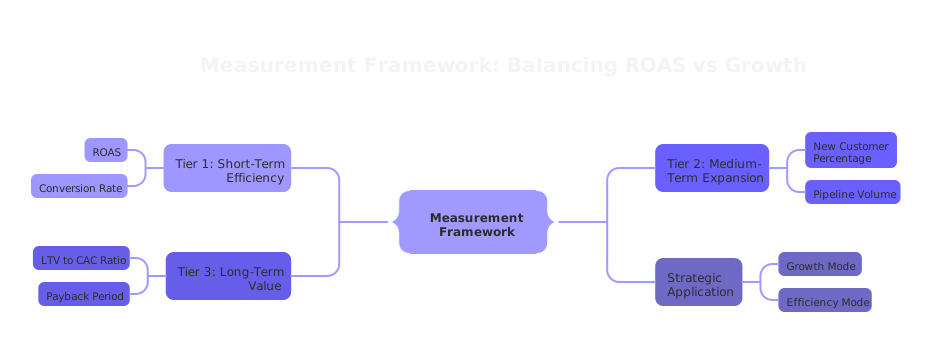
A Practical Measurement Framework for Balancing ROAS and Growth
You need a set of metrics that cover different time horizons and different parts of the funnel. Here is a straightforward way to think about it.
Tier 1: Efficiency Metrics (Short-Term)
These tell you how well your current spend is converting.
- ROAS by channel and campaign type
- CAC (Customer Acquisition Cost) for new customers specifically, not blended
- Conversion rate by funnel stage
These are your tactical dials. Useful for optimization. Dangerous as strategy.
Tier 2: Expansion Metrics (Medium-Term)
These tell you whether you are growing your addressable audience.
- New customer percentage of total revenue. If this number is falling, you are depending more and more on existing buyers.
- Reach and frequency in upper-funnel campaigns. Are you actually getting in front of new people?
- Pipeline volume by stage. Is the top of your funnel filling or draining?
If your Tier 1 numbers are strong but your Tier 2 numbers are declining, you are in a harvest mode. That is fine for a quarter. It is not a growth strategy.
Tier 3: Value Metrics (Long-Term)
These tell you whether the customers you are acquiring are worth having.
- LTV (Customer Lifetime Value) by acquisition channel and cohort
- LTV:CAC ratio. A ratio above 3:1 is generally healthy. Below 2:1 is a signal to investigate.
- Payback period. How many months until you recover your acquisition cost?
These numbers often take 6 to 12 months to become meaningful. That is why most teams ignore them. But they are the only metrics that tell you whether your growth is actually sustainable.
How to Apply This in Practice
The goal is not to optimize all three tiers simultaneously. That leads to paralysis. The goal is to know which tier matters most right now, given your stage and your objectives.
If you are in growth mode, Tier 2 and Tier 3 metrics should be driving decisions. Accept lower short-term ROAS to fill the pipeline and acquire customers with strong LTV potential. Measure success by new customer rate and cohort LTV, not campaign ROAS.
If you are in efficiency mode, Tier 1 metrics take priority. Tighten targeting, reduce waste, improve conversion rates. But set a floor on upper-funnel spend. If reach drops below a threshold you define, you are cutting muscle, not fat.
If you are unsure which mode you are in, that is the real problem. Most teams operate without a clear answer to this question. They optimize by instinct, and ROAS wins by default because it is the most visible number.
One practical starting point: separate your new customer CAC from your blended CAC. Most platforms blend returners and new buyers together, which makes ROAS look better than it is. When you isolate new customer acquisition cost, you often find it has been quietly rising for months.
The Role of Attribution in This Trade-Off
Attribution is where the ROAS vs growth debate gets complicated fast.
Last-click attribution, which is still the default in many platforms, gives all the credit to the final touchpoint before conversion. That almost always means bottom-of-funnel campaigns look great and upper-funnel campaigns look useless. So upper-funnel gets cut. And then conversion rates on lower-funnel campaigns eventually decline because the pipeline has dried up.
Multi-touch attribution helps, but it is not a silver bullet. Different models (linear, time-decay, data-driven) tell different stories. The point is not to find the "right" model. The point is to use a model that prevents you from systematically undervaluing the early touchpoints that create future demand.
If you want to go further, incremental measurement, through geo tests, holdout experiments, or media mix modeling, can show you what revenue actually would not have happened without a given channel. This is harder to set up, but it is the most honest way to understand whether your spend is creating growth or just taking credit for it.
At House of MarTech, we work with teams on building measurement architectures that connect these dots across channels and time horizons. It is one of the most impactful things you can do for long-term marketing performance.
What a Balanced Scorecard Looks Like
You do not need a dozen metrics. You need the right four or five, mapped to the right decisions.
Here is a simple structure that works for most growth-stage businesses:
| What You Are Measuring | Metric | Review Cadence |
|---|---|---|
| Current efficiency | ROAS by channel | Weekly |
| New customer growth | New customer % of revenue | Monthly |
| Acquisition cost trend | New customer CAC | Monthly |
| Long-term value | LTV:CAC by cohort | Quarterly |
| Pipeline health | Upper-funnel reach and volume | Monthly |
The key discipline is reviewing these together, not in isolation. A single dashboard that shows all five, side by side, forces a more honest conversation than a ROAS report alone ever will.
What Is ROAS vs Growth, Really?
At its core, ROAS vs growth is a question about time horizon.
ROAS optimizes for now. Growth optimizes for later. Neither is wrong. Both are necessary. The mistake is letting one crowd out the other without a deliberate choice.
The businesses that get this right treat ROAS as a guardrail, not a goal. They set a minimum acceptable ROAS floor, then allocate spend to maximize pipeline growth within that constraint. They invest in measurement systems that track value over time, not just conversion events.
They also accept that some of the most important marketing work will never show a clean ROAS number. Brand awareness, content, community, and word-of-mouth all compound over time in ways that are genuinely hard to attribute. That does not make them less valuable. It makes them harder to defend in a spreadsheet.
Common Questions
Should I optimize for ROAS or LTV?
Optimize for LTV:CAC as your primary strategic metric. Use ROAS as a short-term efficiency signal within that context. If your LTV:CAC is healthy and growing, lower ROAS on some campaigns is acceptable and often necessary.
What ROAS is considered good?
There is no universal answer. It depends on your margins, your customer value, and your business model. A 4x ROAS on a product with 20% margins is very different from a 4x ROAS on a product with 70% margins. Focus on profit contribution, not the ROAS number itself.
How do I know if I am in harvest mode?
Look at your new customer percentage of revenue over the last 12 months. If it is declining quarter over quarter while your ROAS is rising, you are harvesting. That is a signal to rebalance toward acquisition and upper-funnel investment.
What is the right budget split between upper and lower funnel?
This depends heavily on your category, competitive position, and growth stage. As a general orientation, businesses in active growth phases often allocate meaningfully to upper-funnel, sometimes 40 to 60 percent of total media spend, while businesses in efficiency phases skew lower. The right number for you comes from testing and from understanding where your pipeline is actually coming from.
Where to Go From Here
Start with one honest audit. Pull your new customer acquisition cost for the last four quarters. Not blended. New customers only. Then compare it to your overall ROAS trend for the same period. If CAC is rising while ROAS holds steady or improves, you have a harvest problem.
From there, the path is to build a measurement system that covers all three tiers: efficiency, expansion, and value. Not all at once. Start with new customer CAC and pipeline volume. Add LTV tracking once your cohorts are large enough to be meaningful.
If you want help building that system, the measurement and attribution work we do at House of MarTech is designed exactly for this. Not a generic analytics setup. A framework built around your funnel, your channels, and the decisions you actually need to make.
The goal is not a better dashboard. It is a clearer picture of whether your marketing is building something real.
Related Articles
Need Help Implementing?
Get expert guidance on your MarTech strategy and implementation.
Get Free Audit