
B2B Intent Data Activation Playbook: From Signal Detection to Revenue Pipeline
Transform buyer intent signals into revenue. Complete playbook for detecting, scoring, and activating B2B intent data across your marketing and sales stack.


TL;DR
Quick Summary
Listen to summary
0:00 audio overview
B2B Intent Data Activation Playbook: From Signal Detection to Revenue Pipeline
Quick Answer
Picture this. Your marketing team gets an alert. A target account just visited your pricing page twice this week. They also researched your product category on three industry publications. Two of their employees engaged with your LinkedIn content.
Your system flags the account as high-intent. Then what?
If your answer is "someone adds it to a spreadsheet and the sales team follows up next week," you have found the real problem. Not the data. The delay.
This is the gap where most B2B intent data programs fall apart. And it is the exact gap this playbook helps you close.
What B2B Intent Data Activation Actually Means
Buying intent data is information that shows which companies might be researching a solution like yours. It comes from things like website visits, content consumption on third-party sites, review site comparisons, and search activity.
B2B intent data activation is the process of turning those signals into real sales actions. Fast. With the right context. Delivered to the right person.
Collecting the signal is step one. Acting on it effectively is where revenue is made or lost.
Most companies are stuck at step one.
The Real Problem: Data Without Action
The B2B intent data market is large and growing fast. Adoption is high. But only about a quarter of companies that deploy intent data report strong return on investment.
That gap is not about data quality alone. It is about what happens after the signal appears.
Here is the typical timeline for a company with average intent data processes. A target account visits a pricing page on Tuesday. The signal appears in a dashboard by Wednesday morning. Someone reviews the dashboard during a Friday check-in. A list gets pulled and sent to sales leadership on Monday. Outreach goes out on Wednesday. That is eight days after the original signal.
Eight days is too long. Research shows that companies acting on buying signals within 48 hours see dramatically higher conversion rates than those who wait. The buying window is real. And it closes fast.
This is the core challenge of B2B intent data activation. Speed matters more than most teams realize.
Why Signals Are Hints, Not Facts
Here is something worth saying plainly. An intent signal is not proof that someone is ready to buy. It is a hint that someone is paying attention.
When a platform tells you an account is "actively researching" your category, it usually means someone at that company visited a webpage or engaged with related content. That could be a decision-maker evaluating vendors. It could also be an analyst writing a market overview. Or an employee who was curious.
One study found that only 5 to 10 percent of detected purchase intent signals actually represented active buying cycles. That is not a reason to abandon intent data. It is a reason to validate before you act.
Treating every signal as a buying signal wastes sales time and creates frustration. The fix is not better data. It is a smarter process for deciding which signals deserve a response.
The Three-Layer Validation Framework
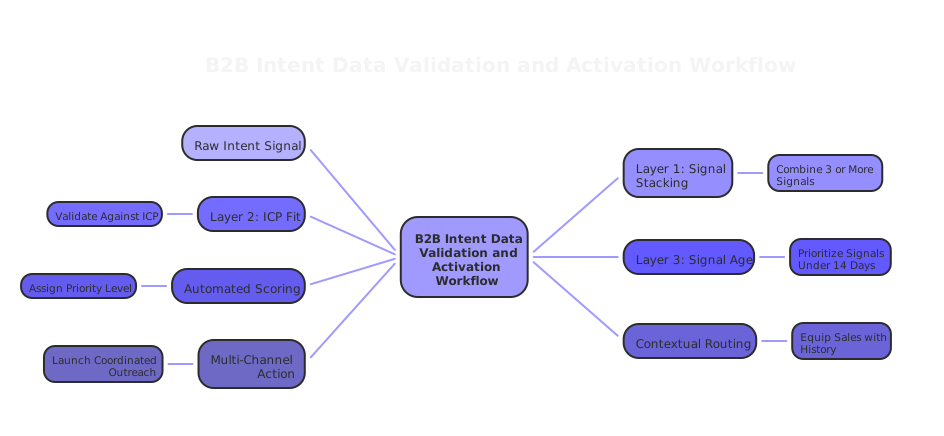
Strong B2B intent data activation strategy starts with validation. Before a signal triggers outreach, it should pass through at least three filters.
Layer One: Signal Stacking
A single signal is weak. Multiple signals pointing in the same direction are strong.
A company visiting your pricing page once is low priority. A company visiting your pricing page, researching your category on a third-party site, and having two contacts re-engage with your emails is a different story. Research suggests that combining three or more correlated signals can push conversion probability into the 55 to 70 percent range versus 30 to 40 percent for a single signal alone.
Build your workflows to require signal stacking before routing to sales. One signal can enter a nurture sequence. Three signals with recent timing should trigger immediate outreach.
Layer Two: ICP Fit Check
High intent from a poor-fit company is still a poor lead. Before acting on any signal, cross-reference it against your ideal customer profile.
Does the company have the right size, industry, and budget? Is their tech stack compatible with your solution? Did they recently hire for roles that suggest a buying initiative is underway?
Intent without fit is noise. Intent plus fit is opportunity.
Layer Three: Signal Age
Intent signals decay fast. A signal from two weeks ago has less predictive value than one from yesterday. A signal from 60 days ago is largely irrelevant for most B2B software purchases.
Build decay into your scoring model. Signals from the past 7 to 14 days carry full weight. Signals from 8 to 30 days get progressively discounted. Anything older than 60 days should be treated as expired.
This discipline keeps your pipeline focused on current opportunities rather than historical research patterns.
From Signal to Action: The Activation Workflow
Once a signal clears validation, the clock starts. Your B2B intent data activation implementation should be designed to move accounts through the following steps without manual delay.
Step One: Real-Time Scoring
When a signal arrives, it should be scored automatically against your ICP criteria and signal stack requirements. No human needed at this step. The system should determine account priority and route accordingly.
High-priority accounts go to sales immediately, with full context attached. Medium-priority accounts enter a targeted nurture sequence. Low-priority accounts receive standard marketing touches.
Step Two: Contextual Routing
Sales reps should never receive a signal without context. "This company showed intent" is not actionable. "This company visited your pricing page three times this week, two contacts re-engaged with your email campaign, and they recently posted a job listing for a sales operations manager" is actionable.
Your routing should include everything the rep needs to have an intelligent first conversation. Account history. Recent activity. Firmographic data. Relevant contacts and their roles.
Step Three: Coordinated Multi-Channel Response
The best outreach does not happen through one channel. It happens across email, LinkedIn, phone, and targeted ads at the same time.
When a high-intent account is routed to a rep, your marketing system should simultaneously adjust ad targeting to serve that company relevant content. A LinkedIn connection request can go out the same day as the first email. A follow-up call is scheduled before the rep even starts typing.
This coordination is what separates companies with 2 percent response rates from those with 10 to 15 percent response rates. It is not magic. It is infrastructure.
The Buying Group Problem Most Teams Ignore
Here is a common mistake in B2B intent data activation. Treating the whole company as a single buyer.
The average B2B purchase involves 6 to 10 people. A technical evaluator cares about integrations and security. A financial approver cares about cost and ROI. An operational champion cares about implementation and adoption. Each person is doing their own research. Each person has different questions.
Account-level intent data tells you the company is interested. Persona-level intent data tells you who is interested and what they care about.
The difference matters. If you know the VP of IT is researching integration capabilities, you send them technical documentation. If you know the Director of Operations is evaluating ease of deployment, you send them an implementation guide. Generic outreach treats both people the same. Personalized outreach speaks directly to what each person is trying to figure out.
When evaluating intent data providers, ask specifically about persona-level tracking and buying group identification. Account-level surge data is a starting point. Buying group intelligence is where real precision begins.
First-Party Data Is Your Most Valuable Signal
A lot of teams obsess over third-party intent signals while ignoring the signals already sitting in their own systems.
Your own website data is incredibly valuable. Who is visiting? Which pages are they viewing? How many times have they come back? Is the same contact hitting multiple pages in a single session?
Email engagement tells you which contacts are actively reading your content. CRM history tells you which accounts have had previous conversations and how those ended. Product usage data, if you have a free trial or freemium model, tells you which users are showing expansion behavior.
These first-party signals are often more reliable than third-party data because there is no identity resolution problem. You know exactly who is doing what.
The best B2B intent data activation best practices combine first-party and third-party signals. First-party data validates what third-party data suggests. When both point in the same direction, your confidence level rises significantly and false positives drop.
Building the Infrastructure That Makes It Work
Talking about better activation is easy. Building it requires investment in the right infrastructure.
Most companies run fragmented stacks. Intent data lives in one platform. CRM lives in another. Marketing automation is somewhere else. Sales engagement is a fourth tool. When these systems do not talk to each other in real time, every handoff introduces delay and data loss.
The organizations getting the best results from intent data are not necessarily buying more data sources. They are consolidating their signal processing so that detection and action happen in one connected motion. When an account hits a scoring threshold, the system automatically updates the CRM record, alerts the assigned rep, triggers a marketing sequence, and adjusts ad targeting. No manual steps. No queue.
This is where working with a partner like House of MarTech can make a significant difference. The technology decisions matter, but so does the workflow design. Getting the routing logic, scoring thresholds, and channel coordination right requires both technical and strategic expertise. Many teams have the tools but not the configuration. That gap is often what separates marginal results from transformational ones.
Measuring What Actually Matters
Most intent data programs measure the wrong things. Pipeline influenced. Accounts reached. Signals detected. These numbers can look good while revenue stays flat.
The metrics that actually tell you whether your B2B intent data activation is working are simpler and more direct.
Signal-to-meeting rate. Of the high-intent accounts you routed to sales, what percentage resulted in a booked meeting? If this number is low, your signal quality or validation process needs work.
Signal-to-pipeline rate. Of the meetings booked from intent-sourced accounts, what percentage became active pipeline? This tells you whether the intent is translating into genuine buying conversations.
Signal age at close. When deals close, how old were the original intent signals that sourced them? If your closed deals are consistently tracing back to signals that are 90-plus days old, your activation speed is not competitive.
Track these three numbers and you will have a clear picture of where your process is breaking down.
A Simple Starting Point
If you are not sure where to begin, start here.
Pick one signal type you already have access to, pricing page visits or competitor comparison activity on a review site are good options. Define a basic ICP filter. Set a response time target of 24 to 48 hours. Assign a small number of reps to handle these accounts exclusively for 30 days. Track what happens.
You will learn more from 30 days of focused execution than from months of planning. The gaps in your process will become visible quickly. Then you can fix them systematically.
The Bottom Line on B2B Intent Data Activation
Intent data is not a shortcut to revenue. It is a signal system. How you respond to the signals is what determines the outcome.
The companies getting real value from intent data are not the ones with the most signals or the most sophisticated platforms. They are the ones who act fast, validate thoughtfully, coordinate across channels, and treat buying groups as groups instead of single entities.
The technology exists to do this well. The harder part is building the process and the organizational alignment around it.
If you want to audit your current intent data workflow or build an activation architecture that actually closes gaps between signal and revenue, that is exactly the kind of work House of MarTech helps with. Start with what you have. Fix what is broken. Then scale what works.
Frequently Asked Questions
Get answers to common questions about this topic
Have more questions? We're here to help you succeed with your MarTech strategy. Get in touch
Related Articles
Need Help Implementing?
Get expert guidance on your MarTech strategy and implementation.
Get Free Audit