
Smarter Audience Targeting to Cut Ad Waste
Most ad budgets bleed money not because of bad creative, but because of bad targeting. Here is how to fix that with first-party data, smart segmentation, and a system that gets tighter over time.


TL;DR
Quick Summary
Listen to summary
0:00 audio overview
Smarter Audience Targeting to Cut Ad Waste
Quick Answer
Your ad budget does not disappear into thin air. It lands somewhere. The question is whether it lands on people who will actually buy from you, or on people who were never going to.
Most businesses fall into the same trap. They run broad campaigns, target wide demographics, and hope the algorithm figures it out. Sometimes it does. But more often, a meaningful chunk of that budget gets spent on the wrong people at the wrong time.
The fix is not a bigger budget. It is a smarter approach to who you are talking to in the first place.
This is what smarter audience targeting to reduce wasted ad spend actually looks like in practice.
Why Broad Targeting Costs You More Than You Think
Here is a simple way to see the problem.
Imagine you sell project management software to operations managers at mid-size companies. You run a paid search campaign targeting anyone who searches "project management software." Your ad reaches freelancers, students, enterprise procurement teams, and small business owners. All of them see your ad. Almost none of them are your buyer.
You paid for every single one of those impressions and clicks. You got very few conversions. Your cost per acquisition climbs. Your team blames the creative. The creative was fine.
The problem was the audience.
Broad targeting feels safe because it feels like reach. But reach without relevance is waste. And in most ad platforms, waste is invisible until you go looking for it.
What Is Smarter Audience Targeting?
Smarter audience targeting means showing your ads to people who are most likely to convert, not just people who fit a general demographic profile.
It combines three things:
- Better data about who your real customers are
- Clearer signals about who is ready to buy right now
- Ongoing exclusions to stop spending on people who will never convert
When those three things work together, your ad spend goes further. You reach fewer people, but the right people. Your conversion rates go up. Your cost per acquisition comes down.
That is the core idea behind smarter audience targeting to reduce wasted ad spend.
Start With Your First-Party Data
First-party data is the information you already have about your customers. It comes from your CRM, your website, your email list, your purchase history.
It is also the most valuable targeting asset you own, and most businesses underuse it.
When you upload your customer list to a paid ad platform, you can build lookalike audiences based on your actual buyers, not a platform's guess at who might be interested. You can also suppress your existing customers from seeing acquisition ads they do not need to see, which saves real money.
The businesses that are winning at smarter audience targeting right now are the ones building first-party data systems that feed directly into their ad platforms. Not one-time uploads. Continuous, automated syncing.
If your CRM is not connected to your ad accounts, that is the first thing worth fixing. It is one of the most practical starting points we work through with clients at House of MarTech.
Demographic Targeting Is a Starting Point, Not a Strategy
Age, gender, location, income. These are useful filters. They are not a targeting strategy.
Demographic targeting tells you who someone is. It does not tell you what they want right now or whether they are ready to buy.
Behavioral targeting gets you closer. It looks at what people have done: the pages they visited, the content they consumed, the products they browsed, the emails they opened. Behavior is a much stronger signal of intent than a demographic profile.
The most effective campaigns combine both. You use demographics to set the boundaries, and you use behavioral signals to prioritize within those boundaries.
A good rule of thumb: if you cannot explain why a specific behavior makes someone more likely to buy from you, that behavior probably should not drive your targeting.
Segmentation Is Not Just for Email
A lot of businesses segment their email lists carefully and then run completely unsegmented ad campaigns. That is a missed opportunity.
The same logic that makes segmented emails perform better applies to paid ads. Different audiences need different messages. A first-time visitor needs different creative than someone who visited your pricing page three times last week.
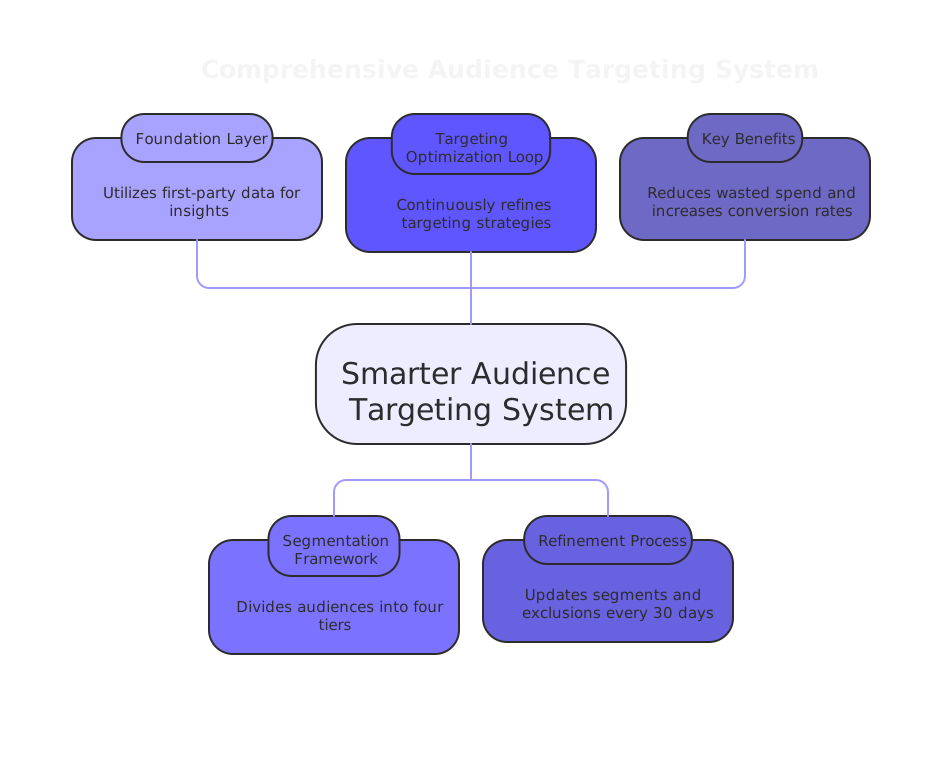
Here is a practical segmentation framework for your ad campaigns:
Segment 1: Cold audiences
People who match your ideal customer profile but have never interacted with your brand. Use lookalike audiences built from your best customers. Keep messaging broad and value-focused.
Segment 2: Warm audiences
People who have visited your website, watched your videos, or engaged with your content. They know you exist. Use retargeting to stay visible and move them toward a decision.
Segment 3: Hot audiences
People who visited your pricing page, started a checkout, requested a demo, or took another high-intent action. These people are close. Your messaging should reflect that. Make it easy to take the next step.
Segment 4: Existing customers
People who already bought. Do not waste acquisition budget on them. Suppress them from cold and warm campaigns. Instead, run separate campaigns aimed at retention, upsell, or referral.
This four-segment structure is not complicated. But it requires your data to be clean, your audiences to be built, and your campaigns to actually be separated. Most businesses skip the setup and then wonder why their ads do not perform.
How AI Fits Into Audience Targeting
AI tools in ad platforms are getting better at finding high-intent audiences automatically. Google's Performance Max, Meta's Advantage+ audiences, and similar features use machine learning to optimize delivery based on conversion signals.
These tools work better when you give them better inputs.
If you feed a Performance Max campaign nothing but a broad keyword list and a generic audience signal, the algorithm has to figure everything out from scratch. That takes time and money.
If you feed it your customer list, your website visitor data, your high-value customer segments, and clear conversion tracking, the algorithm has a head start. It knows what a good conversion looks like. It finds more of those people faster.
The AI does not replace your strategy. It amplifies it. Garbage inputs produce garbage outputs, no matter how good the model is.
This is one of the most consistent things we see when working with businesses on ad efficiency. The platform tools are capable. The data feeding them is usually the weak point.
Exclusions Are Targeting Too
Most targeting conversations focus on who to include. Exclusions are just as important.
Who should never see your ads?
- Current customers (in most acquisition campaigns)
- People who converted in the last 30 days
- Job titles or industries that have never converted
- Audiences with very high click-through rates but zero purchases
Building and maintaining exclusion lists is not glamorous work. But it directly prevents budget waste. If you have been running paid campaigns for more than six months and you have not built meaningful exclusion lists, you are almost certainly spending money on audiences that will never convert.
We covered a related version of this idea in our post on stopping wasted ad spend by excluding junk leads systematically. The same principle applies here: what you stop spending on matters as much as what you start spending on.
Intent Data: Knowing Who Is Ready Right Now
First-party data tells you about your existing audience. Intent data tells you who outside your current database is actively researching what you sell.
Intent data comes from third-party sources that track content consumption across the web. If someone is reading multiple articles about your category, comparing competitors, or downloading related guides, that is a signal they are in buying mode.
For B2B businesses especially, intent data can be layered into your targeting to prioritize accounts that are actively in-market right now, not just accounts that fit your ideal customer profile on paper.
This is core to account-based marketing strategies, and it is one of the more powerful ways to concentrate your ad spend on moments that actually matter.
The catch is data quality. Intent data varies widely in how it is collected and how fresh it is. Treat it as one signal among several, not the whole picture.
What Good Measurement Looks Like
You cannot improve what you do not measure. But you also need to measure the right things.
Click-through rate tells you if your creative is compelling. It does not tell you if you are reaching the right people.
Metrics that actually tell you whether your targeting is working:
- Conversion rate by audience segment: Are some segments converting at 3x the rate of others? Double down on those.
- Cost per acquisition by segment: Where is your most efficient spend coming from?
- View-through and assisted conversions: Some audiences convert later, through different channels. Know which ones.
- Frequency and overlap: Are you hitting the same people too often? Are your segments overlapping in ways that inflate costs?
When you build targeting segments with intention, your reporting becomes more useful. You can see exactly where your budget is working and where it is not.
A Practical Starting Point
If this feels like a lot to take on at once, here is where to start.
Step 1: Connect your CRM to your ad platforms.
Sync your customer and lead data. Build suppression lists for existing customers. Build lookalike audiences from your best customers.
Step 2: Separate your campaigns by funnel stage.
Cold, warm, hot, and existing customers should be in separate campaigns with separate budgets and separate creative.
Step 3: Review your exclusions.
Pull a report on who clicked your ads but never converted. Look for patterns. Build exclusion lists based on what you find.
Step 4: Set up conversion tracking properly.
If you are not tracking the actual revenue events (purchases, signed contracts, qualified demos booked), you are optimizing for the wrong thing.
Step 5: Review and tighten every 30 days.
Audience targeting is not a set-it-and-forget-it task. Markets shift. Buying behaviors change. Your targeting should evolve with your data.
The Real Opportunity Here
Smarter audience targeting to reduce wasted ad spend is not about finding a magic tool. It is about building a system where your data, your targeting, and your measurement all work together.
The businesses that do this well are not necessarily the ones with the biggest budgets. They are the ones that know their customers well, keep their data clean, and treat targeting as an ongoing discipline rather than a one-time setup.
If you want to build that kind of system and you are not sure where the gaps are in your current setup, that is exactly the kind of work House of MarTech was built for. We help businesses connect their data, build smarter audience structures, and stop paying for clicks that were never going to turn into customers.
Start with your data. The rest follows from there.
Frequently Asked Questions
Get answers to common questions about this topic
Have more questions? We're here to help you succeed with your MarTech strategy. Get in touch
Related Articles
Need Help Implementing?
Get expert guidance on your MarTech strategy and implementation.
Get Free Audit