
CPM Collapse in the AI Content Era
AI content tanks ad monetization CPM despite high traffic. Business leaders: fix measurement gaps, diversify revenue. House of MarTech reveals strategies that work.


TL;DR
Quick Summary
Your traffic is up. Your revenue is not.
That gap is not a reporting glitch. It is the new reality for publishers and content-driven businesses in 2026. AI-generated content has flooded the internet. Advertisers know it. Their tools detect it. And they are paying less, or nothing, for ad placements next to it.
The metric most businesses still measure, CPM (cost per thousand impressions), is quietly becoming less useful. Not because CPM itself is broken. Because the conditions that made CPM a reliable indicator of revenue health have changed.
This post explains why that is happening, what to measure instead, and how to build a revenue mix that does not collapse when ad rates do.
What CPM Actually Measures (And What It Misses)
CPM tells you what an advertiser paid per thousand times their ad was shown. It is a supply-and-demand number. When advertisers compete for your audience, CPM goes up. When they do not, it goes down.
For years, more traffic meant more demand. More demand meant higher CPMs. The logic held.
AI content broke the logic.
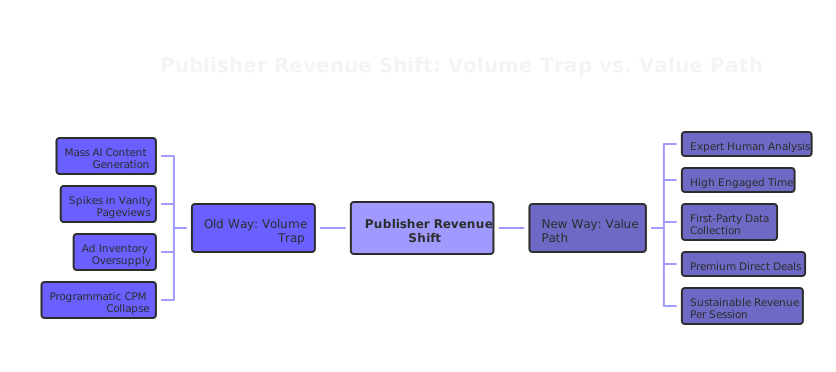
When any site can publish ten thousand articles a month with minimal cost, ad inventory explodes. Supply overwhelms demand. Programmatic platforms, which set prices algorithmically, respond by dropping floor prices. Your CPM falls even if your traffic grows.
Worse, brand safety tools now flag AI-generated content at scale. Advertisers using these tools exclude entire domains. The content you published to drive traffic is actively reducing your ad monetization CPM value.
The result: more pages, more sessions, and less revenue per visit.
The AI Content Supply Shock
Here is a concrete way to see this.
Imagine a mid-size media site that grew its content output threefold using AI writing tools in 2024. Traffic doubled. Impressive on a dashboard. But their average CPM dropped by nearly half, because programmatic buyers detected the content patterns, reduced their bids, and redirected spend toward human-curated inventory.
That site did not fail at content production. It failed at understanding what advertisers actually buy.
Advertisers are not buying your page views. They are buying attention from a specific kind of person, in a specific kind of context, at a specific moment of receptivity. AI-generated content, even when accurate, often lacks the contextual trust signals that make that attention valuable.
Brand safety researchers and industry observers have noted this shift clearly: advertisers increasingly evaluate the content environment, not just the audience profile. A thousand impressions next to a trusted, human-authored analysis are worth more than ten thousand impressions next to auto-generated summaries. The CPM difference reflects that.
Why Vanity Traffic Is a Liability Now
High traffic with low engagement quality creates a hidden problem. Advertisers who run campaigns on your inventory and see poor results stop bidding on it. They do not tell you. They just leave.
Over time, your programmatic floor collapses. Your direct sales team faces harder conversations. And your analytics still show green, because pageviews are up.
This is the trap. You are measuring what is easy to count, not what drives revenue.
The sites that are holding their revenue despite traffic disruption share one thing. They shifted their measurement from volume metrics to engagement quality metrics. They stopped optimizing for clicks and started optimizing for what happens after the click.
What to Measure Instead of CPM Alone
CPM still matters. But it should sit inside a larger measurement framework, not lead it.
Here are the metrics that correlate more reliably with sustainable ad revenue:
Engaged time per session. How long does a real person stay with your content? Advertisers, especially direct buyers, increasingly ask for this. A page with 90 seconds of average engaged time is worth more than a page with 15,000 visits and a 12-second average.
Return visitor rate. If readers come back, they trust you. Trust is the signal advertisers cannot buy through programmatic, and will pay a premium for through direct deals.
Revenue per session (RPS). Divide your total revenue by sessions, not pageviews. This number strips away inflated traffic and shows you what each visit actually earns. If RPS is declining while sessions grow, you have a monetization problem, not a traffic success.
Direct deal ratio. What percentage of your ad revenue comes from direct advertiser relationships versus programmatic? Direct deals command higher CPMs and are immune to algorithmic bid suppression. Growing this ratio is the clearest indicator of a healthy ad business.
Email list growth and engagement. Your email audience is owned. It cannot be devalued by programmatic shifts. A growing, active email list is leverage for sponsorships, paid products, and direct advertiser packages.
How to Protect and Grow Ad Monetization CPM in 2026
The goal is not to abandon programmatic. It is to stop being entirely dependent on it.
1. Build inventory that commands premium rates.
Premium CPMs go to content in specific, high-intent verticals: finance, health, B2B software, travel. If your content strategy is broad, it is competing with everything. If it is specific and deep, advertisers in that vertical will seek you out.
Contextual intelligence platforms can help surface your highest-performing inventory to the right buyers. The sites winning on ad monetization CPM strategy in 2026 are not publishing more. They are publishing with more precision.
2. Create direct advertiser packages.
Programmatic will always be a race to the floor. Direct deals are a negotiation toward value. Package your best inventory, your most engaged audience segments, and your editorial context into something a brand cannot buy anywhere else.
This requires knowing your audience deeply. First-party data, the information your readers give you directly through registrations, subscriptions, and behavior, is the foundation of every premium direct deal.
At House of MarTech, we help publishers build the data infrastructure to make these conversations possible. When you can tell an advertiser exactly who your audience is and what they do after engaging with your content, you are no longer selling CPMs. You are selling outcomes.
3. Diversify your revenue mix deliberately.
Ad revenue should be one stream, not the only stream. The publishers holding steady in 2026 typically have three to five revenue sources operating in parallel.
Common complements to advertising include:
- Paid newsletters or membership tiers
- Sponsored content or branded editorial (distinct from standard display ads)
- Commerce content with affiliate or retail media arrangements
- Events, communities, or cohort-based experiences
- Licensing content to platforms or tools that need high-quality training or reference data
Each of these is audience-first. They all require you to have a clear picture of who your readers are and what they value.
4. Invest in content that signals human expertise.
Not all AI content tanks CPMs. AI-assisted content, where a human expert is clearly the source of the original thinking and the AI helps with structure or editing, still carries the trust signals advertisers look for.
The distinction matters to brand safety tools and to readers. Content that demonstrates lived experience, specific opinion, and accountable authorship performs better across every dimension: engagement, SEO, and ad monetization CPM.
This is not about word count. A 400-word sharp analysis from a credible human voice outperforms a 3,000-word AI summary on every quality signal.
What Is Ad Monetization CPM and Why Does It Fluctuate?
Ad monetization CPM is the revenue a publisher earns per thousand ad impressions served. It fluctuates based on advertiser demand for your audience, the context of your content, the quality signals your inventory sends to programmatic platforms, and the time of year (Q4 consistently delivers higher CPMs than Q1).
In the AI content era, CPM fluctuates more dramatically because supply has increased faster than demand. The sites with stable CPMs are the ones with differentiated audiences, strong direct relationships with advertisers, and content that passes quality filters.
The Measurement Gap Most Businesses Miss
The deepest problem here is not a revenue problem. It is a measurement problem.
Most analytics setups still reward the wrong behavior. If your team is measured on sessions and pageviews, they will optimize for sessions and pageviews. If those metrics no longer drive revenue, you are building a machine that produces the wrong output efficiently.
Aligning your measurement to revenue outcomes is one of the most important changes a content-driven business can make right now. That means connecting your analytics to your actual revenue data, whether that is ad server reports, subscription systems, or commerce attribution.
If you cannot draw a clear line from a content decision to a revenue result, your measurement is not built for 2026.
A Practical Starting Point
You do not need to overhaul everything at once. Start with three questions:
What is my revenue per session this quarter versus the same quarter last year? Has it grown or shrunk relative to traffic growth?
What percentage of my ad revenue comes from direct deals? If it is under 20%, that is a vulnerability worth addressing.
Do I have a first-party data strategy? If I lost all my programmatic revenue tomorrow, what would I sell and to whom?
The answers will tell you where to focus.
What House of MarTech Does Here
We work with content businesses and publishers who are seeing the gap between their traffic story and their revenue reality. The work usually starts with measurement, mapping what you are tracking to what actually drives income. From there, it moves into first-party data strategy, direct sales infrastructure, and revenue mix design.
None of that requires replacing your existing stack. It requires connecting it deliberately. If that is a conversation you want to have, you know where to find us.
The Straightforward Truth
Traffic was never the product. Audience attention was. AI-generated content made traffic cheap and abundant, which made it less valuable to buyers who know the difference.
The businesses that will hold their revenue, and grow it, are the ones that invest in genuinely knowing their audience, creating content that earns real trust, and building advertiser relationships that do not depend on an algorithm to set the price.
CPM collapse is not the end of ad-supported content. It is the end of ad-supported content that coasts on volume.
The shift is uncomfortable. It is also clarifying. Build for the audience you actually want, and monetize from a position of real value. That path is harder than publishing at scale. It is also the one that holds.
Frequently Asked Questions
Get answers to common questions about this topic
Have more questions? We're here to help you succeed with your MarTech strategy. Get in touch
Related Articles
Need Help Implementing?
Get expert guidance on your MarTech strategy and implementation.
Get Free Audit