
Predictive Lead Scoring: Turning Data into Revenue, Fast
Most teams use predictive lead scoring to chase better accuracy. The ones winning with it use it to reject leads faster and route the right ones smarter.


TL;DR
Quick Summary
Listen to summary
0:00 audio overview
Predictive Lead Scoring: Turning Data into Revenue, Fast
Quick Answer
Here is a scenario that plays out in sales teams every week.
A rep gets a lead with a high score. The prospect visited the pricing page three times, downloaded two guides, and opened six emails. The rep calls. The prospect is a junior analyst doing vendor research for a project that is eight months out. No budget. No authority. No urgency.
Meanwhile, a lead with a low score sits untouched. That person attended a webinar, asked a sharp question during Q&A, and mentioned a specific pain that matches your product exactly. Nobody called.
This is the core problem with most predictive lead scoring setups today. They measure activity. They do not measure intent.
What Predictive Lead Scoring Actually Is
Predictive lead scoring uses data to rank your leads by how likely they are to buy. It pulls in behavioral signals, firmographic data, and sometimes third-party intent data to build a score for each lead.
The goal is simple. You have limited sales capacity. You want your reps spending time on leads that will close, not leads that will ghost.
Done well, it is one of the most powerful tools in your sales enablement stack. Done poorly, it is expensive noise that sends your team chasing the wrong people with confidence.
The Accuracy Trap
Most teams evaluate their lead scoring model by asking one question: how accurate is it?
That feels like the right question. It is not.
A model can be 85% accurate at predicting who will not buy. That tells you almost nothing about revenue impact. What you actually want to know is lift. How much more revenue did you generate because of the model versus without it?
When vendors publish lift data, it typically lands between 12% and 35%. That is real, and worth pursuing. But it is not the 2x or 3x implied in most sales pitches.
According to Forrester research from 2025, only 34% of B2B companies report high confidence in their predictive model accuracy. More than half say their models drift and need recalibration every six to eight months. HubSpot's 2025 State of Sales report found that companies with predictive lead scoring closed 23% of leads, while companies without it closed 21%.
Two percentage points. That is the average result when the model is treated as a set-it-and-forget-it tool.
The teams getting outsized returns are doing something different.
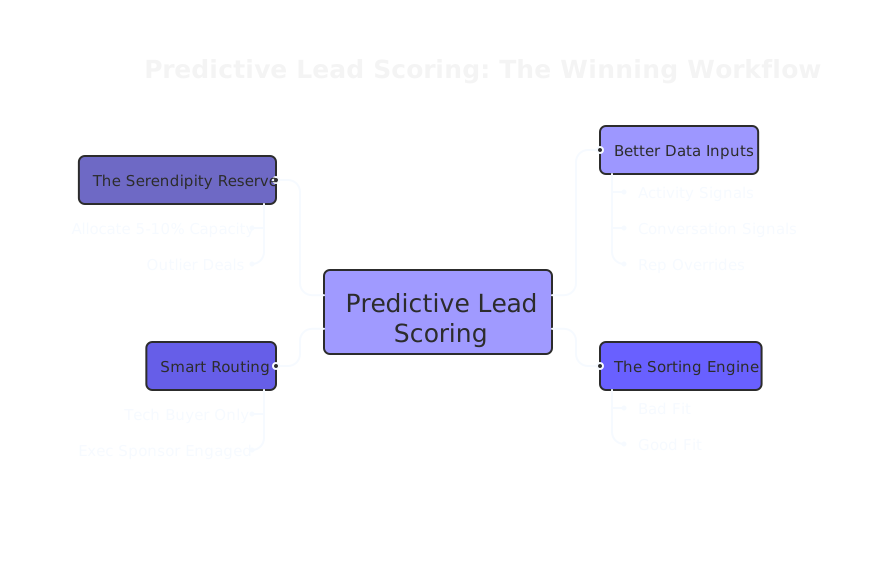
Stop Scoring Better. Start Rejecting Smarter.
This is the shift that most predictive lead scoring guides skip entirely.
The real SaaS ROI from lead scoring does not come from predicting your best leads more accurately. It comes from eliminating your worst leads faster.
Think about what a bad-fit lead actually costs. A rep spends 30 to 60 days pursuing a prospect who was never going to buy. That is time not spent on a deal that could close. It is also demoralizing, which erodes sales performance over time.
One vertical SaaS company at $15M ARR tried something counterintuitive. Instead of tuning their scoring model for better accuracy, they built a disqualification workflow. Leads that matched specific criteria, company size under $5M revenue, certain low-fit verticals, single stakeholder with no budget authority, were automatically removed from outreach. No follow-up. No nurture sequence. Just out.
The result: same overall lead volume, 35% fewer sales cycles attempted, 22% improvement in sales productivity per rep, and average deal size increased 18%. The higher-value prospects were the ones who stayed engaged without constant follow-up.
The lesson is not that you should ignore small companies. The lesson is that your model should tell you who not to chase, not just who to chase harder.
Why Your Model Might Be Lying to You
There is a problem with predictive lead scoring that nobody in the vendor community wants to highlight.
Your model learns from your historical data. Your historical data reflects the decisions your sales team has already made, including the bad ones.
If your sales team historically struggled with enterprise deals, they closed fewer of them. Your model learned that enterprise leads convert at a lower rate. Now it scores them lower. Your reps deprioritize them. Enterprise close rates stay low. The model reinforces the pattern.
This is not a data problem. It is a bias problem. The model does not know the difference between a deal your team could not close and a deal your team chose not to pursue.
Before you trust your model, audit it. Ask whether low scores in specific segments reflect genuine buyer fit or just gaps in your sales motion. The answer changes what you do next.
Activity Is Not Intent
Here is one of the most practical insights for anyone building a sales enablement strategy around lead scoring.
The signals most models weight heavily, pricing page visits, email opens, guide downloads, are activity signals. They tell you someone was curious. They do not tell you someone is ready to buy.
Decision-makers at enterprise companies often delegate research to junior staff. A junior analyst visits your pricing page five times, opens every email, downloads every comparison guide. They score highly. Their VP has never heard of you.
Meanwhile, the VP at a different company mentioned your product in a Slack message to their team. Their score is low because they have never clicked anything.
The companies getting the best results from predictive lead scoring are shifting away from pure activity signals and toward conversation-based signals. They use tools like Gong to analyze actual discovery call transcripts. They look for specific language patterns that indicate genuine buying intent, not just exploratory interest.
One enterprise B2B software company at $50M ARR made this shift. They replaced 40% of their behavioral scoring with conversation scoring from Gong's AI analysis. Predicted conversion accuracy improved from 62% to 71%. More importantly, sales cycles shortened by 15 to 20% because low-intent conversations were flagged and deprioritized early.
Activity tells you who is browsing. Conversation tells you who is buying.
The Multi-Stakeholder Problem
Most predictive lead scoring models score individuals. Most enterprise deals involve buying committees of five to twelve people.
This creates a real gap in your sales enablement implementation. You might have a highly engaged technical buyer on your radar who scores at 82. But if procurement is not involved, if finance has not seen the business case, if the executive sponsor has competing priorities, that deal is going nowhere.
One enterprise infrastructure software company at $75M ARR built a simple fix. When a lead hit MQL status, their team mapped the deal dynamics. Technical buyer but no executive sponsor? Flag as high friction. Assign to an experienced closer who knows how to build a broader business case. Executive sponsor engaged with budget authority? Flag as high opportunity. Move fast.
Deal velocity increased 30%. Win rate on high-opportunity flagged deals reached 35% versus 18% for deals that went through the standard process.
This is not a technology solution. It is a process layer on top of your scoring model. But it is one of the highest-impact changes you can make to your sales enablement best practices without buying new software.
When to Trust Your Reps Over the Algorithm
Sales teams override their lead scoring model all the time. A rep looks at a low-score lead and says, this one is different. Sometimes they are right. Sometimes they are wrong.
Here is what most companies do with that information: nothing.
The override data disappears. No one tracks when reps were right to deviate from the model. No one analyzes the patterns. No feedback loop improves the model.
This is a missed opportunity. When you track overrides and tag the reasoning, a clear pattern starts to emerge. The CEO is a personal contact. The timing signal came from a conference conversation. There is a shared industry background. These are real signals that no behavioral model captures.
Companies that systematically capture override reasoning and feed it back into their scoring logic end up with better models over time. Not because they trusted the algorithm less. Because they used human judgment to improve it.
Reserve space for this in your sales enablement strategy. A well-designed feedback loop between your reps and your scoring model is worth more than most intent data subscriptions.
The Serendipity Problem
Over-optimization in lead scoring has a cost most teams never calculate.
The deals that fall outside your model are not always bad deals. Sometimes they are the best deals you will close all year. The unexpected referral. The company in an unusual vertical that turns out to be a perfect fit. The low-score lead that becomes your biggest account because one rep had a great conversation.
If your scoring model routes 100% of sales effort toward high-probability leads, those outlier deals never get worked.
A practical fix: reserve 5 to 10% of your sales development capacity for leads that defy your model. Give your reps permission to pursue deals based on judgment, not just score. Track those outcomes separately. You will likely find a meaningful percentage of your most valuable deals originated there.
This is not about ignoring data. It is about not letting data crowd out the judgment that data cannot replicate.
How to Audit Your Current Scoring Setup
If you are not sure whether your predictive lead scoring model is actually driving SaaS ROI, start here.
Check your lift, not just your accuracy. Compare close rates and deal size for high-score leads versus medium-score leads over the last 12 months. If the gap is small, your model is not adding much value.
Look at your override rate. Ask your sales team how often they ignore the model's recommendations. If it is above 25 to 30%, your model is not reflecting what actually matters in your sales process.
Audit for bias by segment. Pull close rates by company size, vertical, and buyer persona. Look for segments where scores are consistently low but close rates are decent. Those are likely undervalued opportunities your model is burying.
Track your disqualification rate. If you are not actively removing unqualified leads from your pipeline, you are probably wasting significant sales capacity. Build a disqualification workflow before you rebuild your scoring model.
Check your recalibration schedule. According to Forrester, most models need recalibration every six to eight months. If yours has not been updated in a year or more, the signals it is weighting may no longer reflect how your best customers actually behave.
Where to Go From Here
Predictive lead scoring is not a silver bullet. It is a tool. Like any tool, it works well when you use it for the right job.
The right job is not predicting with perfect accuracy who will close. The right job is routing your sales team's time and energy toward deals worth pursuing, and away from deals that waste capacity.
That means building in rejection logic, not just scoring logic. It means weighting conversation signals alongside behavioral signals. It means auditing your model for bias before trusting its recommendations. And it means giving your reps a feedback loop that makes the model smarter over time.
If you are building out your predictive lead scoring setup for the first time, or if you suspect your current model is not driving the SaaS ROI it should be, House of MarTech works with teams to audit, rebuild, and operationalize lead scoring as part of a broader sales enablement strategy. Not just the technology. The whole motion.
Start with your data. Be honest about what it is actually telling you. And build a model that reflects your best customers, not just your most active prospects.
Frequently Asked Questions
Get answers to common questions about this topic
Have more questions? We're here to help you succeed with your MarTech strategy. Get in touch
Related Articles
Need Help Implementing?
Get expert guidance on your MarTech strategy and implementation.
Get Free Audit