
Drive Direct Revenue Through Segmented Marketing
Most businesses segment their customers. Few do it in a way that actually moves revenue. Here is how to close that gap with a systematic approach to segmentation that connects directly to your bottom line.


TL;DR
Quick Summary
Listen to summary
0:00 audio overview
Quick Answer
Most businesses know they should segment their customers. They split their email list by industry or geography. They tag contacts in their CRM. They call it done.
Then they wonder why their campaigns feel flat.
Here is the truth: segmentation without a revenue connection is just sorting. It looks organized. It does not drive growth.
To drive direct revenue through segmented marketing, you need more than labels. You need a system that connects who your customers are to what they buy, when they buy it, and why they respond.
This post shows you how to build that system.
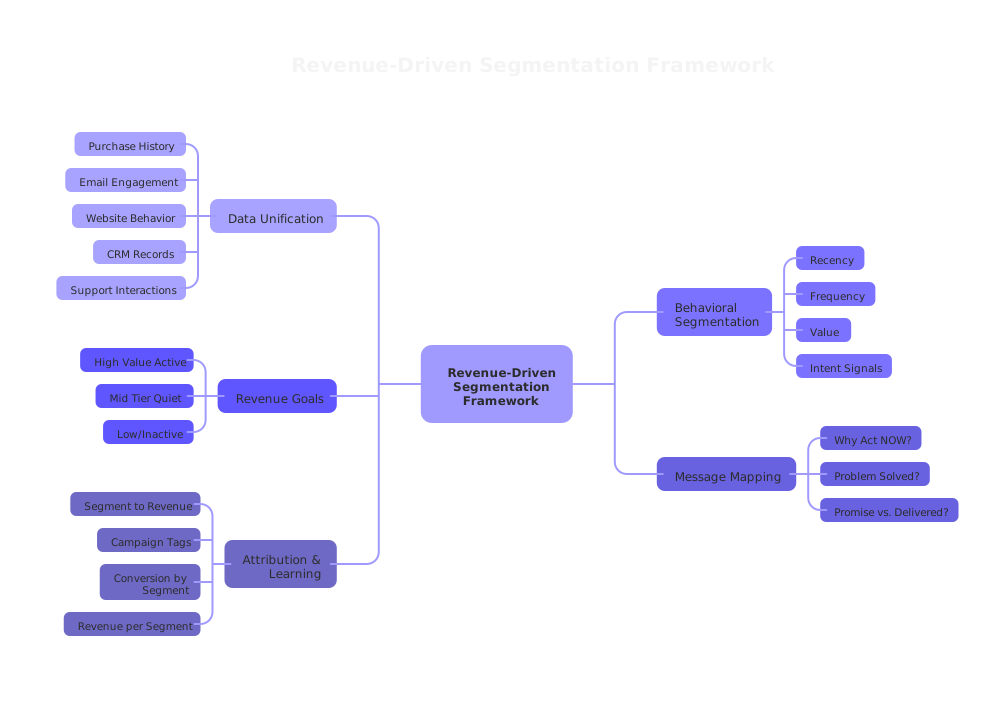
Why Segmentation Fails to Deliver Revenue
Most segmentation projects start with good intentions. A team meets. They agree the audience is too broad. They create five or six customer categories. They build campaigns around those categories.
Six months later, the results are underwhelming. Revenue did not move the way anyone expected.
The problem is almost never the segmentation itself. It is the gap between the segment and the decision.
Teams segment by demographics or firmographics because that data is easy to get. But demographics do not predict buying behavior. They describe it after the fact.
What drives a purchase is intent. Need. Timing. Fit between what you offer and what the customer is trying to solve right now.
When your segments are built on surface-level data, your campaigns talk at people instead of talking to them. And talking at people does not close deals.
The Segmentation Mistake Most Teams Make
Here is the pattern we see constantly: a business invests in a CRM, an email platform, maybe a CDP. They have the tools. They have the data. But each tool holds a different version of the customer.
The CRM knows who bought. The email platform knows who opened. The ad platform knows who clicked. Nobody talks to each other.
So when the marketing team builds a segment, they are working from incomplete information. They might target "customers who purchased in the last 90 days" without knowing those same customers just submitted a support ticket about a problem with their order.
That is not a segment. That is a guess dressed up as a strategy.
Segmentation only drives direct revenue when it is built on unified data. One source of truth. One complete picture of the customer.
This is where the right MarTech stack either earns its cost or wastes it. If your tools are not sharing data, your segments are not real.
What Effective Segmentation Actually Looks Like
Effective segmentation answers three questions at once:
Who is this person? Not just their job title or company size. What is their relationship with your brand? Are they a first-time buyer, a loyal customer, someone who almost churned, or someone who has never converted despite repeated contact?
What do they need right now? This comes from behavioral data. What have they clicked? What have they searched? What have they purchased or not purchased? Behavioral signals tell you where someone is in their decision process.
What is the right next step for revenue? This is where most teams stop short. They create segments and then hand them to a campaign tool without a clear action tied to each one. Every segment needs a specific goal: upsell, reactivation, first purchase, referral, renewal.
When you can answer all three questions, your segment becomes a revenue play. Not just an audience.
A Real Example: Retail Segmentation That Drove Measurable Lift
Retail is one of the clearest places to see this in action.
A specialty retail brand was running blanket promotional emails to their entire list. Open rates were decent. Revenue per email was not.
They rebuilt their segmentation around three behavioral tiers based on purchase recency, frequency, and average order value. But more importantly, they tied each tier to a specific revenue action.
High-value recent buyers got early access to new collections. No discount. Just exclusivity and timing.
Mid-tier buyers who had gone quiet got a single, personalized reactivation message based on their last category of purchase. Not a generic "we miss you." A message that referenced what they actually bought and what was new in that same space.
Low-tier or inactive contacts got a clean, value-first message with a clear reason to come back.
The result was not magic. It was method. Revenue from the reactivation segment increased meaningfully because the message matched the moment. Each segment had a job. The system was built to do that job.
This is what it means to drive direct revenue through segmented marketing. Not more segments. Smarter ones with purpose.
How to Build Segments That Connect to Revenue
Here is a practical framework you can apply to your own marketing.
Step 1: Audit Your Data Before You Segment
Before you create a single segment, know what data you actually have and where it lives. Pull together your purchase history, email engagement, website behavior, and CRM records.
Ask yourself: do these sources agree on who my customers are? If not, you have a data unification problem before you have a segmentation opportunity.
At House of MarTech, a lot of our client work starts here. Not with strategy decks. With a clear-eyed look at what the data actually says versus what the team assumes it says.
Step 2: Define Segments by Behavior, Not Just Identity
Stop defining segments by who people are. Start defining them by what they do.
A customer who bought once six months ago and has not opened an email since is a different segment than a customer with the same demographics who buys every quarter. They need different messages and different goals.
Behavioral segmentation pulls from:
- Purchase history (recency, frequency, value)
- Email and content engagement patterns
- Website activity (pages visited, products viewed)
- Support or service interactions
- Sales stage or pipeline position (for B2B)
Step 3: Assign a Revenue Goal to Every Segment
Every segment needs one clear commercial objective. Just one.
- First purchase from a prospect
- Repeat purchase from a lapsed customer
- Upsell to an existing customer
- Renewal of a subscription or contract
- Referral from a satisfied buyer
When a segment has no revenue goal, it generates activity but not outcomes. That is the difference between a busy marketing team and a productive one.
Step 4: Map Your Message to the Segment's Goal
Your message should answer one question for the reader: why should I do this now?
For a lapsed customer, that answer is different than for a loyal one. For a prospect who has visited your pricing page three times, it is different than for someone who just discovered your brand.
Match the message to the moment. That is the whole game.
Step 5: Attribute Revenue Back to the Segment
This step is where most teams fall apart. They run the campaign. They see some revenue come in. They move on.
Without attribution, you cannot learn. You cannot know which segment performed. You cannot improve next time.
Build simple attribution into every segmented campaign. Tag the campaign. Track the revenue it generates. Connect it back to the segment definition.
This does not have to be complex. Even basic UTM tracking and a revenue report tied to campaign source gives you something to work with.
Over time, this data tells you which segments are worth investing in and which ones need a different approach.
What Is Revenue Attribution in Segmented Marketing?
Revenue attribution is the process of connecting a sale back to the marketing action that influenced it.
In the context of segmented marketing, attribution tells you which segment and which message drove a purchase. It answers: did targeting this specific group with this specific message actually work?
Good attribution does not require a perfect model. It requires consistency. Use the same tagging structure across campaigns. Track the same metrics every time. Compare results across segments over a meaningful time period.
Simple attribution beats no attribution every time.
The Cross-Functional Problem Nobody Talks About
Here is something that rarely comes up in segmentation conversations: your segments are only as good as the teams using them.
Marketing can build a perfect segment. But if sales is not aligned to that segment's goal, the leads go cold. If product is launching something that contradicts the campaign message, the segment gets confused.
Segmented marketing that drives revenue is a cross-functional effort. Marketing defines the segment and the message. Sales knows which segment a prospect came from and what was promised. Product and customer success understand what the segment was told to expect.
When those teams are not aligned, you lose revenue at the handoff. Not at the campaign level. At the moment the customer says yes and finds out the experience does not match the promise.
This alignment work is unglamorous. It involves shared dashboards, agreed-on definitions, and regular check-ins between teams. But it is what separates businesses that grow from ones that spin their wheels.
Common Segmentation Questions Answered
How many segments should I have?
Start with fewer than you think you need. Three to five well-defined, behaviorally grounded segments with clear revenue goals will outperform fifteen vague ones every time. You can always add more as you learn.
Do I need a CDP to do segmentation well?
Not necessarily. A CDP helps when your data lives in many places and you need one unified view. But if your data is reasonably consolidated in a CRM or email platform, you can build effective segments there first. Build the habit before you buy the tool.
How often should I update my segments?
At minimum, quarterly. Customer behavior changes. Your segments should reflect that. Set a calendar reminder to review segment definitions, check if the revenue goals still make sense, and update based on what the data shows.
What is the difference between demographic and behavioral segmentation?
Demographic segmentation groups people by who they are: age, location, company size, industry. Behavioral segmentation groups them by what they do: purchase patterns, engagement history, product usage. Behavioral data predicts future action better because it reflects real intent.
Where to Start If You Are Starting From Zero
If your current segmentation is essentially "everyone on our list," here is a simple starting point.
Look at your last 12 months of purchases. Identify your top 20% of customers by revenue. What do they have in common behaviorally? Not demographically. Behaviorally.
That is your first segment. Build one campaign specifically for retaining and growing that group. Assign it a clear goal: upsell, renewal, or referral. Track the revenue it generates.
That is it. One segment. One goal. One campaign. One attribution report.
Do that well and you will learn more about segmentation in 90 days than most teams learn in a year of strategy meetings.
If you want support building that system, or you need help unifying your data before segmentation makes sense, that is exactly the kind of work we do at House of MarTech. No overbuilt frameworks. Just a clear path from where you are to where you want to be.
The Bottom Line
Segmentation is not a marketing tactic. It is a revenue discipline.
When it is done well, it means every campaign has a purpose. Every message has a reason. Every dollar you spend is aimed at a customer who is ready to hear it.
That is how you drive direct revenue through segmented marketing. Not with more tools or bigger lists. With a system that connects your customers to your goals and measures what actually happens.
Start simple. Build the habit. Let the data teach you.
House of MarTech helps growing businesses build MarTech systems that connect strategy to revenue. If you want to talk through your segmentation approach, reach out. We are glad to take a look.
Frequently Asked Questions
Get answers to common questions about this topic
Have more questions? We're here to help you succeed with your MarTech strategy. Get in touch
Related Articles
Need Help Implementing?
Get expert guidance on your MarTech strategy and implementation.
Get Free Audit